Written by: CryptoMiao

"......Based on my understanding of the Sui Foundation, acquiring a listed company and playing a financing game of left foot stepping on the right foot is not the style of the Sui Foundation. The Sui official is still more inclined to do practical things. It is more likely to facilitate further business cooperation, equity cooperation, and investor exit channels with other companies as written in part 04 of the article."
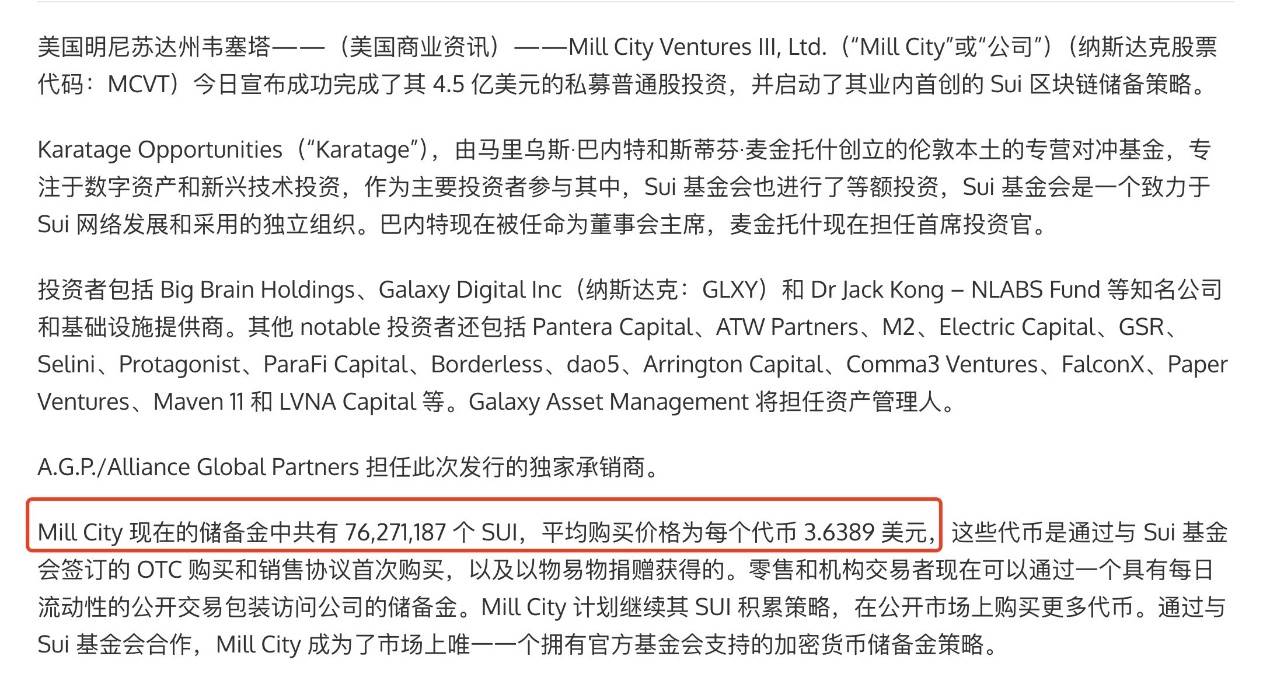
Recently, according to multiple sources, Mill City Ventures III raised a private placement of $450 million to purchase Sui tokens as asset reserves.
Currently, 76.27M SUI tokens have been purchased from the Sui Foundation through OTC at an average price of 3.6389.
I. Sui Strategy is Not a MicroStrategy
Many people say this is a Sui version of MicroStrategy, but that's not the case. They have fundamental differences.
MicroStrategy mostly issues convertible bonds, raises funds to buy BTC, and if the stock price performance is poor, investors will not convert stocks and will receive money at maturity. Essentially, it is still a form of debt.
The Sui strategy is direct equity financing. This money does not need to be repaid, directly becoming shareholders, and even if it goes to zero, no money needs to be repaid.
Moreover, through this financing and backdoor listing, the company's actual controller has been directly changed.
II. Who Invested the $450 Million?
The $450 million private placement was funded by multiple institutions, with the main lead investor being Karatage Opportunities, a London digital asset hedge fund, investing equally with the Sui Foundation. Other notable investors include Pantera Capital, ATW Partners, M2, Electric Capital, GSR, Selini, Protagonist, ParaFi Capital, Borderless, dao5, Galaxy Digital, and Big Brain Holdings.
And the hedge fund Karatage Opportunities is an early investor of Sui Foundation, they are all one family.
That is to say, Sui itself invested $450 million, took a stake in the listed company, and then bought back its own asset Sui, putting Sui into the listed company and taking the money back, a left-hand to right-hand transfer.
III. How to Backdoor List Mill City?
Before the news was announced, Mill City Ventures III (MCVT) had a market value of 11.2M on July 24, 2025, and rose over 200% to 35.7M on July 25 after the news was announced. Currently (August 2, 2025), it is 29.83M.
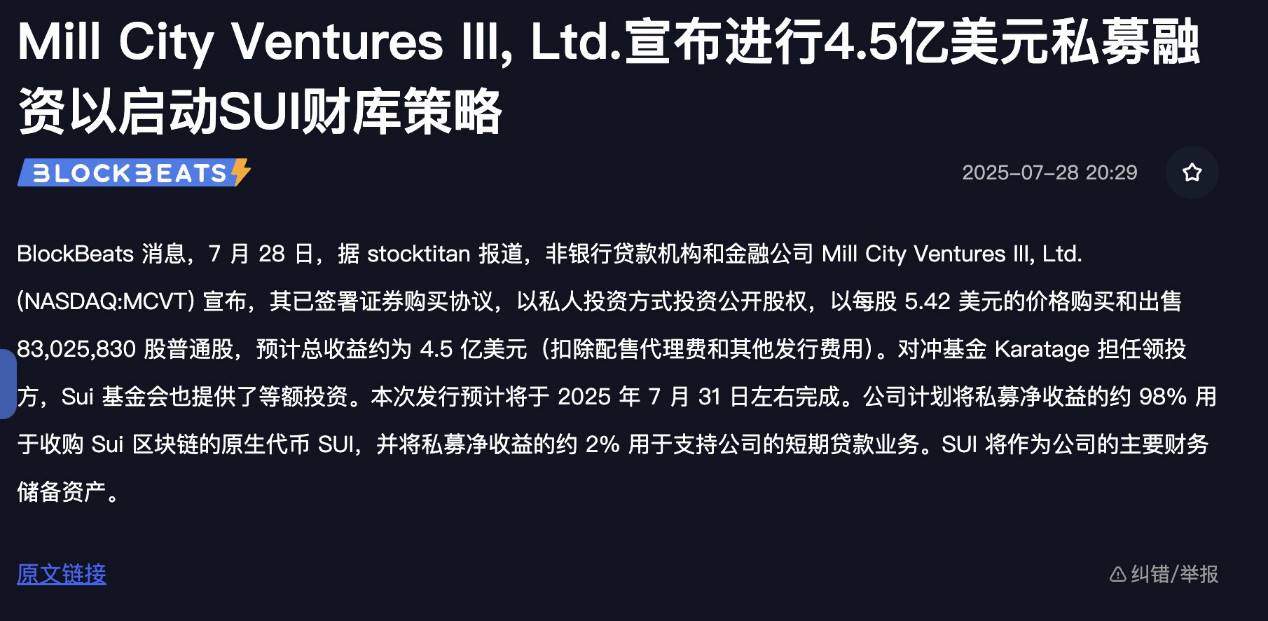
The Sui Foundation's entry price is $5.42, and calculated at this price, the original shareholders' equity value is $32.93M.
The foundation's entry value is $450 million, with the equity change approximately being:
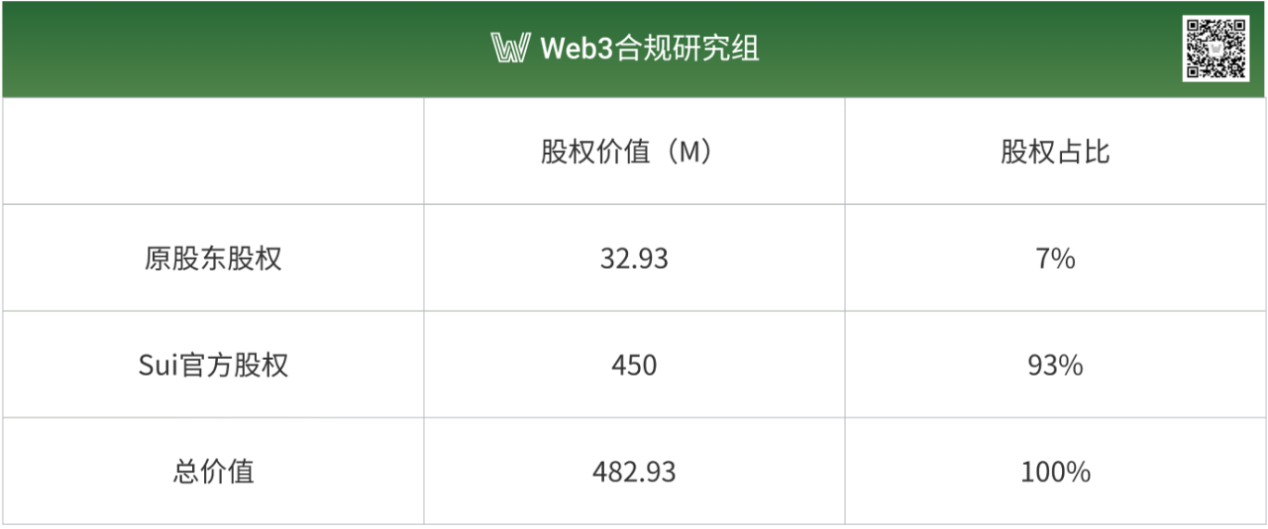
That is to say, the Sui Foundation (and its allies) has become the absolute controlling shareholder of the listed company through asset injection with Sui, with a controlling stake of 93%.
PS: The Sui Foundation's entry price is $5.42, with a pre-entry stock average of 1.8, giving original shareholders a 3-fold premium to purchase company control.
It spent 11.2M*2=22.4M to buy a listed company.
IV. Why Does Sui Backdoor List?
(I) Seemingly for Assets, Actually for Listing (Seeking Cooperation)
First, unlike MicroStrategy, it is not to buy quality assets like BTC to increase shareholder value.
Instead, it becomes a shareholder itself, similar to Satoshi Nakamoto buying a listed company's controlling stake with BTC, with the purpose of seeking further circulation of Sui in the capital market and further business and equity cooperation with other enterprises.
After all, some enterprises might want to cooperate with Sui, but directly holding Sui tokens might be troublesome.
For example, whether token holding violates company charter regulations, what if it's stolen, how to hold, whether a new management institution needs to be set up, how to convince the board of directors and shareholders, how to price on the balance sheet, how to disclose information, and the laws and securities regulatory requirements of different countries are all different.
But holding company stocks is much easier, developing cooperation and signing agreements through a normal process is OK, without technical risks and compliance barriers.
For instance, if Nintendo one day holds Mill City's stocks, it means Pokemon and Sui truly have further cooperation. Having Nintendo hold Sui tokens would be very complicated with a series of procedures, while holding stocks for cooperation is a matter of minutes.
(II) Seeking Investor Exit Mechanism
Because many early investors have a large number of Sui tokens gradually unlocking, direct selling would have a huge impact on Sui's price.
With a listed company as a springboard, they can seek capital market takeover, reducing the impact on Sui token price, whether through direct secondary market selling or OTC trading, the stock market's absorption capacity is much larger than the token market.
Moreover, if new investors want to invest in Sui cooperation, they can directly negotiate trading early investors' tokens in stock form.
V. Does Token Price Decline Affect the Company?
Some say Sui entered at an average of 3.64, and now Sui is 3.5, so the pass-the-parcel game can't continue.
Is this really the case?
Essentially, the company's purchase of Sui was originally Sui's official using its own money to buy its own Sui. Whether it rises or falls, it's all its own, with no intention to sell.
Original shareholders have already been given a 3-fold price premium, so their interests will not be damaged.
VI. How Should the Company Be Valued?
Previously, the company was long hovering around 10M. With the $450 million investment, the Fair Value is around $460M.
If calculated simply, ignoring other company assets, we can just look at the Sui held by the company. (Like MicroStrategy only looking at BTC value)
VII. Relationship Between Stock Price and Sui Token Price
According to a simple model calculation, looking only at Fair Value of held Sui:
1. If company market value is $450M, FV of held Sui is $450M, it's equivalent to buying Sui of equal value by buying stocks
2. If company market value is $562M > FV of held Sui $450M, it means each $1 of stock buys $0.8 of Sui, with a stock premium of 25%
The foundation can then raise funds from the market, further buy Sui after fundraising, further increase company value, and then push up stock price.
3. If company market value is $360M < FV of held Sui $450M, it means each stock buys 1.25 value of Sui
Then the foundation can sell Sui to repurchase stocks, selling $1 of Sui can repurchase $1.25 of Sui holdings, pulling up stock price.
Ultimately, company Market Cap = Fair Value (simple calculation)
Of course, stocks generally have a premium, Market Cap = Fair Value * (1 + premium)
VIII. Written at the End
The above is a judgment based on existing public information, not investment advice. And based on my understanding of the Sui Foundation, acquiring a listed company and playing a financing game of left foot stepping on the right foot is not the style of the Sui Foundation. The Sui official is still more inclined to do practical things.
It is more likely to be as written in IV. Why Does Sui Backdoor List?, to facilitate further business cooperation, equity cooperation, and investor exit channels with other companies.
So, unless other companies also join the game of Sui as an asset, there may not be much buying in the short term. In the long term, breaking through the barriers between traditional capital markets and Web3 is more conducive to long-term development layout.
Sui Holder, patiently wait, the project team is doing things (market-making)