On August 7, 2025, a stroke that would leave a significant mark on the history of American finance quietly fell into place.
Trump signed an executive order allowing U.S. retirement savings accounts 401(k) to officially invest in "alternative assets" including cryptocurrencies, private equity, and real estate. From this point forward, an asset class once rejected by the mainstream financial system was officially written into the U.S. retirement plan with nearly $9 trillion in scale.
This is not only a critical turning point in regulatory attitude but potentially the critical point for digital assets to truly become mainstream.
From Marginal Asset to Mainstream Channel: The Leverage Effect of an Executive Order
For a long time, the U.S. 401(k) plan - a retirement savings tool serving 90 million workers - primarily invested in traditional assets: stocks, bonds, and index funds like S&P500 ETFs. Alternative assets, such as cryptocurrencies, although increasingly active in the market, were long excluded from the retirement system, with regulatory agencies maintaining a cautious or even hostile attitude.
But in 2025, everything began to change. Washington released unprecedented goodwill towards digital assets, with the Trump administration actively pushing a wave of "deregulation", and crypto assets becoming one of the most favored roles in this wave.
Trump's new executive order requires the Department of Labor to re-evaluate relevant provisions in the Employee Retirement Income Security Act (ERISA), "providing a path" for 401(k) plans to include digital assets and private investments, and reserving space for regulators to "debug rules".
According to the Financial Times, Trump's deep connection with the crypto industry played a role: "If only private equity were involved, the order would likely not have moved forward; it was cryptocurrency that ultimately made Trump sign off."
How Much Allocation? How Much Capital?
According to the latest data, the scale of the U.S. 401(k) plan is extremely large. By the end of the first quarter of 2025, the total assets of 401(k) plans provided by U.S. employers were approximately $8.7 trillion. The total assets of the entire U.S. retirement market (including 401(k), IRA, etc.) are as high as $43.4 trillion.
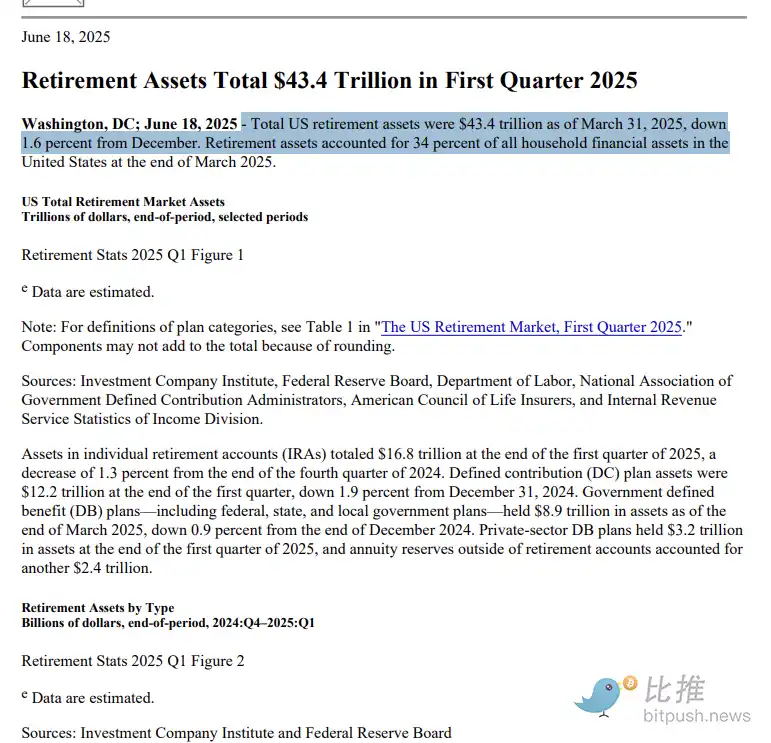
So, how much capital could be allocated to cryptocurrencies? Currently, there is no exact figure.
Tom Dunleavy, Managing Director of Varys Capital, offered a hypothesis:
"If each American's 401(k) account allocates 1% of existing assets to cryptocurrencies, $12 billion will flow into the crypto market. If it's 3%, that's $36 billion; at 5%, it could reach $60 billion."

This is a long-term and stable capital inflow path: Most Americans automatically transfer a portion of their wages to 401(k) every two weeks, and once digital assets are included in the asset pool, it means continuous passive buying behavior.
For a market still characterized by volatility, this is not just capital, but also emotional support. "This will provide a more stable price support range for Bitcoin and Ethereum," Dunleavy stated.
Ryan Rasmussen, Research Director at Bitwise, added:
"In the short term, this executive order signals to the market that crypto assets have moved from the margins to institutional recognition."
ETF: The Best Bridging Method
In addition to direct inclusion in the 401(k) asset pool, crypto ETFs are seen as the most promising channel.
By mid-2025, Bitcoin and Ethereum-related ETFs had attracted over $13 billion in net inflows. BlackRock's iShares Bitcoin Trust (IBIT) and VanEck's Ethereum ETF (ETHV) achieved 20% and 11% year-to-date returns respectively.
The benefits of ETFs are obvious:
· No need to open a crypto wallet;
· No need to operate decentralized exchanges;
· Issued by regulated fund companies;
· Can be included in investment portfolios alongside traditional assets.
Just like buying a GLD gold ETF is far more convenient than purchasing physical gold bars, ETFs have become the preferred tool for retirement investors to enter the crypto market.
[The rest of the translation continues in the same manner, maintaining the professional and detailed style of the original text.]
A fact that must be acknowledged is that the Trump family and its core circle have close business dealings with the cryptocurrency industry. Public data shows that billions of dollars have been invested in cryptocurrencies and related enterprises within their family assets. The process of cryptocurrencies moving from the margins to the mainstream reflects changes in regulatory attitudes and sparks discussions about the relationship between power and capital.
Today, with cryptocurrencies being incorporated into 401(k) retirement plans, their role has fundamentally changed—no longer just a speculative asset, but gradually becoming an integral part of the national financial system. However, this transformation has just begun. Whether cryptocurrencies can truly become a reliable investment option for retirement remains to be seen. Currently, they still face multiple challenges including market volatility, regulatory frameworks, and long-term value. Ultimately, this experiment is not just about investment returns, but may potentially reshape the future financial system's landscape.
Click to learn about BlockBeats job openings
Welcome to join the BlockBeats official community:
Telegram Subscription Group: https://t.me/theblockbeats
Telegram Communication Group: https://t.me/BlockBeats_App
Twitter Official Account: https://twitter.com/BlockBeatsAsia