Just now, OpenAI President Greg Brockman "pleaded guilty"?
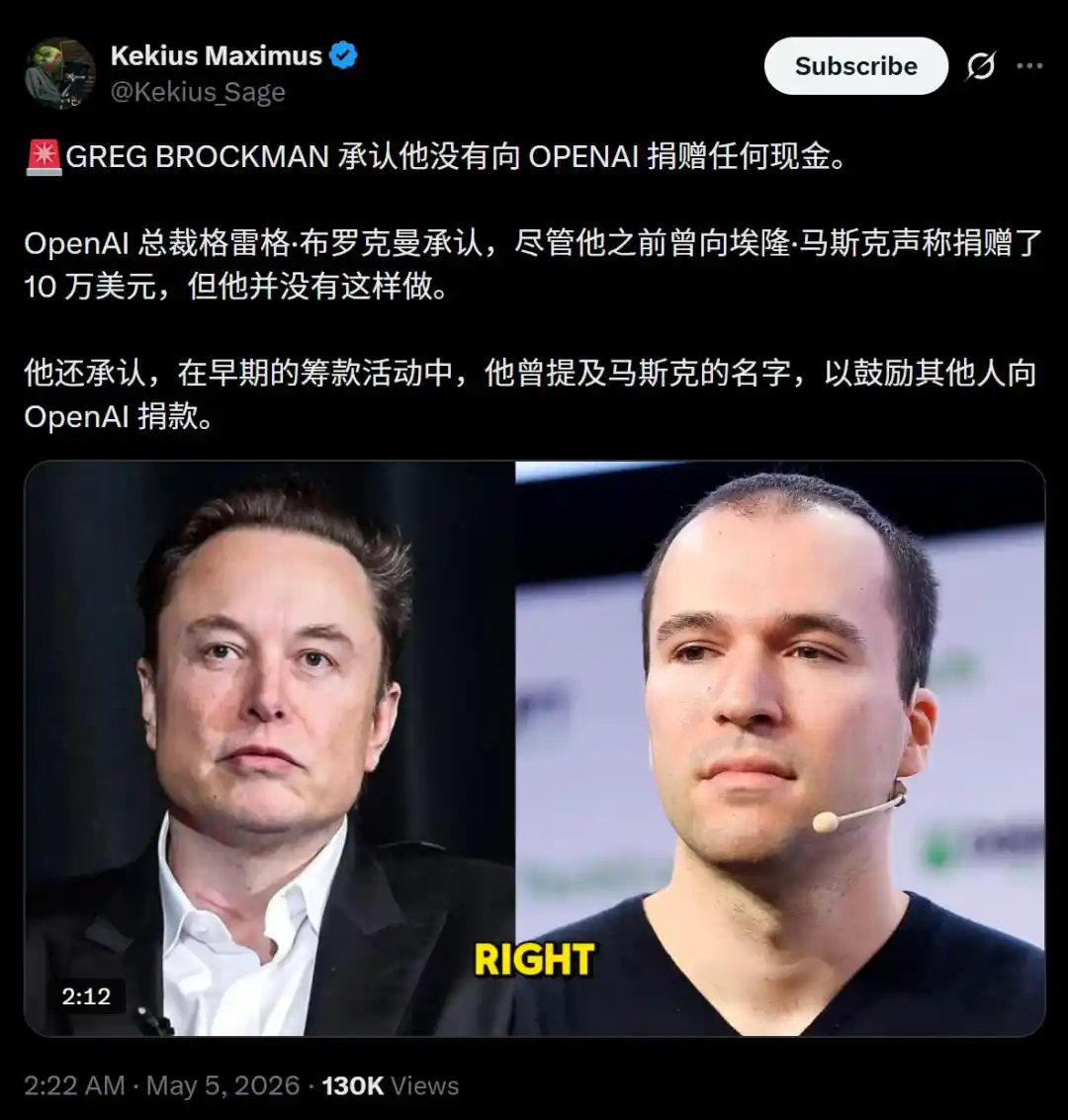
He admitted in court that he had never invested a single penny, yet had obtained equity worth $30 billion.
This news not only stunned everyone in the courtroom, but also shocked all netizens.
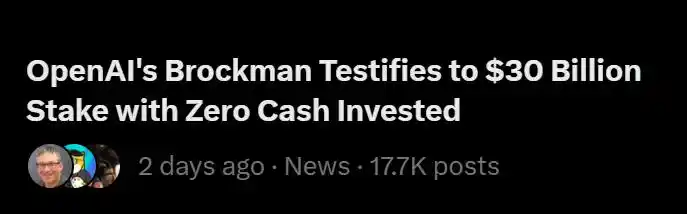
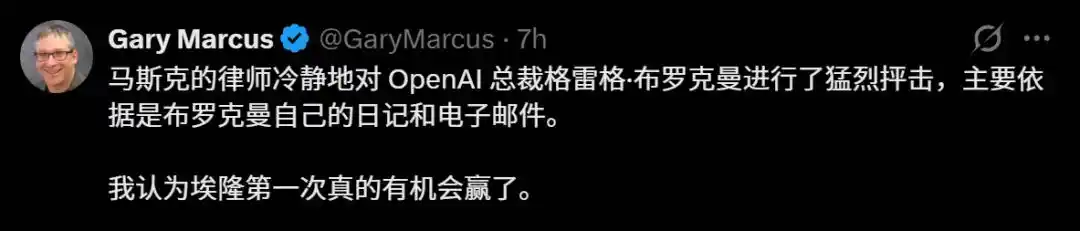
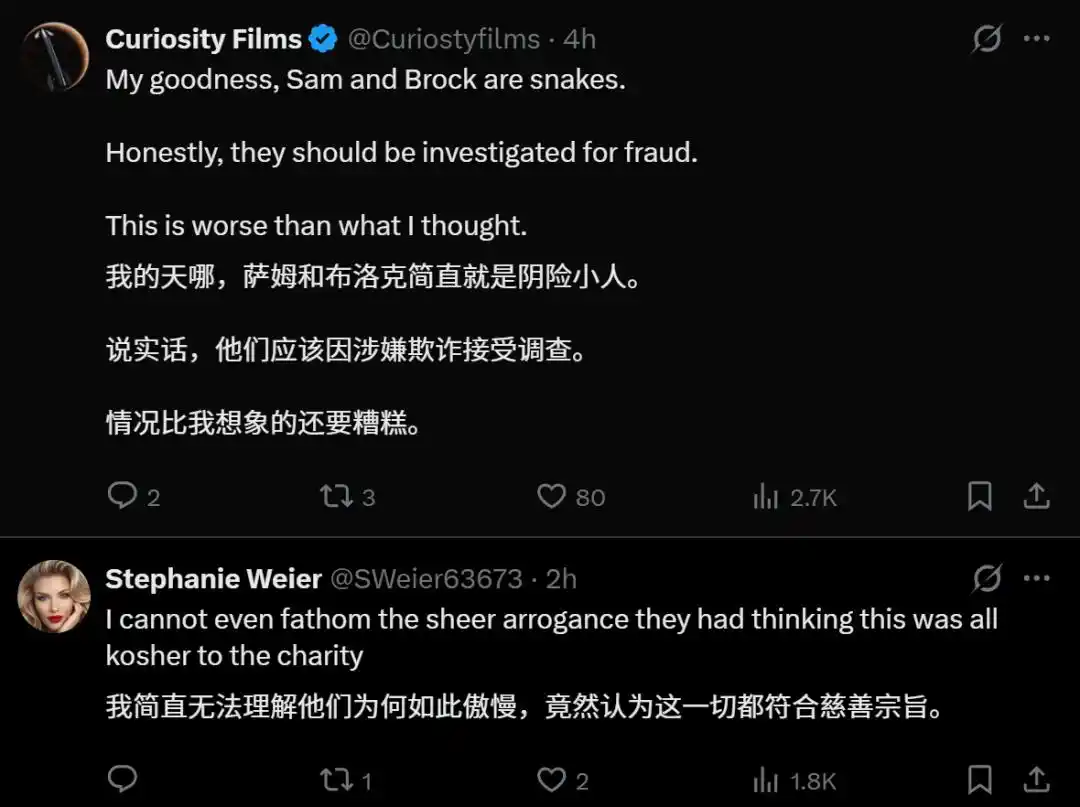
Upon hearing this explosive news, New York University scholar Marcus concluded: "I think Musk has a real chance to win for the first time."
The Silicon Valley Trial of the Century
OpenAI CEO Pleads Guilty
An atmosphere of tension filled the Oakland Federal Court in May 2026.
This courtroom houses some of the world's brightest minds, and also the most intense power struggles in human history.
On one side is Elon Musk, the world's richest man, dedicated to sending humans to Mars; on the other side are the leaders of OpenAI, currently the crown jewel of global AI: Ultraman and Greg Brockman.
Now, the trial has evolved into a multi-billion dollar corporate spy thriller filled with betrayal, intrigue, secret agreements, and the transfer of benefits.
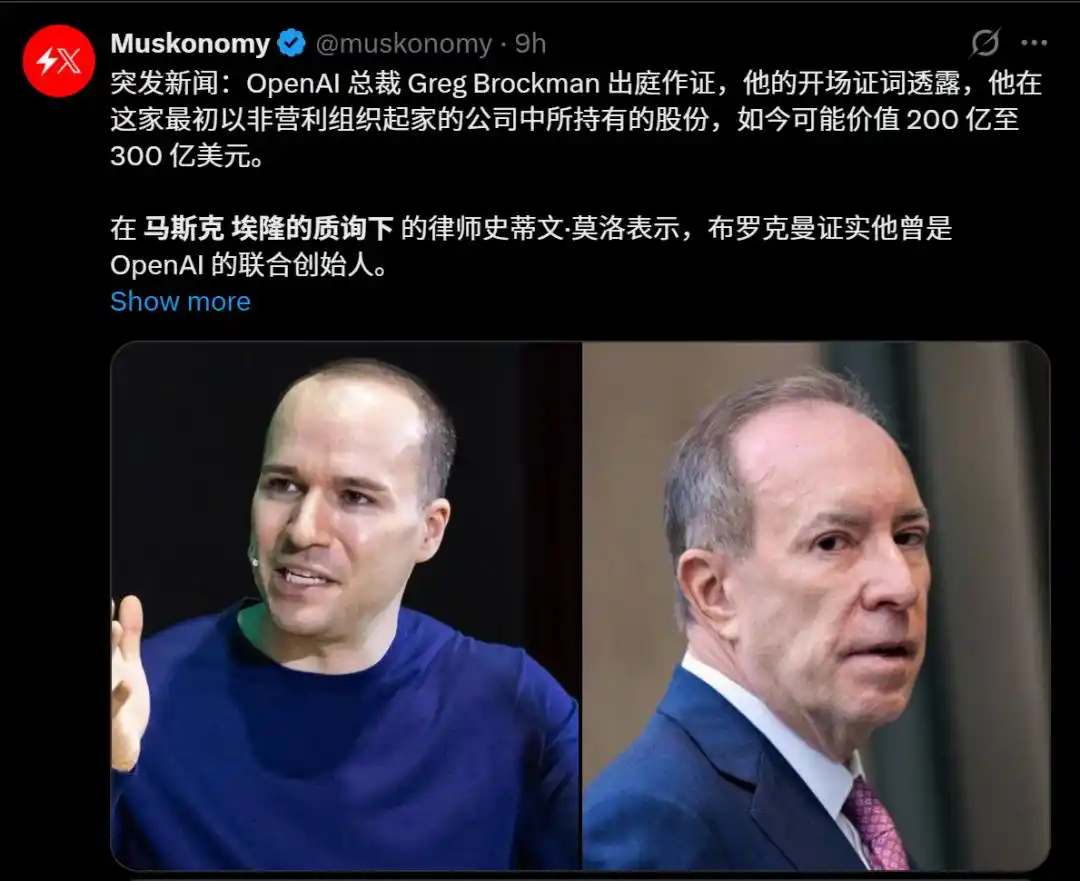
At the trial, Musk's lawyer appeared calm and collected, elegantly presenting Brockman's diaries and emails in a "live dismemberment" manner.
The most shocking scene then unfolded.
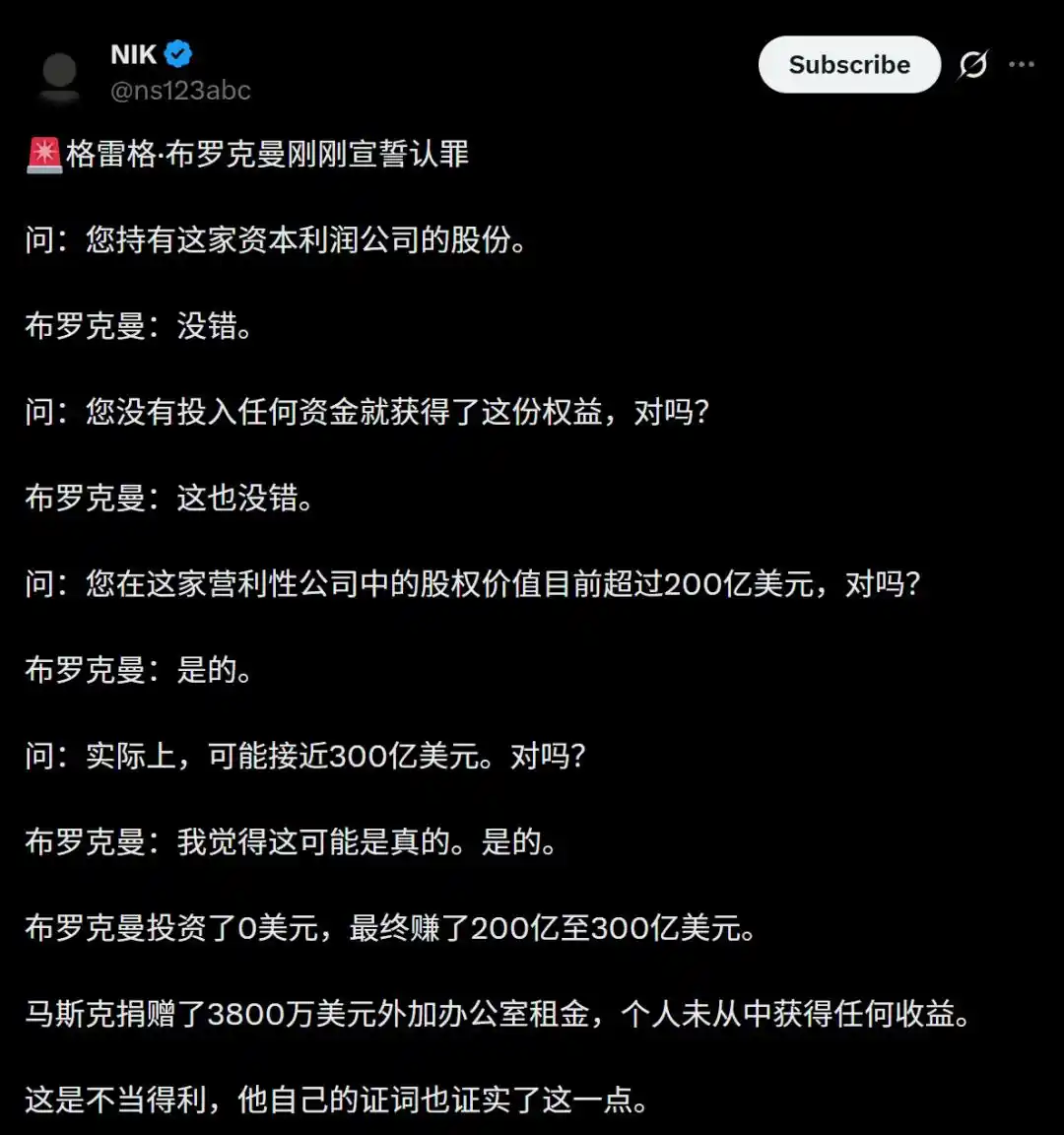
The following is a conversation when the lawyer asked Brockman about his shareholding in OpenAI's for-profit entities.
Q: "You have an ownership interest in this for-profit company, right?"
Brockman: "Yes, exactly."
Q: "And to obtain these benefits, you invested $0 in cash. Is that correct?"
Brockman (after a hesitation): "That's accurate too."
Q: "Your stake in this for-profit entity, valued at over $20 billion today, is that correct?"
Brockman: "Yes."
Q: "In fact, it might be closer to $30 billion. Right?" Brockman: "I think that's probably true. Yes."
As the number echoed in the courtroom, a subtle commotion arose in the gallery.
It's worth noting that Musk, as one of OpenAI's earliest funders, donated over $38 million in cash, provided early office space, and even personally recruited top talent.
But in today's OpenAI, Musk's personal shareholding is zero.
Moreover, Brockman had to admit an embarrassing fact: he had used Musk's name to endorse his campaign in the early stages of fundraising, and even verbally promised to donate $100,000, but in reality, he never delivered on that promise.
This is precisely the core of Musk's accusation: unjust enrichment.
Under California's charitable trust law, trustees of nonprofit organizations should receive salaries rather than share in charitable assets.
Musk's logic is simple: I donated money to create a public instrument that benefits humanity, but you secretly dismantled the instrument, pocketed the parts, and labeled yourselves as being worth $30 billion.
Cerebras: A $20 Billion Self-Deal
If the $30 billion stake was the first bombshell in this trial, Cerebras was the second. The related-party transactions involving Cerebras disclosed during the trial directly crossed legal red lines.
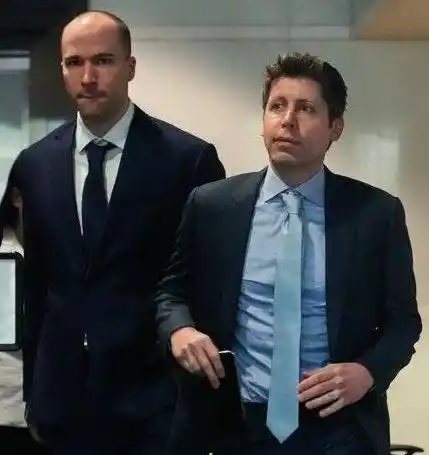
Musk's lawyers have unearthed an old case.
In 2017, while serving as a trustee of OpenAI, Brockman privately purchased shares in the AI chip startup Cerebras. At the same time, Altman also made a personal investment in the company.
However, in the following period, Brockman began to lobby frantically within OpenAI, prompting OpenAI to reach a deal with Cerebras.
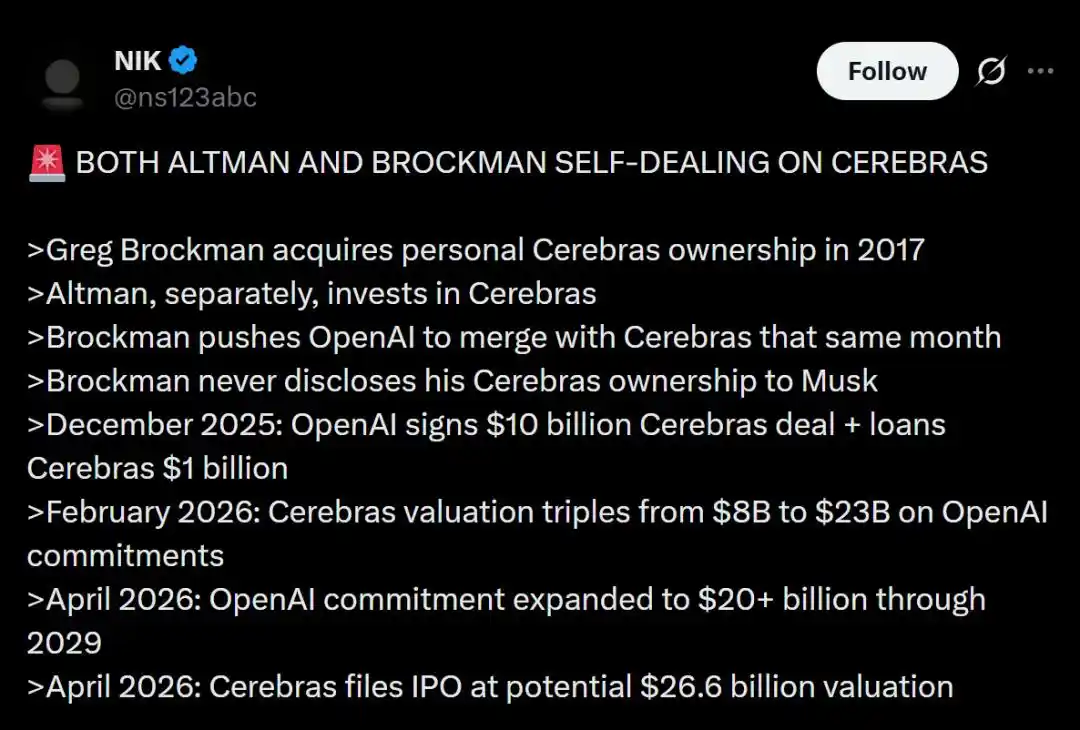
The specific timeline is as follows.
December 2025: OpenAI signed a $10 billion order with Cerebras and provided an additional $1 billion loan.
February 2026: Thanks to a huge order from OpenAI, Cerebras' valuation soared from $8 billion to $23 billion, nearly tripling.
April 2026: OpenAI increased its order to $20 billion.
Now: Cerebras has officially filed for an IPO, with its valuation approaching $26.6 billion.
The following is a dialogue from the courtroom.
Q: When you're discussing the financial transactions between OpenAI and Cerebras, you're actually a shareholder of Cerebras, right?
Brockman: "There is some overlap between the discussions and my role as an investor in Cerebras. Yes."
Q: Can you point to an email that informed Musk of your Cerebras stake? While you were pushing for a deal between OpenAI and Cerebras?
Brockman: "I don't believe such an email exists."
Q: What about the chat history? Brockman: "No." Q: What about the text messages?
Brockman: "No."
Q: However, if there is a deal between OpenAI and Cerebras, would you personally profit from it?
Brockman: "I think so, but that's not what I was thinking at the time."
California charitable trust law has a specific name for this: self-dealing. This kind of self-dealing is legally extremely dangerous.
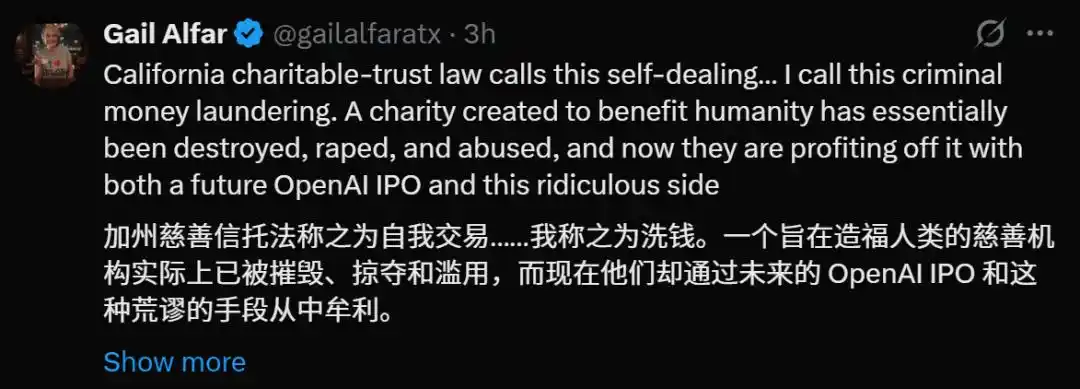
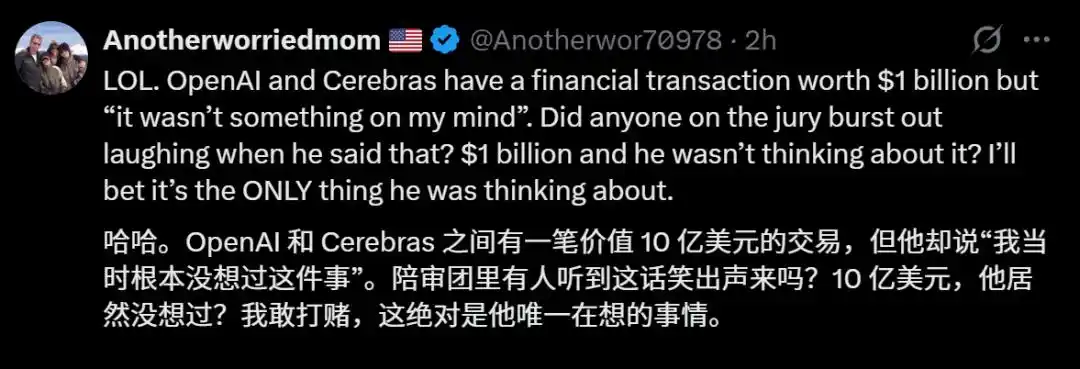
As heads of nonprofit organizations, they use charitable funds to support companies they personally invest in, thereby achieving exponential growth in their personal wealth.
This is no longer just a matter of "deviating from the original intention," but involves serious violations of professional ethics and conflicts of interest.
"The most hated person in America"
OpenAI clearly has no intention of sitting idly by and waiting for its demise.
In response to Musk's "greed" claim, their lawyers revealed a set of provocative text messages in court!
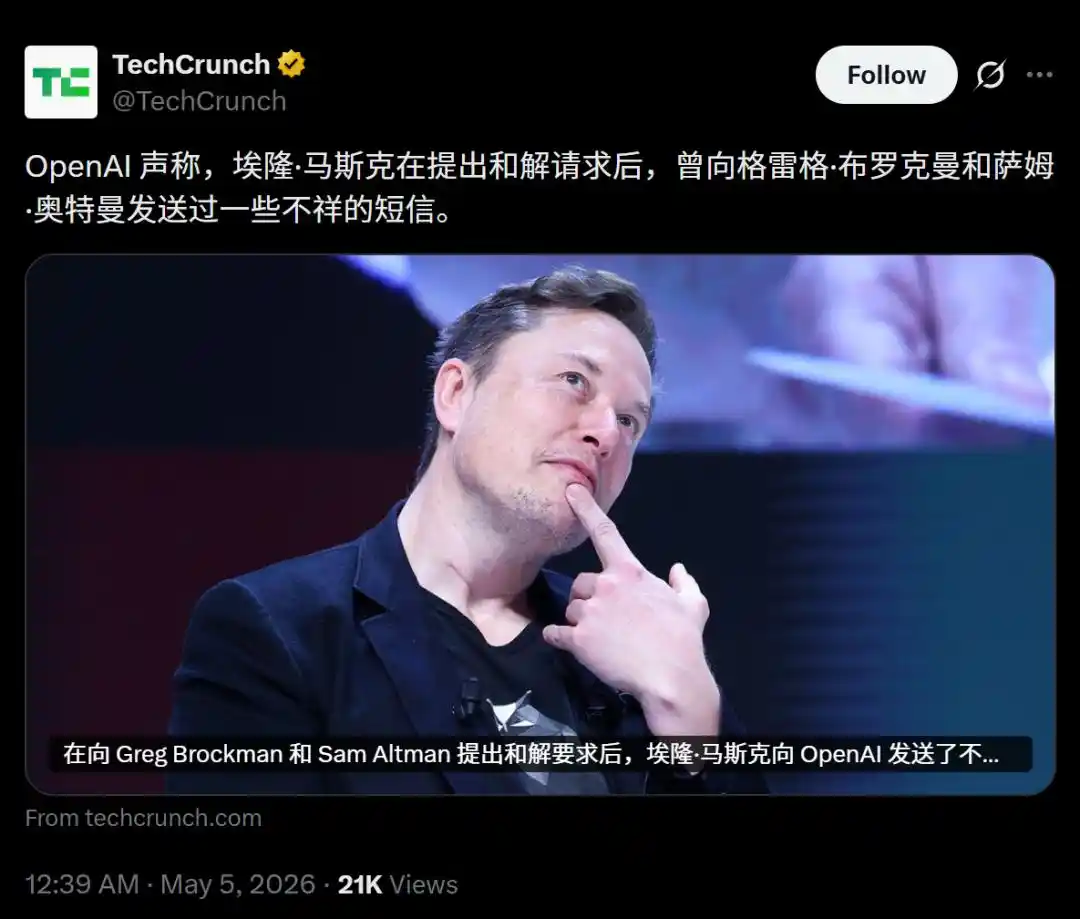
According to OpenAI, two days before the trial, Musk contacted Brockman to offer a settlement. Brockman politely responded that it would be better if both parties withdrew the lawsuit.
Then, the conversation unexpectedly went off track.
Musk seemed to instantly "go berserk," replying, " By the end of this week, you and Sam will be the most hated people in America. If you insist (on not settling), then so be it. "
This text message, dubbed "Ominous," was interpreted by OpenAI as a threat and intimidation from Musk.
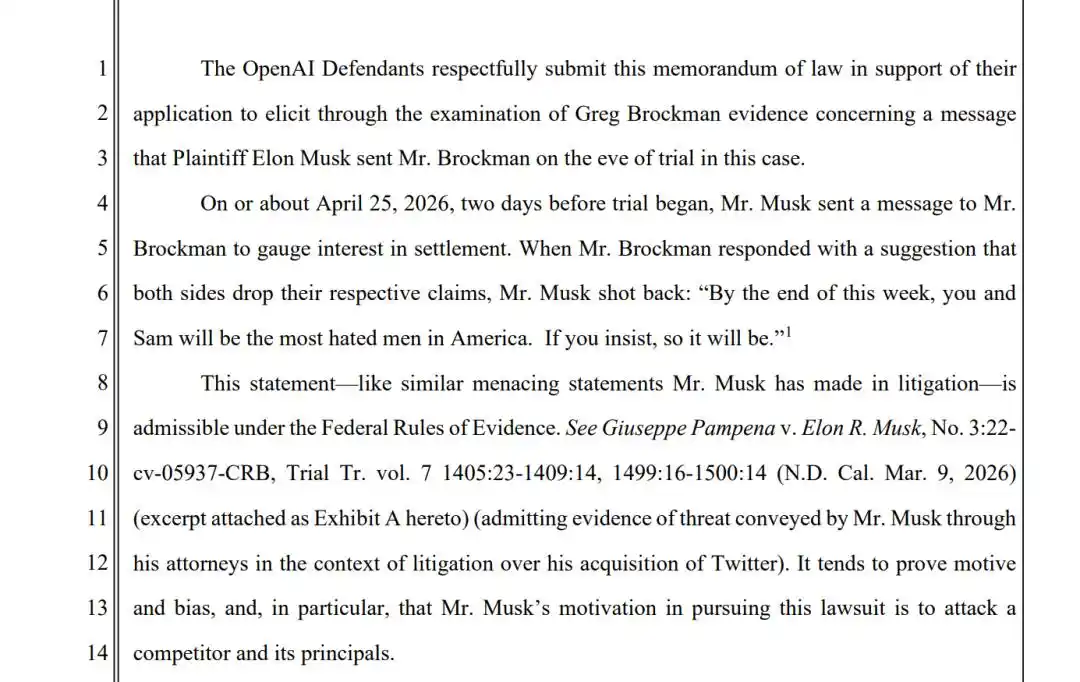
Court documents: https://storage.courtlistener.com/recap/gov.uscourts.cand.433688/gov.uscourts.cand.433688.522.0.pdf
OpenAI's lawyers are trying to prove that Musk's lawsuit is not about "human safety" or "nonprofit dreams," but rather because he is jealous of OpenAI's success and wants to demand a breakup fee from his old partner.
However, Judge Yvonne Gonzalez Rogers was not swayed by these gossips and ruled in court that the contents of these text messages could not be used as evidence.
The judge's focus remains clear: Did OpenAI violate its contractual obligations at the time of its founding? Was its transition from a non-profit to a for-profit organization legal?

Experts' concerns: The "doomsday" of the AGI arms race.
The only thing that could remind people of the grand theme of "human destiny" in this trial was the expert witness called by Musk—Stuart Russell, a computer science professor at the University of California, Berkeley.
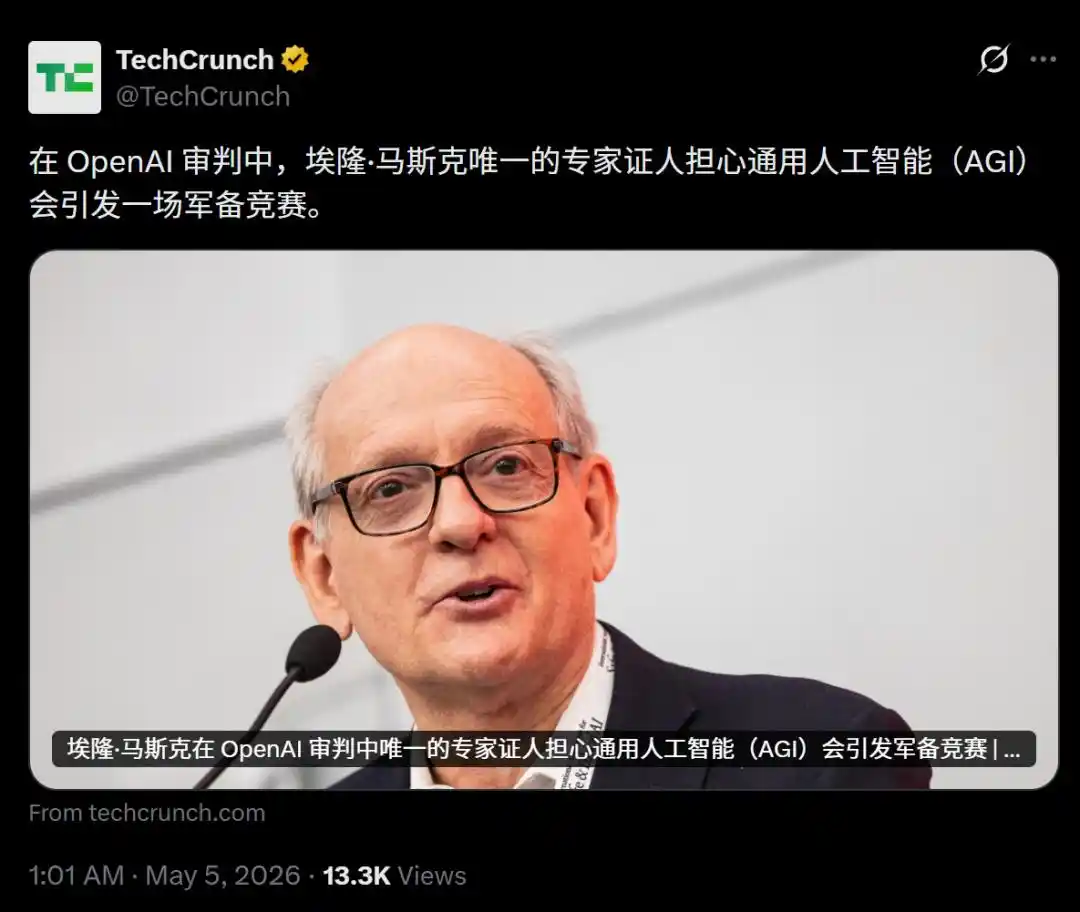
As a leading figure in the field of AI, Professor Russell's testimony instantly sombered the atmosphere. He warned that the current AGI race has degenerated into an out-of-control "arms race."
"There is an inherent tension between pursuing AGI and safety," Russell told the jury.
He pointed out that OpenAI is sacrificing security in order to win the competition. This "winner-takes-all" mentality will cause developers to ignore the stringent requirements for AI alignment.
The most ironic detail is that while Musk sued OpenAI for pursuing profits, his own xAI is also a for-profit company, and it is also frantically buying graphics cards and expanding computing power.
So, is this a battle between two idealists for the future of humanity, or a fight between two billionaires for a ticket to God's power?
Professor Russell even expressed concern that if the lawsuit forces OpenAI to disclose details of its core technologies, it could exacerbate the risk of AI militarization globally.
OpenAI: This is a "necessary evil"
Faced with accusations of "betrayal," OpenAI's logic is unique.
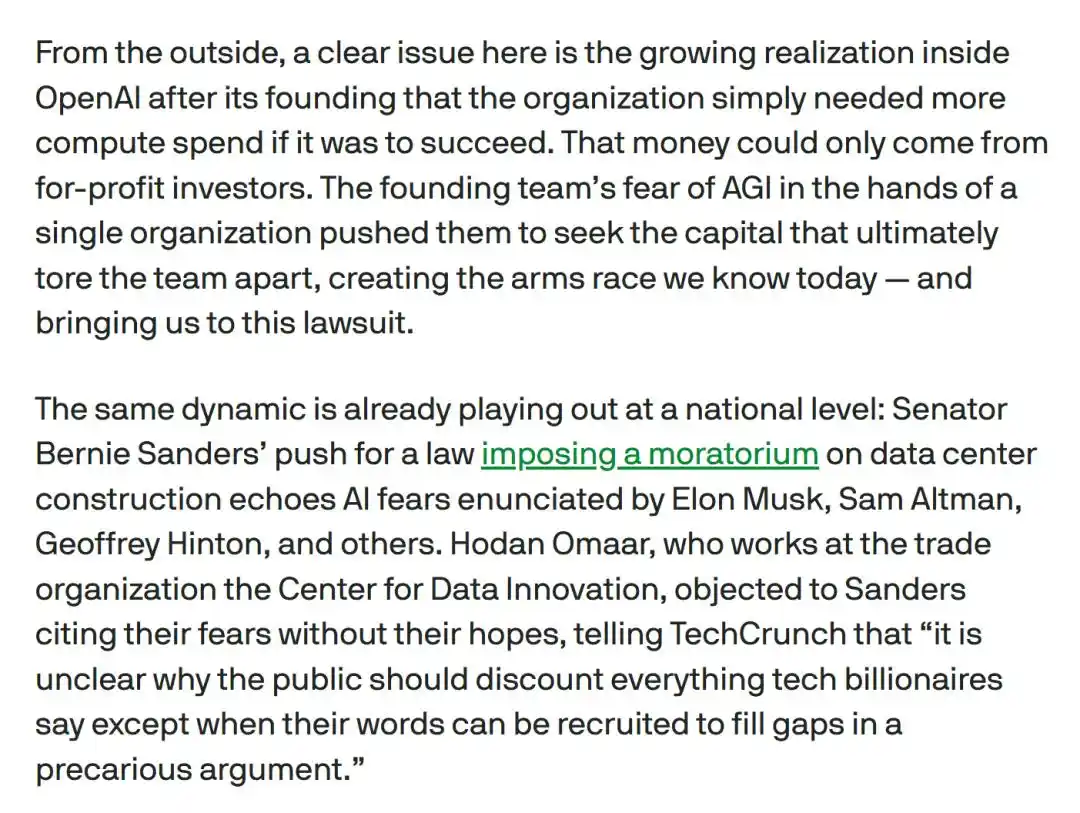
In his testimony, Brockman repeatedly emphasized that OpenAI transformed itself because they discovered that achieving AGI required astronomical amounts of computing power. If it had relied solely on charitable donations, OpenAI would have long since died in the shadow of Google DeepMind.
"In order to attract top talent and to purchase tens of thousands of H100 graphics cards, we must introduce a for-profit structure," OpenAI's defense lawyers insisted, calling it a "necessary evil."
Musk's team countered: If you need money, you can raise funds again, but you can't simply take away the assets and reputation that everyone invested based on the "non-profit" premise and convert them into private shares.
It's worth noting that in an early email, Brockman himself stated that if OpenAI were to become for-profit, it would be "moral bankruptcy."
Now, sitting atop a pile of $30 billion in equity, one wonders if he still remembers what he said back then.
The Great Values Gap in Silicon Valley
This trial is essentially the ultimate clash between two Silicon Valley values.
One type is the "Old Testament idealism" represented by Musk: a promise is a promise, and a contract cannot be broken.
One approach is the "pragmatic expansionism" represented by Ultraman: Technology iterates too quickly; survival is paramount. To achieve AGI, any minor adjustments to the legal structure and changes in the distribution of benefits are justified.
California law may favor the former.
In California, charitable assets are strictly protected. If you establish a charity and then decide to turn it into a private company, you must undergo an extremely complex evaluation and return the full value of the assets to the public.
What would happen if Musk won?
First, OpenAI may be forced to open source—a demand that Musk has always made.
Second, Microsoft's investment may be at risk. Musk has requested the cancellation of the exclusive licensing agreement with Microsoft. If the court grants this request, OpenAI's valuation will collapse instantly.
Third, the profits of OpenAI's for-profit divisions may be forcibly transferred back to the non-profit parent company, and Brockman's $30 billion "zero-cost equity" may vanish.
Ultimately, this ruling will serve as a precedent, warning all AI startups: you cannot raise funds under the guise of charity and then reap profits under the guise of business.
But if OpenAI wins, it would mean that Silicon Valley's "wild growth" logic has once again triumphed.
As long as you can create world-changing technology, all your initial promises can be overshadowed by the golden glow of success.
References:
https://x.com/TechCrunch/status/2051340893299593439
https://x.com/TechCrunch/status/2051346525142634618
https://x.com/ns123abc/status/2051346265963721125
https://x.com/GaryMarcus/status/2051367230949232730
This article is from the WeChat official account "New Zhiyuan", author: New Zhiyuan.