In other words, if native Rollup becomes a reality, then in the future, whether a transaction occurs on L1 or on a native Rollup, its final settlement and security will be guaranteed by the same group of ETH validators, with the trust level being completely equivalent.
This means that depositing $10 million on a native Rollup will have the same level of security as directly depositing on the ETH mainnet.
Declan Fox, the project lead of Linea, stated that their long-term goal is to become a native Rollup. He believes this is an "upgraded version" of ETH 2.0 sharding - no longer rigidly running 64 structurally identical shard chains, but building a heterogeneous Rollup system in a highly programmable and customizable way to serve different scenarios and user needs.
Unlike the homogeneous shard architecture of past ETH 2.0, native Rollup can be heterogeneous, providing more diverse and differentiated application experiences for end users.
Although native Rollup has not yet been formally written into the Ethereum roadmap, with the official launch of zkEVM and the gradual reconstruction of L1 architecture, pre-setting interfaces and pre-compiled logic for it has obviously become a foreseeable technological trend.
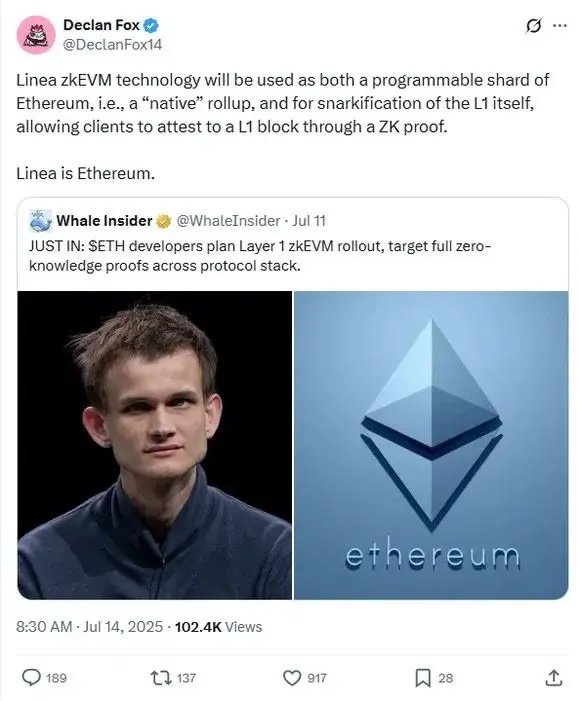
Ladislaus summarized that "in terms of EVM Snarkification (i.e., integrating ZK proof capabilities) and advancing native Rollup, Ethereum has a high degree of technical synergy, because both share the underlying ZK technology stack". Of course, this process still needs to go through Ethereum community governance, form an EIP (Ethereum Improvement Proposal), and ultimately be deployed in a hard fork.
With an optimistic expectation, if everything goes smoothly, the relevant EIP might be submitted by the end of the year and launched in the fork after the Glamsterdam upgrade.
However, this timeline still has high uncertainty and should be viewed cautiously.