The White House is preparing to issue an executive order to punish banks that discriminate against crypto companies. This news has been circulating widely, and those who have been in the crypto industry for more than two years would rub their eyes in disbelief, exclaiming "it feels like a lifetime ago".
However, it has only been just over a year since March 2023, when the "Suffocation Action 2.0" was fully implemented. During the Biden administration, through agencies like the Federal Reserve, FDIC, and OCC, a joint statement was issued classifying crypto business as a "high-risk" area, requiring banks to strictly assess crypto customer risk exposure. Regulatory agencies informally pressured crypto-friendly banks like Signature Bank and Silvergate Bank to close core businesses and restrict new customer access. Payment and trading platform builders would be particularly sensitive to this, and listed crypto companies like Coinbase were forced to invest hundreds of millions of dollars in establishing independent banking networks. Small and medium-sized crypto startups were compelled to register offshore due to inability to meet KYC/AML requirements.
Over the past month, policy winds have swiftly redefined almost all crypto asset types, including stablecoins, DeFi, ETFs, LST, and more. The accelerated entry of traditional financial institutions and the prevalence of crypto-stock companies have created a strong sense of disconnection. But beyond giving "institutions" a starting signal, what opportunities can we find in these bills?
Four Statements, Three Bills, Two Executive Orders
Before interpreting, let's comprehensively review the series of initiatives launched by the U.S. government and regulatory agencies between July and August. Though they appeared dense and fragmented, they piece together like a puzzle to form the current U.S. crypto regulatory blueprint:
[The rest of the translation follows the same professional and precise approach, maintaining the original structure and translating all text while preserving any HTML tags.]In the Super App Era of Everything on Chain, Which Crypto Tracks Can Benefit from Policy Dividends
At this point, the U.S. has built a compliance framework for the crypto field. The Trump administration established the foundational status of "stablecoins" through stablecoin legislation and anti-central bank digital currency legislation, primarily by binding to U.S. Treasury bonds and linking global liquidity, thereby extending stablecoins to various crypto domains without hesitation. The CLARITY Act genius bill established the jurisdictional scope of SEC and CFTC. From July 29 to August 5, four statements within a short week were more related to on-chain activities, from opening BTC and ETH ETF "physical redemption" to liquidity staking certificates, all aimed at first connecting the "old money" channels to the chain and then expanding the financial system on-chain through "DeFi yields". The two administrative orders issued in recent days are genuinely injecting "bank" and "pension" money into the crypto field. This series of combination punches brought the first truly "policy bull market" in crypto history.
Regarding Atkins' launch of Project Crypto, he mentioned a key concept of "Super-App", referring to the "horizontal integration" of product services. In his vision, a single application could provide comprehensive financial services for customers in the future. Atkins stated: "Broker-dealers with alternative trading systems should be able to simultaneously offer non-securities crypto assets, crypto asset securities, traditional securities trading, and services like crypto asset pledging and lending, without obtaining licenses from over 50 states or multiple federal licenses."
Discussing this year's hottest Super App candidates, traditional broker Robinhood and the earliest "compliant" trading platform Coinbase are undoubtedly the top contenders. While Robinhood acquired Bitstamp this year, launched tokenized equity, and collaborated with Aave to bring it on-chain (simultaneously conducting platform and on-chain transactions), Coinbase further integrated its Base chain ecosystem and Coinbase exchange channels, upgrading the Base wallet to a unified app of social and off-chain application layer services. However, RWA in various fields under the Super App context is the true breakthrough.
With policy encouragement to bring traditional assets on-chain, Ethereum bonds, stock tokenization, and short-term government bond tokenization will gradually enter the compliant path. According to RWA.xyz data, the global RWA market grew from about $5 billion in 2022 to about $24 billion in June 2025. However, rather than calling this RWA, it's better to call it Fintech, with the purpose of making financial services more efficient through institutional and technological means. From real estate investment trusts (REIT) born in the 1960s, E-gold, to the emergence of ETFs, and through countless experiments of decentralized ledgers, colored BTC, and algorithmic stablecoins, they eventually became RWA.
With policy system recognition now serving as the most reliable endorsement, its market will be enormous. Boston Consulting Group believes 10% of global GDP (about $16 trillion) can be tokenized by 2030, while Standard Chartered Bank estimates tokenized assets will reach $30 trillion by 2034. Tokenization opens an exciting new door for institutional companies by reducing costs, smoothing underwriting, and improving capital liquidity. It also helps increase returns for investors willing to take on more risk.
Regarding stablecoins' essence as on-chain government bonds, the U.S. dollar assets, especially U.S. dollars and U.S. Treasury bonds, have always occupied center stage. This is the result of nearly 80 years of economic history, with the 1944 Bretton Woods system developing the U.S. dollar into the global financial pillar. Global central banks hold most reserves in U.S. dollar-denominated assets, with approximately 58% of official foreign exchange reserves held in dollars, mostly invested in U.S. Treasury bonds. The U.S. Treasury bond market is the world's largest bond market, with about $28.8 trillion in outstanding bonds and unparalleled liquidity. Foreign governments and investors alone hold about $9 trillion of this debt.
Historically, few assets match the depth, stability, and credit quality of U.S. Treasury bonds. High-quality government bonds are the cornerstone of institutional portfolios, used to safely store capital and serve as collateral for other investments. The crypto world utilizes these same fundamentals, and since stablecoins became crypto's largest "entry and exit point", their relationship is deeper than ever.
Although from one perspective, cryptocurrencies haven't fulfilled Satoshi Nakamoto's expectation of "establishing an alternative to the dollar system", they have instead become a more efficient infrastructure for dollar-based finance. This has become a necessary condition for the U.S. government to "fully accept its existence", and in fact, the U.S. government might need it more than ever.
With recent additions like Saudi Arabia, UAE, Egypt, Iran, and Ethiopia, the BRICS group's total GDP in 2024 reached $29.8 trillion, surpassing the U.S.'s $29.2 trillion GDP, meaning the U.S. is no longer the world's largest economic group by GDP. In the past two decades, BRICS economies have grown significantly faster than the G7.
Stablecoins, closely related to this, hold a unique position in the global financial landscape. They are the most liquid, efficient, and user-friendly wrappers of short-term U.S. Treasury bonds, effectively addressing two obstacles associated with de-dollarization: maintaining the dollar's dominance in global transactions while ensuring continued demand for U.S. Treasury bonds.
Stablecoins like USDC and USDT provide traders with stable trading currencies and are backed by the same bank deposits and short-term government bonds relied upon by traditional institutions. While the Treasury bond income of such stablecoins is not owned by holding users, more on-chain financial products are integrating U.S. Treasury concepts, currently using two primary methods to construct tokenized Treasury bonds: yield generation and rebasing mechanisms.
For instance, yield tokens like Ondo's USDY and Circle's USYC accumulate base yields through various mechanisms to enhance asset pricing. In this model, USDY's price after six months will be higher than today due to cumulative yield rates. Conversely, rebasing tokens like BlackRock's BUIDL, Franklin Templeton's BENJI, or Ondo's OUSG distribute yields through newly issued tokens at predefined intervals to maintain dollar parity.
Whether "yield stablecoins" or "Treasury bond tokenization", similar to fund portfolio adoption in TradeFi, on-chain financial products use on-chain U.S. Treasury bonds as a stable yield component. They have become alternatives to high-risk DeFi, allowing crypto investors to obtain stable 4-5% annual yields with minimal risk.
The Most Profitable Field: On-Chain Lending
Traditional lending is one of the most core profitable sectors in the financial system. According to research by magistral consulting, the global credit market will reach $11.3 trillion in 2024 and is expected to reach $12.2 trillion in 2025. In comparison, the entire crypto lending market is less than $30 billion, but with generally yields of 9-10%, far higher than traditional finance. If regulations are no longer restrictive, it will release enormous growth potential.
[The rest of the translation follows the same professional and accurate approach, maintaining the original structure and meaning while translating to English]Behind this trend are the rapidly clarifying regulatory environment and the entry of traditional giants. Nasdaq has proposed creating a digital asset Alternative Trading System (ATS), allowing tokenized securities and commodity tokens to be listed and traded together to improve market liquidity and efficiency. SEC Commissioner Paul Atkins even compared the on-chain tokenization of traditional securities to the digitization of music carriers: just as digital music disrupted the music industry, the on-chain nature of securities is expected to create a completely new issuance, custody, and trading model, reshaping all aspects of capital markets. However, this field is still in its early stages. Compared to other RWA fields worth billions of dollars, the US stock tokenization track seems to have more room for growth, with the total market value of on-chain stocks currently less than $400 million and monthly trading volume around $300 million.
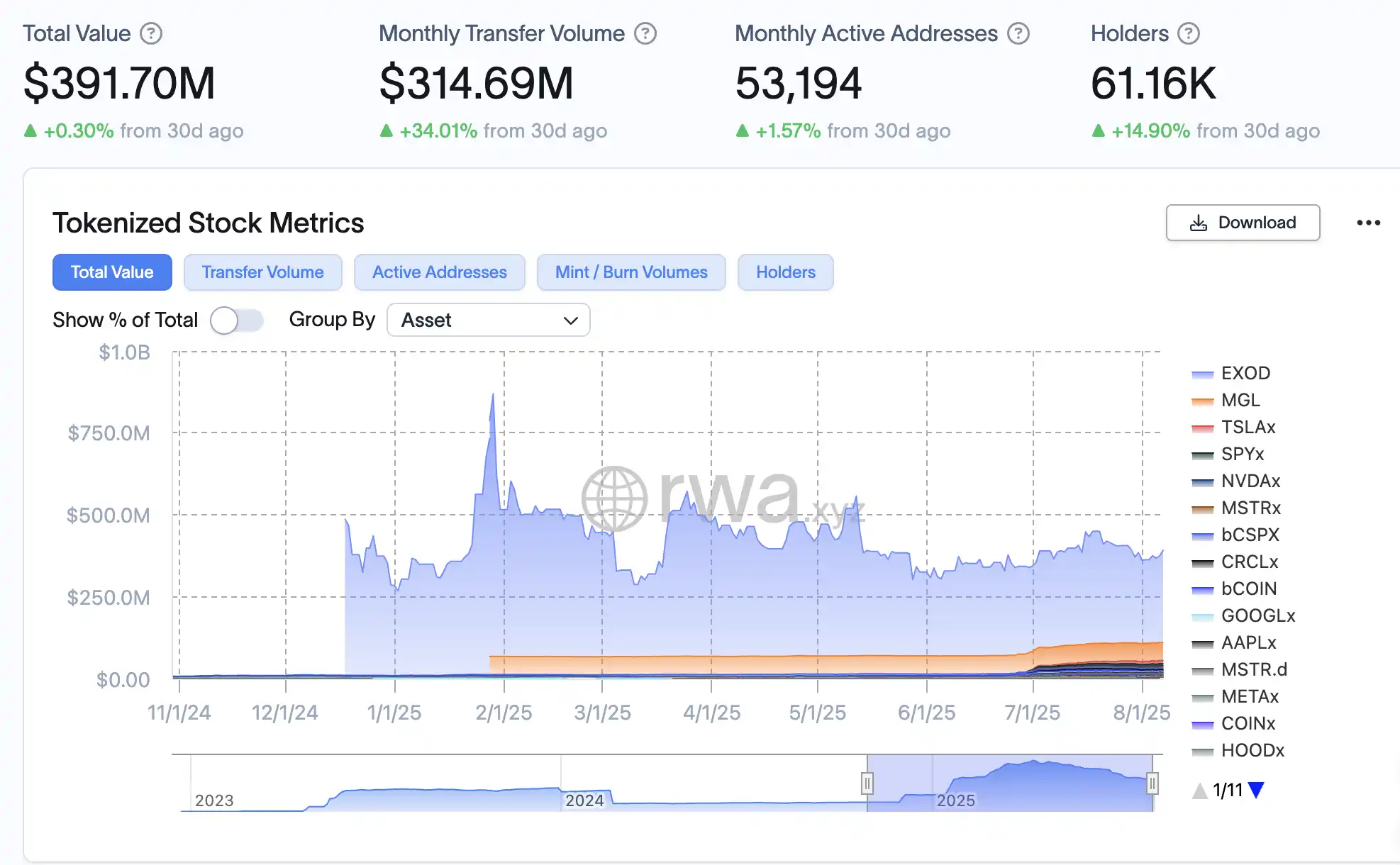
The primary reasons include the fact that the compliance path is not fully cleared, institutional entry regulations are complex, and fund transfer processes are costly. However, for most users, the primary issue is insufficient liquidity. Tech investor Zheng Di stated that high OTC costs mean that US stock players and on-chain players are two different groups: "When transferring funds via OTC, you incur fees of over a thousand, and if using a Singapore-licensed exchange like Coinbase, you'll also face about 1% transaction fees and 9% consumption tax. Therefore, crypto money and traditional brokerage account funds are essentially two separate systems, almost like fighting on two different battlefields."
Because of this, on-chain US stocks currently resemble both an "educator" teaching Degen players basic stock knowledge and a "trainer" shouting "7*24 operational" to traditional brokerage users. StableStock founder ZiXI, in an interview with "Support Without Words", categorized on-chain US stock users into three types and analyzed why on-chain US stocks are "needed" in these usage scenarios.
From Robinhood's press conference to Coinbase submitting a pilot application to become one of the first licensed "on-chain US stocks" services in the US, coupled with the SEC Corporate Finance Department's favorable statement on liquidity staking, it can be anticipated that as the policy bull market progresses, on-chain US stocks will gradually integrate into the DeFi ecosystem, thereby building relatively deep liquidity pools. The US market, once limited to 5x7 hour trading, is accelerating its transformation into an on-chain equity market that global investors can participate in at any time, regardless of time zones. This not only greatly expands crypto investors' asset portfolio but also introduces round-the-clock liquidity to the traditional stock market, marking Wall Street's move towards a "Super-App era" of on-chain capital markets.
The Legitimization of Staked Assets and DeFi's Rise
...Meanwhile, the "world computer" of the crypto world, Ethereum, has also significantly benefited from policy shifts, as new regulations restricted "insider trading and quick token minting for cash," which is favorable for mainstream cryptocurrencies with actual construction and stable liquidity. As the most decentralized, developer-rich public chain that has never experienced downtime, Ethereum has long carried the throughput of most stablecoins and DeFi applications.
Now, U.S. regulators have basically acknowledged Ethereum's non-security nature. In August 2025, the SEC clearly stated that if the underlying assets like ETH are not securities, the liquid staking certificates anchored to them also do not constitute securities. Additionally, the SEC has previously approved spot ETFs for Bitcoin and Ethereum, which essentially confirms Ethereum's status as a commodity.
With regulatory endorsement, institutional investors can more boldly participate in the Ethereum ecosystem, whether issuing RWA assets like on-chain government bonds and stocks, or using Ethereum as a clearing settlement layer to connect with TradFi business, all of which have become realistically feasible. It can be foreseen that while "U.S. public chains" compete to expand compliantly, the "world computer" Ethereum remains the backbone of global on-chain finance. This is not only due to its first-mover advantage and network effects but also because this round of policy dividends has opened a new door for deep integration with traditional finance.
Has Policy Really Brought a Bull Market?
Whether it's the "Stablecoin Act" establishing the compliant status of USD-anchored assets or the "Project Crypto" outlining the on-chain capital market blueprint, this top-down policy shift has indeed brought unprecedented institutional space to the crypto industry. However, historical experience shows that regulatory friendliness does not equal unlimited openness, and the standards, thresholds, and implementation details during the policy trial period will directly determine the life and death of various tracks.
From RWA and on-chain lending to staking derivatives and on-chain U.S. stocks, almost every track can find its position in the new framework. But their real test may be whether they can maintain crypto's native efficiency and innovation while becoming compliant. Whether the global influence of the U.S. capital market can truly merge with blockchain's decentralized characteristics will depend on the long-term game between regulators, traditional finance, and the crypto industry. The policy wind has turned, and how to grasp the rhythm and control risks will be the key to determining how far this "policy bull market" can go.
Click to learn about BlockBeats job openings
Welcome to join the BlockBeats official community:
Telegram Subscription Group: https://t.me/theblockbeats
Telegram Discussion Group: https://t.me/BlockBeats_App
Official Twitter Account: https://twitter.com/BlockBeatsAsia