This report, written by Tiger Research, analyzes how Stable, as a USDT-focused blockchain, drives stablecoin mass adoption through zero gas fee P2P transfers and sub-second settlements.
Key Points
Stable positions itself as a "Trojan horse" in the stablecoin market, aiming to achieve mass adoption through USDT-centric infrastructure.
It offers free USDT transfers, sub-second settlements, and a simplified interface to address key barriers such as high fees, slow transaction speeds, and complex user operations.
The expected plan is to attract users with free, seamless transfer services, and then expand into payment, DeFi services, and institutional collaborations.
1. Stablecoins: The "Trojan Horse" Entering the Market
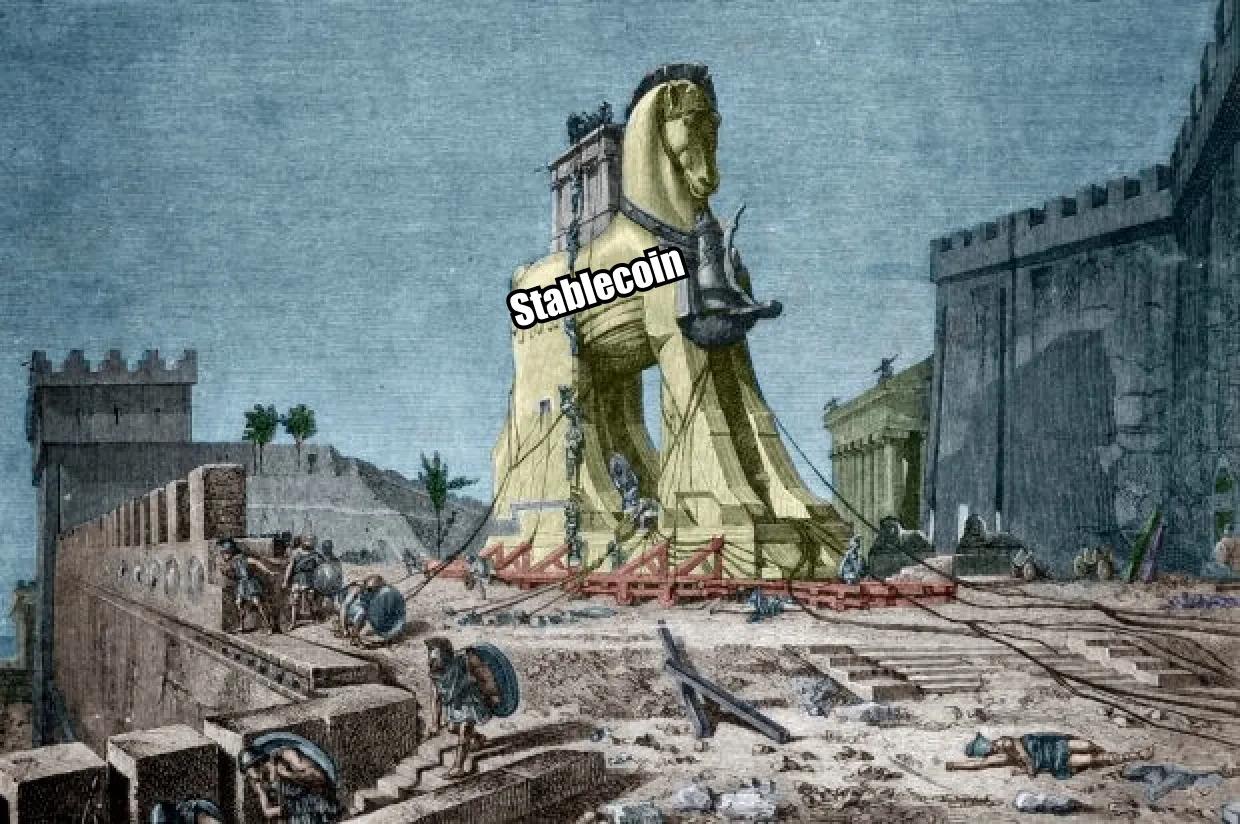
Stablecoins silently enter the cryptocurrency market, like a "Trojan horse".
Stablecoins have now developed into a dominant force in the ecosystem. Initially viewed primarily as a tool to reduce volatility, stablecoins have evolved into a core component of market infrastructure.
The USDT-dominated stablecoin market has a circulating supply of over $150 billion, with more than 350 million users, and trading volumes even exceeding Visa. Circulating supply over $150 billion, with more than 350 million users.
Their development reflects a bridge between traditional and digital finance. In centralized exchanges, they are the primary medium for converting fiat currency to cryptocurrency. In the DeFi realm, they are the benchmark assets for providing liquidity and lending. For cross-border remittances, they offer a faster and more economical option compared to traditional banks.
The shift in market behavior is notable. Early cryptocurrency trading relied on direct token-to-token trades, such as BTC/ETH or BNB/ETH, with value referenced to Bitcoin. Today, trading pairs like BTC/USDT and ETH/USDT dominate. DeFi yields are often denominated in USDT. In parts of Southeast Asia and Latin America, USDT is increasingly used for direct payments, replacing physical US dollars.
The market once relied on volatile token valuations, now stablecoins have become the universal unit of account.
Initially introduced due to demand, they now form the central axis of the cryptocurrency ecosystem.
(Translation continues in the same manner for the rest of the text)Here's the English translation:Account abstraction merges these account types, enabling standard wallets to have smart contract functionality. This allows users to specify operations such as "pay fees with USDT" or "request fee exemption".
The first standard to solve this issue was ERC-4337. It required creating a new smart wallet and transferring funds from the existing wallet, a process prone to user errors.
Previous method: Create new smart wallet → Transfer funds from existing wallet → Use new address
EIP-7702: Retain existing wallet → Add smart contract functionality → Retain same address
EIP-7702 enables smart functionality on existing wallet addresses without fund transfer, eliminating the migration step. Users can continue using their existing MetaMask wallet and add smart functionality.
In Stable, all wallets natively support EIP-7702, enabling smart wallet functionality without additional setup. This includes features like transaction fee sponsorship directly available in existing wallets.
[The rest of the translation follows the same professional and precise approach, maintaining technical terminology and preserving the original structure.]Once such a small payment ecosystem is formed, the number of transactions will grow exponentially. The fee per transaction may be small, but the total transaction volume will reach a considerable level.
5.3. Scenario Three: Deep Integration with the Real Economy
The most ambitious scenario is for stablecoins to become the standard payment method in the real economy. In Southeast Asia and Latin America, USDT payments are emerging, but high fees and slow speeds limit the application of stablecoins.
If Stable can solve these issues, offline commerce may change rapidly. Paying 2 dollars for a coffee in a Vietnamese cafe or buying daily necessities with USDT in a Philippine convenience store could become the norm.
This would completely transform Stable's business model, shifting from a blockchain network to a global payment infrastructure provider. It could provide payment terminals for merchants, digital wallets for consumers, and charge fees from both sides.
By collecting a minimal fee for each USDT transaction through the Stable network, it can establish a stable revenue base as transactions grow.
The delay in promoting central bank digital currencies (CBDC) also presents an opportunity. If private stablecoins are more convenient and accessible than government-issued digital currencies, users will naturally choose the former.
6. Stable's True Strategy
Stable's strategy is clear: attract users through free USDT transfers and convenient user experience. As the ecosystem grows, build a business model around emerging diverse services.
A single transaction may not bring substantial revenue, but the rapid growth in transaction volume will form a considerable total scale. This is similar to Amazon's early strategy of selling books at near-cost to acquire customers, then generating substantial profits through cloud services and advertising.
Free transfers are just the bait. The true goal is to become the central hub of the USDT ecosystem, making all transactions go through Stable. Once the network effect is formed, users will find it difficult to switch to other platforms.
Ultimately, Stable gains a solid market position. This is the true power of the new "Trojan horse".