Author: Li Yuan
Editor: Jingyu
Manus, who moved to Singapore, has not stopped thinking about general AI agents.
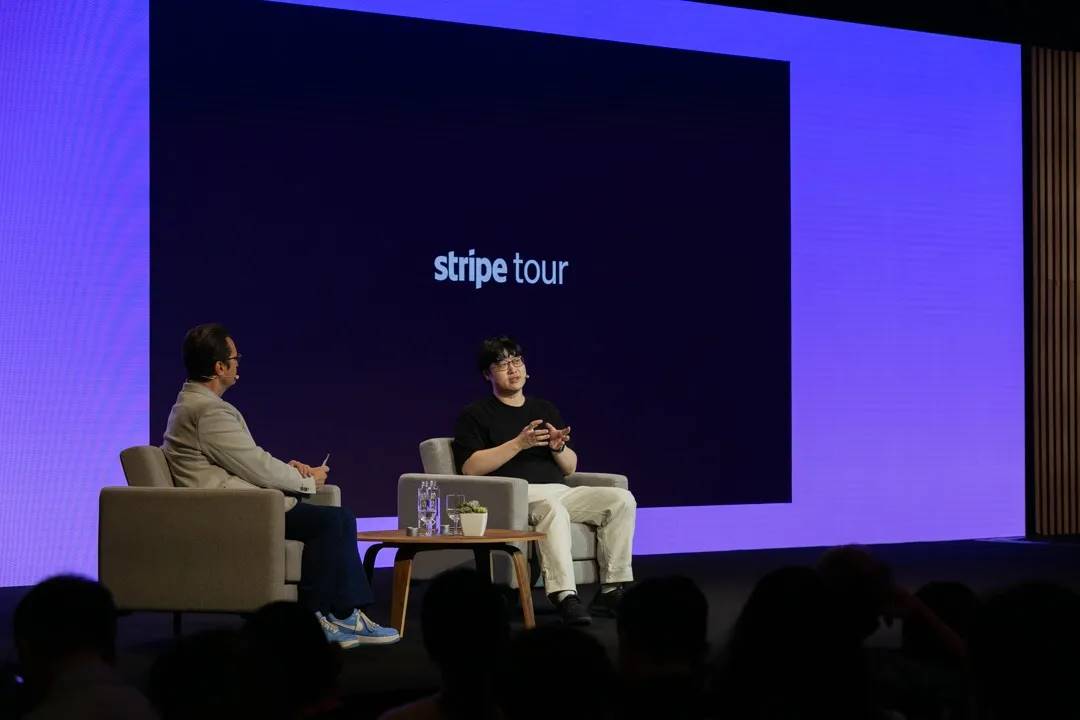
At the Stripe Tour held in Singapore today, Manus co-founder and Chief Scientist Ji Yichao (Peak) spoke with Paul Harapin, Stripe's Chief Revenue Officer for Asia Pacific and Japan.
During the meeting, Manus AI disclosed its recent operating data. Manus AI's revenue run rate (RRR) has reached US$90 million and will soon exceed 100 million.
Manus AI's Xiao Hong also immediately clarified that the revenue run rate refers to the current month's revenue multiplied by 12, and is not equivalent to cash income. Many AI products offer annual payment options, which should only be considered a deposit, not revenue. "If we disclose this [incorrectly], we could end up with numbers far greater than $120 million," Xiao Hong said.
In addition to business data, Ji Yichao also shared how the Manus team thinks about the next step of general agent and what the difference between AI agent and AGI will be in the future.
“Nowadays, almost everything is called an agent. For example, some people call a microphone an ‘environmentally aware radio receiver agent,’” Ji Yichao said jokingly.
He also gave two main lines for expanding the capabilities of general agents: First, use multi-agent collaboration to expand the execution scale (such as deriving hundreds of parallel sub-agents in large-scale surveys); second, open up a larger "tool surface" for agents, not tying their capabilities to a few preset APIs, but allowing them to call open source ecosystems, install libraries, and even view and modify them after visualization, just like programmers.
Ji Yichao also mentioned that today's digital world is still built according to the paradigm of "being used by people" - non-API web pages, CAPTCHA, and "mini-gamification" of processes bring a lot of friction, and the bottlenecks are more like ecological and institutional constraints rather than model intelligence.
This is also one of the reasons why Manus participated in the Stripe event: the two parties are promoting the completion of payments within the agent, connecting "research-decision-order/settlement" into a closed loop, and using infrastructure collaboration to eliminate friction in the world.
The following is the essence of the conversation, edited by GeekPark:
Q: Tell us a little about yourself. Your recent blog post on "Contextual Engineering" is incredibly inspiring, and I think it's essential reading for anyone here developing AI agents. Every time I go to lunch with engineers, they're always talking about it, so I've had to sit somewhere else now (laughs). But for those of you here who might not be familiar with Manus, could you share your journey and vision?
A: Thank you, Paul. Great to be here. Manus is building a general AI agent.
Many research institutions and companies are trying to build a brain—a large language model. But we believe this isn't a good idea from a consumer perspective. AI should be able to actually take action and get things done, so we built Manus.
Our approach is to empower AI with one of humanity's greatest inventions: the general-purpose computer. By giving AI computers the power to do everything a human can, Manus can actually accomplish tasks. For example, it can help you create presentations, plan trips, and even manage your social media presence—though I wouldn't recommend it.
Our users really love Manus. We launched Manus in March and have already achieved a revenue run rate (RRR) of around $90 million, and will soon exceed $100 million.
I think this is a huge achievement for a small startup like us. But more importantly, it shows that AI Agents are no longer just a buzzword in research, but are actually being applied and taking root.
I can share with you a little story about how we built Manus.
We actually got a lot of inspiration from agent coding applications. For example, AI programming products like Cursor have attracted a lot of attention.
As engineers, we naturally use Cursor. But we were surprised to see that many non-engineers in the company also use Cursor. Of course, they don't write software, but rather use it for data visualization or even writing articles. They ignore the code on the left and simply communicate with the AI to get the job done.
This made us realize that we should generalize this approach and empower non-programmers. This is a use case for AI.
Q: We're hearing more and more about AI agents and AGI. Can you help us distinguish between these two concepts more clearly? What do AI agents and AGI mean to you and Manus?
A: We think this is a very good question.
Nowadays, almost everything is called an "agent." For example, some people call a microphone an "environmentally aware radio receiver."
But at least we argue that Agent should be a subset of applied AI. Let's take a step back and look at common AI application categories.
Most people are already familiar with two types of generative tools: chatbots, such as ChatGPT, and generative tools like MidJourney or Sora. In these systems, there are typically only two roles: the user and the model. You interact with the model and receive output. Agents, on the other hand, differ in that, in addition to the user and the model, they also introduce a third key element: the environment.
The concept of "environment" varies depending on the type of agent. For example, in a design-based agent, the environment might be a canvas or a piece of code. With Manus, our goal is to make the agent present within a virtual machine or even the entire internet. This allows the agent to observe the environment, decide what to do next, and modify it through actions. This makes it incredibly powerful.
For example, in Manus, you can express your needs, and it will open a browser, publish a webpage, and book a flight for you. I love this example because, while booking a flight sounds simple, it's actually AI directly changing the real world—the result isn't the model's output, but the ticket in your hand. AI truly intervenes in your world. This is what we call an agent.
Simply put, an agent is an AI system that can interact with the environment on behalf of the user.
As for AGI, the term is often mentioned, and many people equate it with superintelligence. We believe that AGI is a system that can leverage the general capabilities of AI models to complete many tasks without special design.
We believe that "agent coding" is a path to AGI. It's not a specialized capability, but rather, if you give it to a computer, it can do almost anything a computer can do. Therefore, for us, the prerequisite for AGI is to build a sufficiently comprehensive environment to enable this capability to flourish.
Q: In what scenarios is AI truly useful today? Where will it be useful in the future? When will the iPhone moment come?
A: As far as agents are concerned, if we only look at the model capabilities, today's flagship models are already amazing, almost at a "superhuman" level. They can outperform most of us in math competitions or logical reasoning.
But I think models are still like "brains in bottles" and if they want to be truly powerful, they must interact with the real world and touch reality. Unfortunately, this is where the problems begin.
For example, if you ask an AI to do some routine tasks, it is indeed very good at repetitive tasks. For example, a product like Deep Research simply aggregates information and gives a result, and its output simply appears there.
For example, almost everything these days is designed for humans—not just in the physical world, but also in the digital world. Web tools, for example, are like mini-games, lacking APIs or standard interfaces. CAPTCHAs are ubiquitous, blocking agents everywhere.
So I think AI performs very well in closed, self-contained tasks, but once it gets involved in the real world, it runs into obstacles.
When will the iPhone moment come? I think it's not a technical problem, but more of an institutional limitation. It's not something that an agent startup like us can solve alone.
I believe this will require a gradual shift, requiring the entire ecosystem to evolve together. This also requires companies like Stripe to invest in infrastructure. For example, we're currently integrating Stripe's new Agentic payment API. We all need to work together.
Q: Can we talk about some typical scenarios in which users use Manus? How do they use it? What kind of power does it demonstrate?
A: Yes, we are from the current generation of agents, but we have seen many great use cases.
For example, we just moved to Singapore and needed to hire a real estate agent to help us find a place to live. A real agent (laughs).
Now these agencies are already using Manus: they use Manus to analyze the company's location and the areas where employees want to live based on the needs of their clients, and generate corresponding recommendations.
I find this very interesting because it falls under the category of "long-tail demand." Generally speaking, there aren't dedicated AI products designed for this specific scenario, but because Manus is a general-purpose agent, it can meet these needs. We believe that long-tail demand is worthy of attention.
From a macro perspective, it may be a long tail, but for specific users, this is their daily work. This scenario is particularly valuable.
This is like the search engine landscape today. If you're searching for general content, the quality of results is similar whether you use Google or Bing. So why do people choose one over the other? Perhaps it's because one search engine gives them more appropriate results at that particular moment. However, if you're searching for highly personalized or specialized content, the differences become even more pronounced. This is where we believe general-purpose agents have an advantage.
So how do we make it better? We thought about it for a long time, because we believe that everything is inevitable to program. If you give a computer to AI, then the way it interacts with the environment is actually through programming.
We believe there are two areas for improvement. The first is scalability. What if you could amplify the Agent's capabilities a hundredfold?
Manus recently released a new feature called Wide Research. Its basic idea is to allow a single agent to spawn hundreds of agents to work together to complete a task. As you know, if you're just using AI to help you with small tasks, you can often accomplish them yourself. However, if the task is incredibly large and impossible to complete alone, such as large-scale research, having hundreds of agents working in parallel can be incredibly powerful.
Secondly, we need to enable agents to use computers more flexibly. For example, if you only give an AI agent preset tools, its action space is limited to those tools. But imagine if you were a programmer and had the resources of the entire open source community at your disposal.
For example, when 3D printing, it's difficult to directly modify the model's parameters. However, if you can find the appropriate library on GitHub and install it directly, your problem can be solved. At Manus, we optimize for universality and have proposed a concept called the "network effect of tools."
Here's an interesting example: Many users use Manus for data visualization. As you know, this can sometimes cause issues in Asia, such as incorrect fonts when displaying Chinese characters in charts. Perhaps some expert users will hard-code rules, such as which font to use when outputting Korean text. However, this approach can lead to increasingly rigid systems.
Our approach was to add a simple capability to the system: image inspection. The results were surprising—because today's models are already so smart, they can automatically inspect generated visualizations, recognize errors, and then automatically correct them. We found that adding flexibility to the tool can solve more problems than hard-coded rules.
Q: These are exciting times. I'm really excited. I just wish I could be 30 again (laughs). Speaking of medical research, I know Manus is strong in that area as well. Have you seen any users using Manus for medical research?
A: Many people are already using Manus for research, not just in medicine. We find this interesting because there are so many so-called "deep research" products out there that collect a lot of information and perform some analysis, but at the end, they just give you a Markdown file or document. That's not enough.
Often, researchers truly need results they can deliver directly to their bosses or teams. Therefore, we've enhanced the output of research results in Manus. For example, in medical research, formal reports, such as slide presentations, are often required. Therefore, we must optimize AI's output capabilities to meet researchers' needs. This creates a "tooled" experience.
For example, many users now use Manus to do research first, and then directly generate a website. You will find that this is completely different from the traditional way of building a website.
You know, building a website isn't difficult; ensuring the data is reliable and accurate is challenging. Therefore, we believe it's best to complete the entire process in a single session, within a shared context. This way, your research and insights can be seamlessly translated into final results. This is what we do at Manus.
Q: Many countries are discussing the future of humanity and its economic impact in the age of AI. What are your thoughts on job displacement? What new job opportunities will emerge?
A: Our friends and investors often ask us this question. When we launched Manus, we initially thought that if we could build such an agent, it would help people save a lot of time and make money easily.
But in reality, we've found that this vision hasn't been fully realized. Through extensive user research, we've discovered that users actually work more after using the app. This is because they become more efficient and are actually able to do more of the things they're already good at. This is the first point.
Secondly, we believe Manus opens up a whole new space. We've been discussing virtual machines and cloud computing. We see Manus as playing the role of a "personal cloud computing platform." For example, cloud computing has existed for decades, but it was primarily a privilege for engineers. Only we could harness the power of the cloud through programming. Ordinary knowledge workers couldn't use it.
But now, with AI agents like Manus, people can give instructions in natural language and have AI execute them. This unlocks a whole new level of productivity. This is what we bring.
Finally, regarding "replacement," I think it's actually difficult. Real estate agents, for example, use Manus every day to complete their daily work. But as you know, AI can never replace the face-to-face communication between agents and clients. We are an AI company, and even Manus's launch videos are scripted by Manus, but I still appear in the videos because it's about trust. And trust can't be completely left to AI.