Is USDF another "cookie-cutter" stablecoin?
By Alex Liu, Foresight News
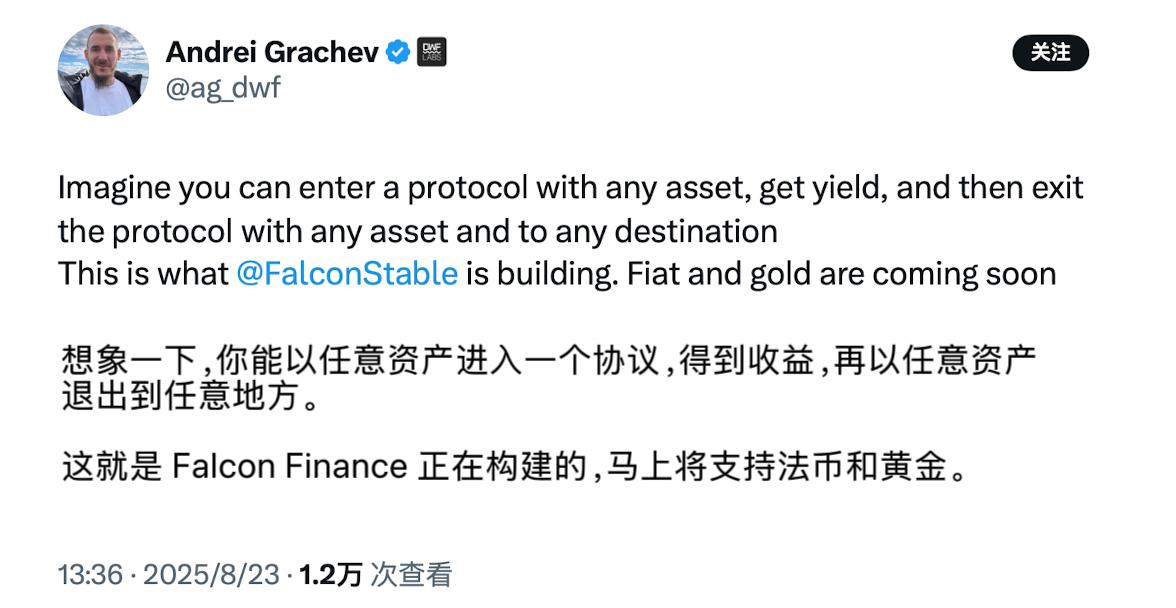
DWF co-founder said: "Falcon Finance is a protocol that allows you to enter with any asset, earn returns, and then exit with any asset to any place."
This is a grand vision that doesn’t sound like a description of a stablecoin project, and this is precisely what makes USDf unique - there are too many stablecoins on the market now, and sometimes they even feel "stereotyped" and it is difficult to find the differences, but in the end the winner will always be the one that is different.
Being different doesn't mean being right. What makes the Falcon different, and will it be the winner?
Different backgrounds
USDf (Falcon Finance) has a different origin.
Falcon Finance's founders and team come from DWF Labs, and its co-founder Andrei Grachev also serves as Falcon's managing partner.
DWF Labs and DWF Ventures are veteran market makers and investment firms in the industry, having participated in market making for a variety of mainstream Altcoin and well-known meme coins, and have achieved remarkable success in this cycle. This is the first time a market maker has entered the stablecoin market.
Falcon Finance's underlying profit strategy relies on a large number of hedging transactions, similar to Ethena, which distributes trading profits to users under the guise of an interest-bearing stablecoin. (See: Under the guise of a stablecoin: Is ENA a model innovation or a valuation scam ?)
The identity of a market maker gives it a natural advantage in the execution of trading and profit strategies.
Different capital
The capital backing Falcon Finance is also different.
Falcon Finance itself is backed by DWF Labs. In April of this year, DWF Labs invested $25 million in the Trump family's crypto project, World Liberty Financial (WLFI), at an average price of $0.10 . The company also stated it would support the liquidity of its USD1 stablecoin. (The market also assumed DWF Labs would serve as a market maker for the WLFI token.)
On July 30, 2025, Falcon Finance announced a $10 million investment from WLFI. This marked WLFI's first investment in the stablecoin sector , as WLFI maintains its own USD1 stablecoin, backed by physical assets such as U.S. Treasury bonds and cash. Both parties stated that the funds will be used to accelerate technical integration, including cross-chain compatibility for Falcon and interoperability between USDf and USD1.
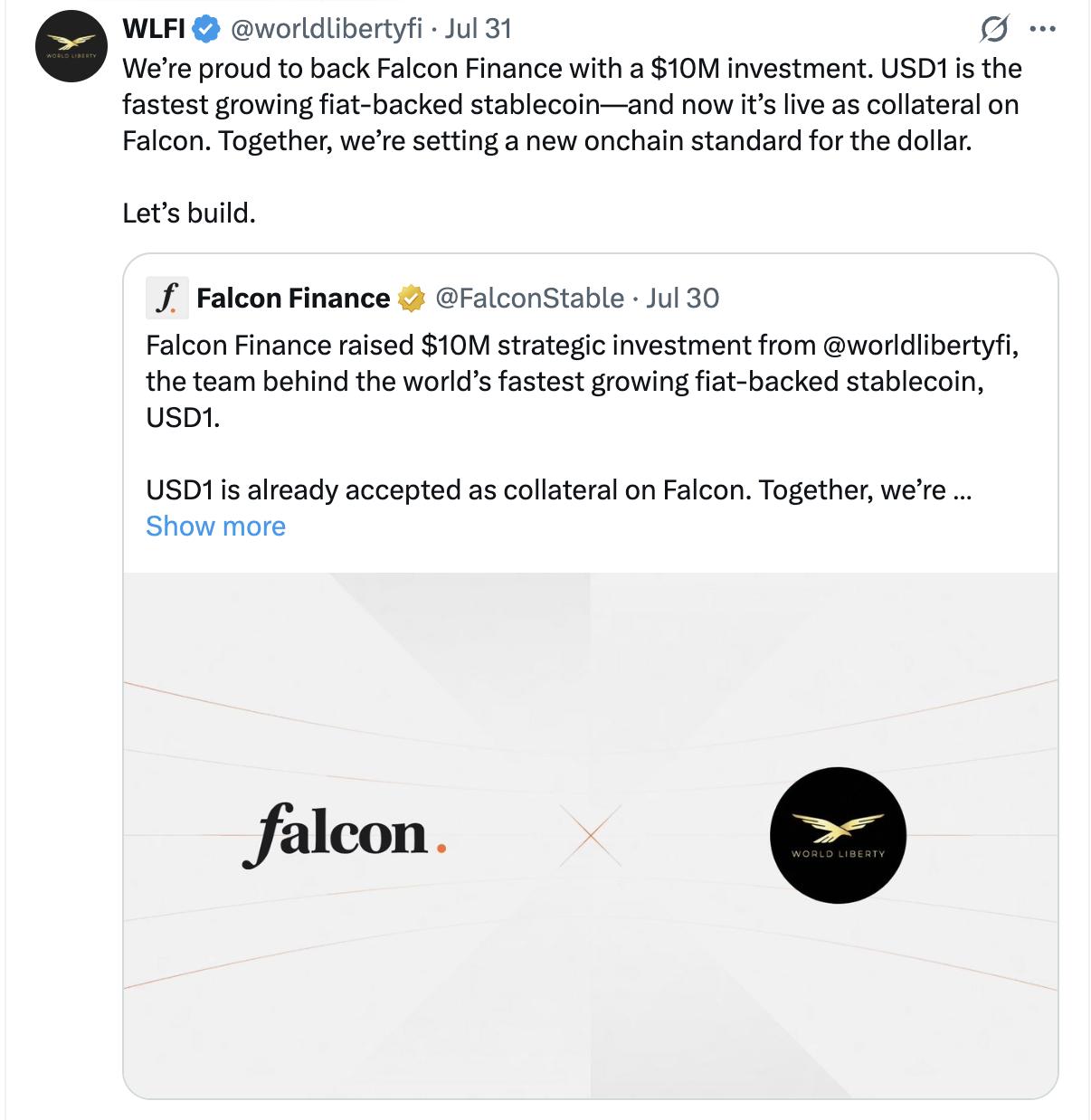
Falcon officials stated that USD1 has been included in Falcon's collateral list, and a USDf/USD1 cross-chain conversion tool will be launched in the future to form a complementary pattern between the two.
The WLFI token has been listed on Binance's pre-market futures market, with a fully floated market capitalization (FDV) exceeding $20 billion. Related concept tokens (such as DOLO) have also performed well recently. The added value of the "WLFI concept" brought to Falcon by this different level of capital is likely to be positive.
Different modes
Falcon’s model (revenue sources, minting mechanisms, etc.) is also different.
There are other stablecoin projects on the market that rely on hedging trading profits as their revenue source, such as the Ethena protocol's USDe/sUSDe. Unlike traditional stablecoins that are fully collateralized by fiat currency, Ethena's USDe is also synthetic USD, but its model uses crypto assets such as BTC, ETH, and SOL combined with perpetual contract positions for delta hedging (a process known as delta-hedging), and maintains a certain amount of mainstream stablecoins for stability.
Falcon's revenue sources are as follows, and with the addition of " market maker expertise " such as cross-exchange price arbitrage, they become even more diverse and complex.
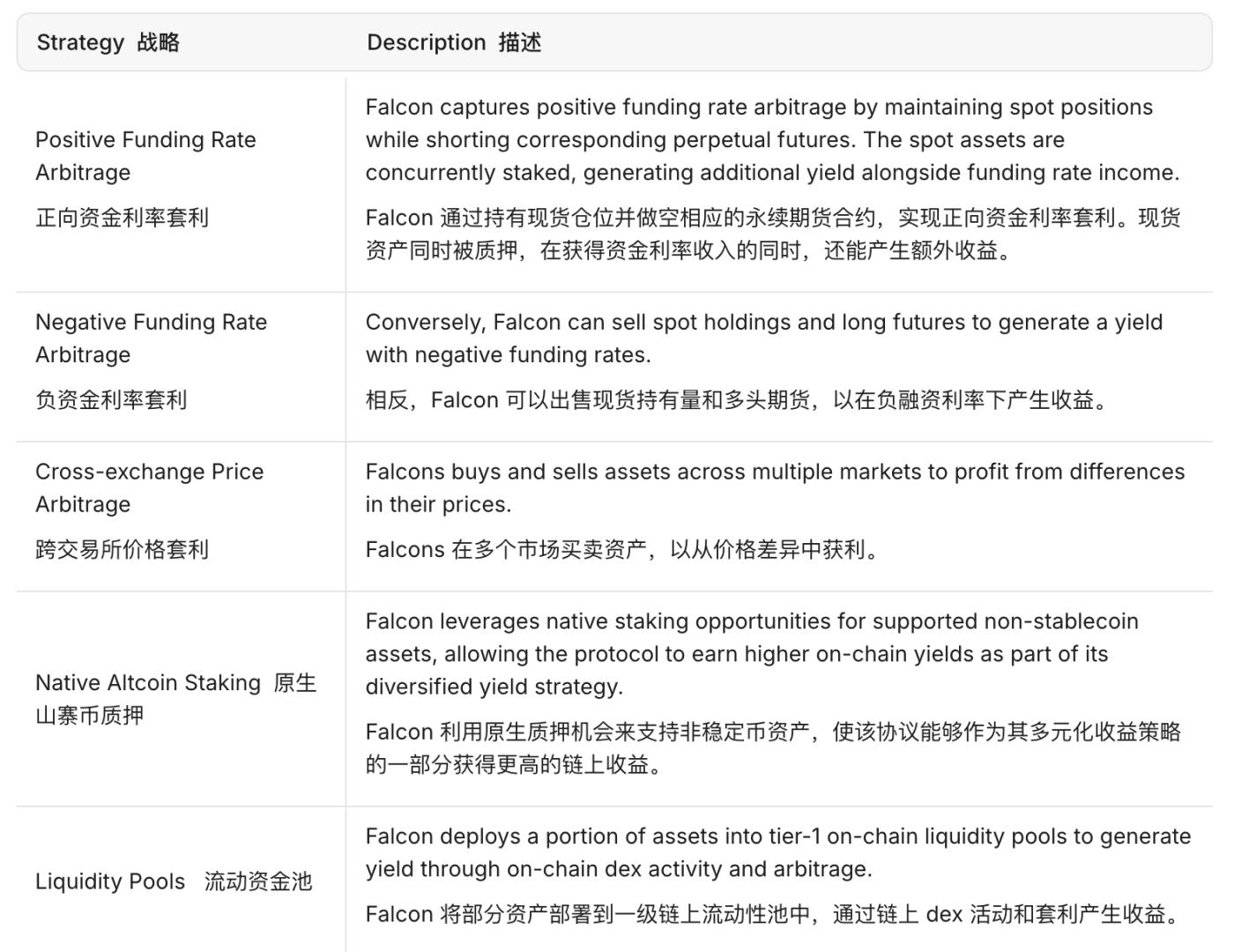
Unlike most stablecoins, USDf is not backed by a single asset, but rather adopts a multi-asset over-collateralization plus hedging strategy: all issued USDfs need to be backed by collateral worth more than US$1, and the current collateralization rate of the protocol is between 110% and 116%.
Falcon's design allows users to mint USDFs with a variety of assets: mainstream stablecoins (such as USDT, USDC, and DAI), as well as major cryptocurrencies (such as BTC, ETH, and SOL), and selected Altcoin . Officials have stated that they will integrate more asset types in the future, including tokenized real-world assets (RWA).
Users can obtain USDf in two ways: minting USDf on the Falcon app (requiring KYC and minimum deposit requirements), with the option to collateralize using either the "traditional" or "innovative" model (a wrapper around options). Alternatively, they can purchase USDf directly on decentralized exchanges (such as Uniswap and Curve), which require no KYC or minimum deposit requirements. Both methods offer the platform's "Falcon Miles" rewards program, though directly minting and collateralizing non-stablecoins offers a higher multiplier for points.
After obtaining USDf, users can participate in the ecosystem and gain benefits through various channels.
- Holding income - Simply holding USDF can earn you 6 times the points reward every day;
- Staking Income - Users can stake USDF into sUSDF to earn interest, supporting both no lock-up (basic income) and periodic lock-up (higher income) modes;
- Liquidity Mining — USDF can provide liquidity in mainstream DEXs (Uniswap, Curve, PancakeSwap, etc.) or aggregators (Convex, StakeDAO, etc.), obtain transaction fees and earn points (up to 40 times) at the same time;
- Lending and Leverage — Falcon has access to lending markets like Morpho, Euler, and Silo, and supports USDf or sUSDf as collateral for lending and circular mining.
- Yield tokenization protocols (such as Pendle) can also use USDF to allow users to further speculate on points or lock in fixed returns by separating future income streams (minting "SY/YT" tokens). Recommended reading: Pendle is difficult to understand, but not understanding it is your loss
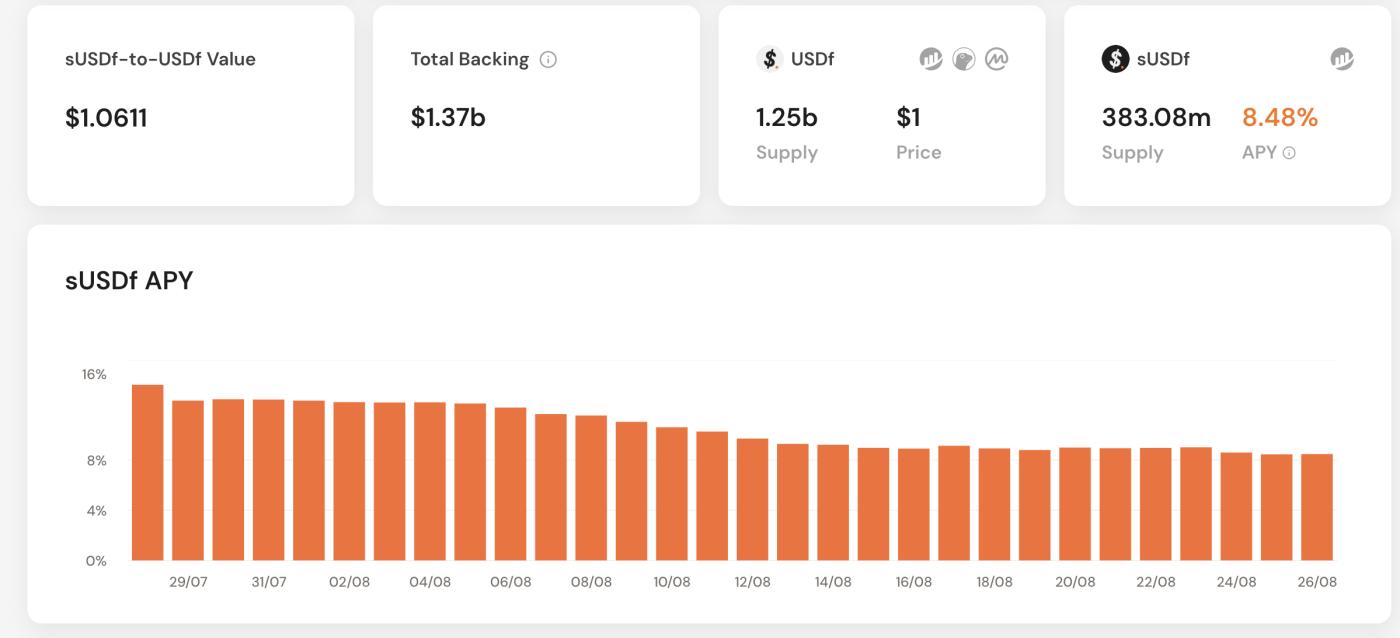
As of today (August 26th), USDF's circulating supply is $1.25 billion, placing it in the top 10 of all stablecoins in terms of issuance as an emerging protocol. The interest-bearing sUSDF has a supply of 383 million tokens and offers an annualized yield of 8.48%.
Different visions
As mentioned at the beginning, Falcon’s vision is also different and is not limited to the scope of “stablecoin”.
Falcon Finance is positioned as a "universal collateral infrastructure" that aims to convert various custodial assets (including crypto tokens, fiat-pegged tokens, and tokenized real-world assets) into on-chain synthetic liquidity pegged to the US dollar.
Falcon is not just about issuing a new stablecoin, but about creating a financial connection layer that can accommodate multiple assets and multiple markets - enter with any asset, get returns, and then exit with any asset to anywhere.
Andrei Grachev of Lianchuang has repeatedly emphasized that the design goal of USDf is to enable traditional financial assets such as U.S. Treasury bonds and stocks to be put on the chain and generate liquidity and returns.
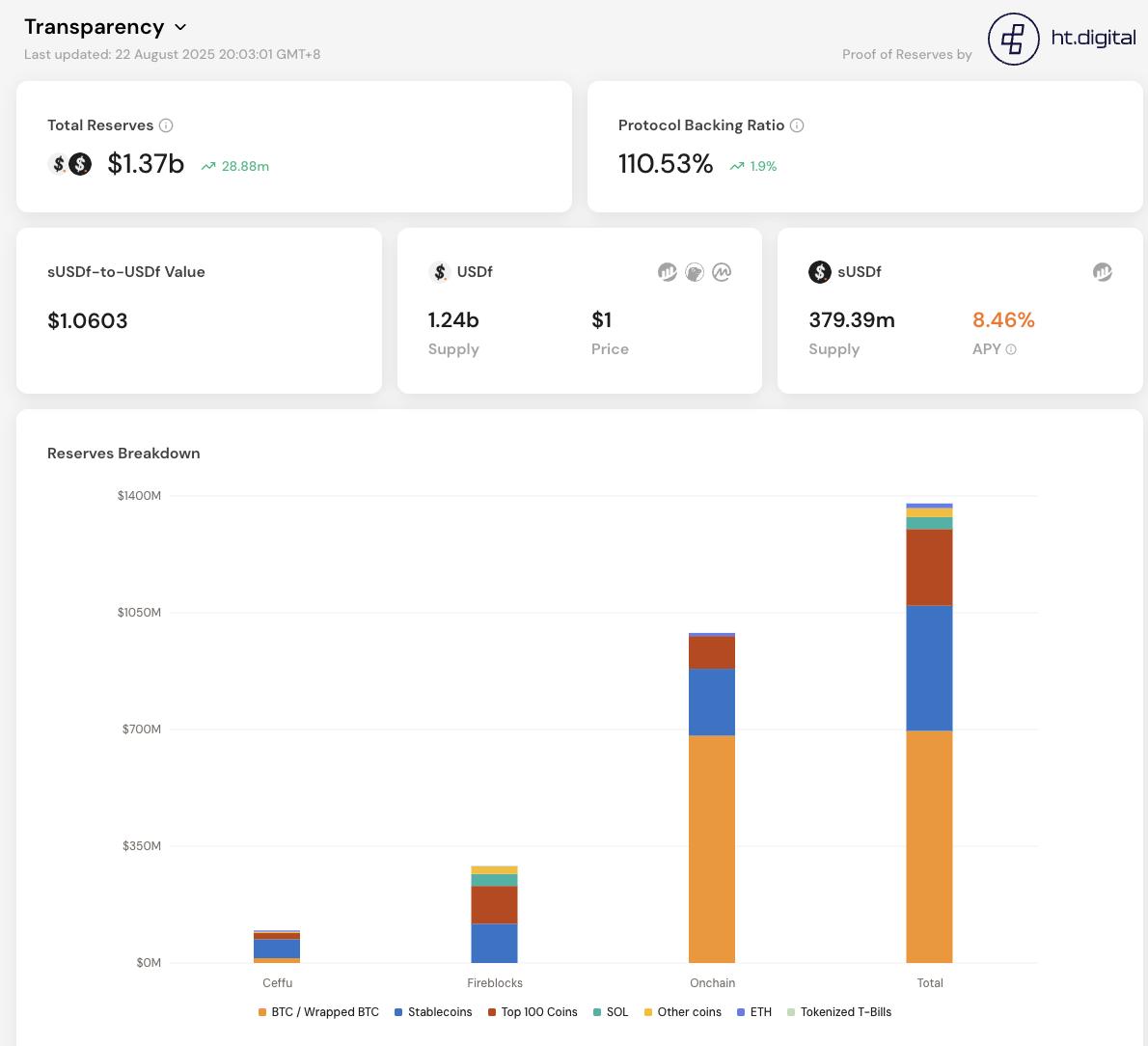
Falcon achieves this goal by efficiently connecting real-world assets with the DeFi ecosystem (trading, lending, market making, etc.) through protocol logic, underpinned by transparent risk management and high-level compliance. Official mechanisms, including audits and transparency dashboards, are designed to enhance trust. For example, the recently launched transparency dashboard publicly demonstrates that USDF has over 110% reserve funds, verified by third-party audits. The Falcon product team also plans to regularly release more detailed reserve certificates and audit reports to meet the security and compliance requirements of institutional users.
Different routes
Due to the above differences, Falcon's project roadmap is also very different from conventional stablecoin projects.
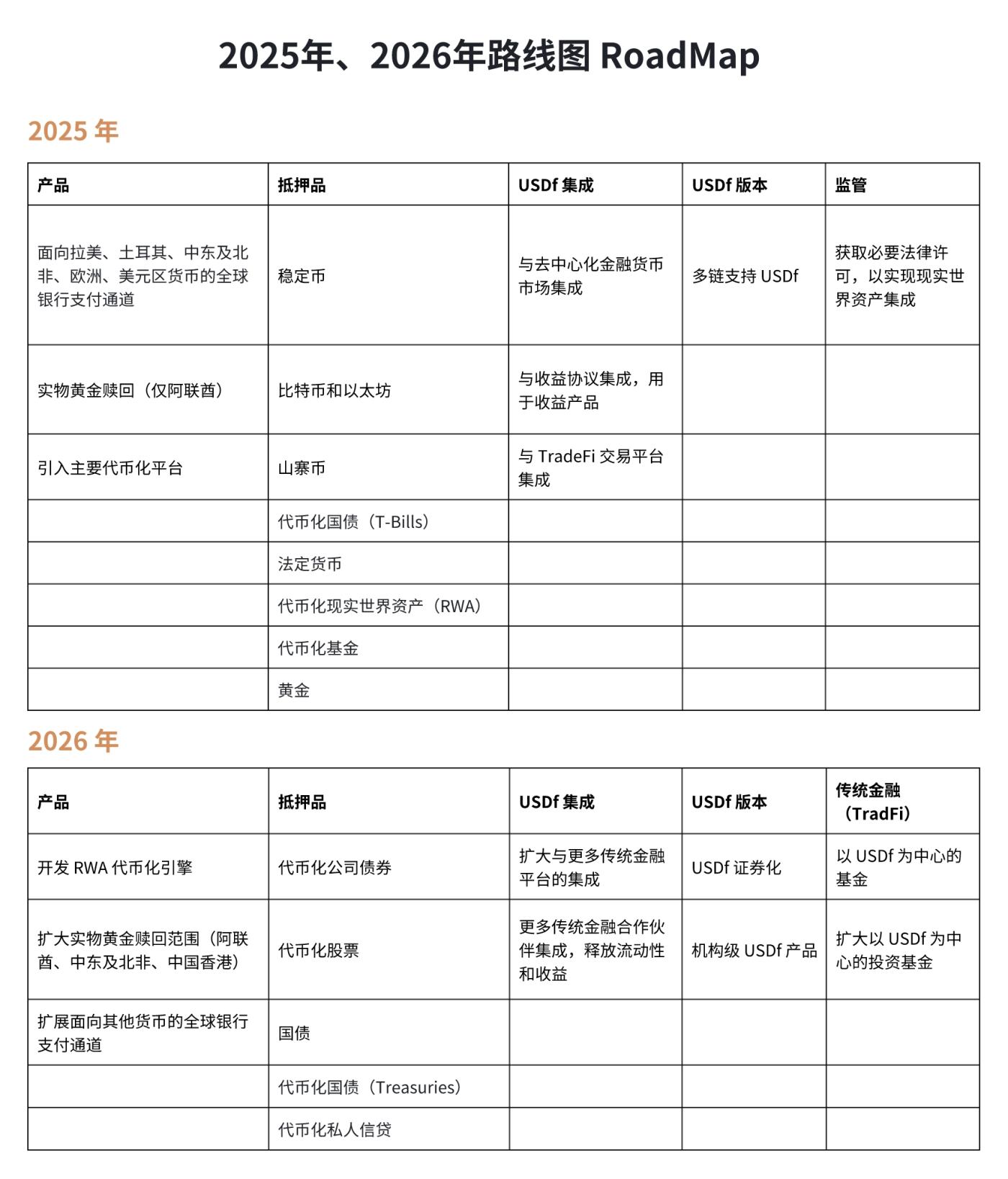
According to the official route, before the end of 2025, Falcon will focus on expanding the "fiat currency channel" of US dollar liquidity and realizing multi-chain deployment: it plans to open regulated fiat currency deposit channels in major markets such as Latin America, Turkey, and the Eurozone, provide 24/7 real-time settlement, and push USDf to Layer1/Layer2 including Ethereum L2 and other public chains to improve cross-chain capital efficiency.
The team is also collaborating with licensed custodians and payment institutions to launch bank-grade USDF products, such as overnight fund yield management and money market fund access. They are also considering adding on-chain physical gold exchange services in major global financial centers, such as the Middle East and Hong Kong. By 2026, Falcon plans to build a "real asset engine" to support tokenized access to assets such as corporate bonds and private credit, and to launch USDF investment tools and structured securities products to meet the needs of larger institutions.
How to participate
At the community level, Falcon has also launched a series of incentive activities to expand ecosystem participation, including Falcon Miles points and Yap2Fly social leaderboards.
Falcon Miles is the project's points system, which is often directly linked to the project's subsequent airdrops. The method of obtaining it has been mentioned above.
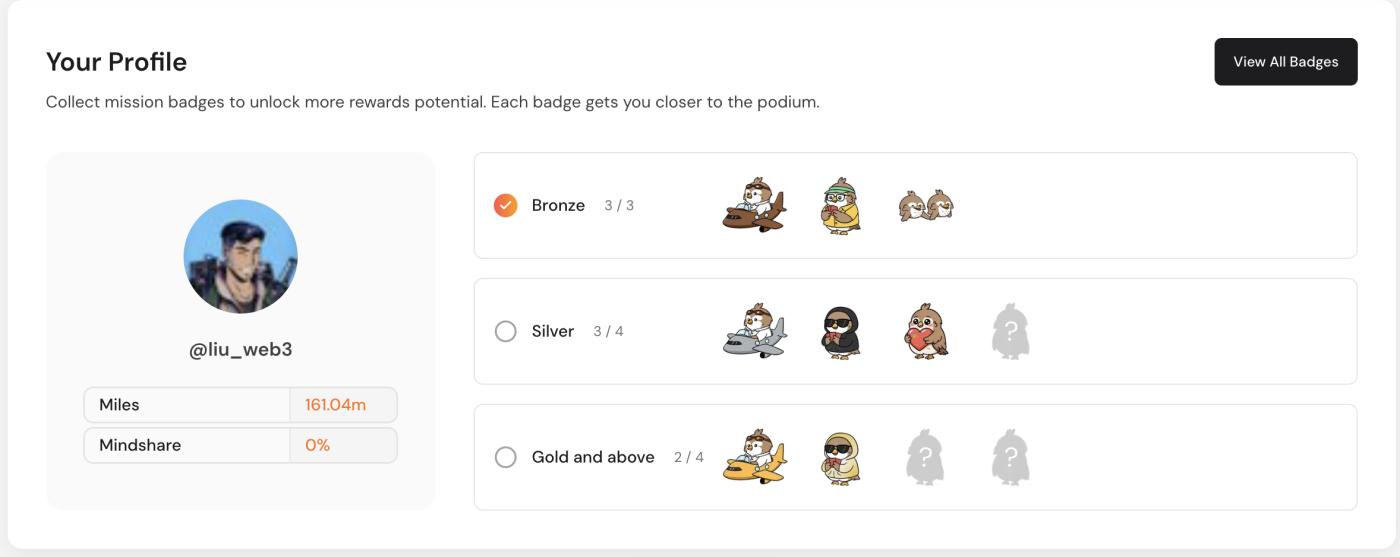
Yap2Fly is a collaborative initiative between Falcon and Kaito. It ranks users based on their Falcon Miles and the "Mindshares" earned from Yap posts on social media. A monthly USDF reward pool of approximately $50,000 will be distributed to the top 50 users. In addition to unlocking a certain percentage of rewards, a badge system may also offer additional rewards.
In summary, Falcon Finance currently has more than $1 billion in USDf circulation and total locked-in volume, leading the scale among synthetic dollar protocols.
Its unique approach lies in using large-scale assets as collateral to create on-chain liquidity and allowing these assets to continue to generate returns. The project team emphasizes attracting institutional users, not just ordinary DeFi users, through rigorous risk management, compliance planning, and access to diverse assets.
In future development, Falcon Finance is expected to continue exploring the integration path between DeFi and traditional finance by expanding diversified asset types and multi-chain deployment.
Disclaimer: The author of this article holds sUSDf YT, the value of which meets the disclosure criteria.