The boundaries of AI-driven creation are rapidly expanding. We are seeing the capabilities of generative models extend to application building, logic orchestration, multimodal collaboration, and automated execution. Many processes that previously required manual handling by engineers, such as tool calls, plugin integration, data processing, model inference, and state management, are now being encapsulated within higher-level AI architectures. The creative process is gradually shifting from one-off "content generation" to an "engineering-based creation process" jointly completed by models, agents, and toolchains.
This shift leads to a clear trend: AI-generated content is transforming from "results" into "applications," and from "single files" into a systematic structure comprised of scripts, prompts, configuration files, plugins, and logic modules. Traditional generation tools (such as ChatGPT, Midjourney, and Runway) can provide a starting point for creation, but they cannot support the engineering structure behind creation—including more complex aspects such as multi-file management, application logic, permissions and storage, collaboration and remixing, on-chain integration, and assetization.
As AI's involvement in content production deepens, the creation process itself is becoming an asset. We see that code, prompts, model fine-tuning versions, plugin logic, call paths, and workflow structures—which were originally implicit "production steps"—are now reusable, composable, collaborative, and potentially valuable content units.
Against this backdrop, CodexField is building a content asset ecosystem for Web3 that not only supports model invocation and multimodal generation, but also supports logical structures, application components, version updates and collaborative behaviors, and allows these results to be saved, reused and extended in a stable manner.
CodexField: Content Moving from "Generation" to "Asset"
CodexField is a system for on-chain content assetization. Its core goal is to reshape the content lifecycle in the AI era, enabling it to possess verifiable, traceable, composable, and tradable attributes from its creation. In this system, content is no longer a one-off product, but an asset unit existing with on-chain identity and a structured form, capable of participating in collaboration, authorization, and economic distribution.
To achieve this goal, CodexField breaks down the production, management, and distribution of content into five basic components:
Gitd: As the source of content, it provides on-chain version control and verifiable identity for code, model engineering, and creation logic;
CodexField Wallet: Serving as the ecosystem gateway and unified account system, it carries identity, assets, and cross-module connections;
AI Playground: As a creation and construction layer, it is the starting point for content to enter the structured asset system;
Marketplace: Responsible for the display, publication, authorization, and trading of content; it is the front-end scenario for asset circulation.
Quest & Rank: Incorporating creation, use, and collaboration into an incentive system to create a sustainable growth and distribution mechanism.
Of these five components, AI Playground is the main intersection between creators and the content system. All generation, composition, application building, and logical orchestration occur here. For the first time, content takes on a manageable and traceable structured form at this layer, allowing it to naturally flow into the Marketplace, enter the incentive system, and ultimately become a sustainable part of the CodexField content economy.
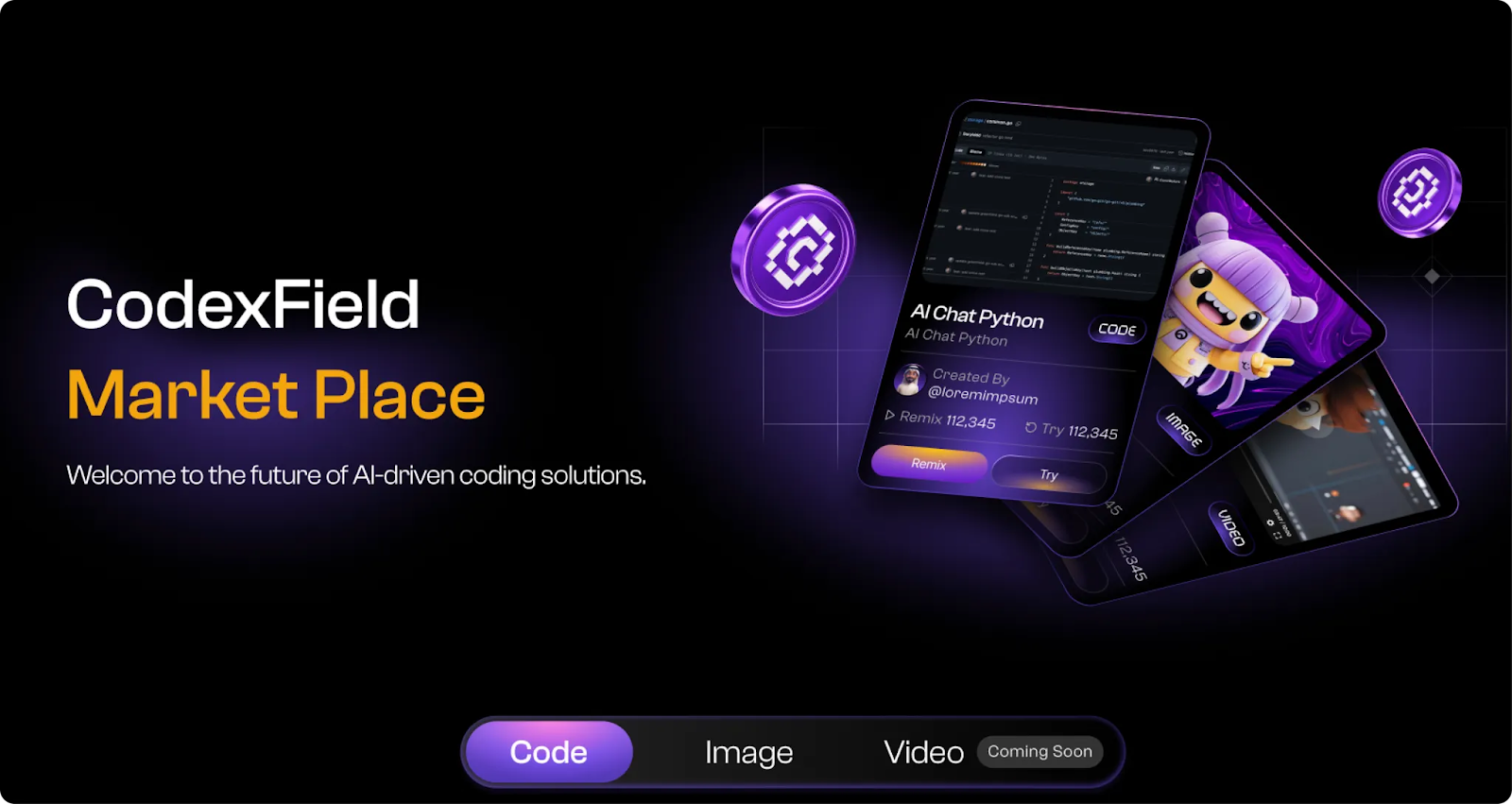
AI Playground: The main engine for on-chain AI creation and application building
AI Playground is CodexField's core workbench for creators, covering the entire creation process from content generation to application building. It integrates model invocation, multimodal generation, application assembly, and logic orchestration into a single interface, enabling users to create, test, and iterate AI applications directly in their browsers without the need for local environments or cumbersome deployments.
In Playground, users can generate text, images, and multimodal content using various models, and further build applications with interactive logic using App Builder, combining plugins, tools, and external APIs into a more complete functional structure. For the expansion or re-creation of existing content, Playground supports remixing based on the work, allowing collaboration and iteration to occur naturally.
To ensure that content has a manageable, traceable, and circulating structure on the blockchain, Playground's design encompasses the entire path from generation and building to storage, publishing, and incentives. Its model invocation layer provides standardized generation capabilities, uniformly managing Prompt templates and model parameters; the application building layer allows creators to easily combine models and tools through a modular interface to generate runnable applications; and the logic orchestration layer allows users to configure parameters, manage state, and visually build Agent workflows, laying the foundation for subsequent on-chain calls and automated execution.
All creation and building activities completed in Playground are recorded on-chain via Gitd. Every modification, expansion, or refactoring generates a clear version record, giving content an on-chain identity from its inception and a verifiable evolutionary trajectory. This provides a solid technical foundation for subsequent collaboration, authorization, and value distribution.
Once created, the work can be published directly on the Marketplace and displayed, invoked, or licensed for use as an application, plugin, or model logic. The Marketplace also supports pulling published content back to the Playground for further modifications, realizing a cyclical structure from creation to distribution and back to creation.
Creation and usage behaviors are ultimately incorporated into the Quest & Rank incentive system. The number of times the application is called, the dissemination path of secondary creations, and the actual contributions of users can all be tracked on the blockchain and reflected in the incentive system, thus forming a shared revenue network centered around content.
Therefore, we see that in the overall structure of CodexField, AI Playground plays a central role in the content ecosystem. Almost all assets that will enter the Marketplace in the future, whether they are AI applications, refined versions of models, plugin logic, or Prompt suites and scripts, will have their initial generation and construction completed in Playground.
At this layer, creations cannot be organized, combined, and transformed into manageable structured units, thus laying the foundation for subsequent on-chain circulation. As content gradually becomes standardized, Playground also becomes a prerequisite for assets to enter the Marketplace, enabling display, licensing, and trading to occur smoothly under a unified format.
At the same time, Playground is also a key driver of the entire collaboration system. Through close integration with Gitd, Remix and derivative works form a verifiable on-chain collaboration network, enabling a transparent evolutionary path for the collaborative creation process involving multiple participants. The generation of creations, the accumulation of versions, the release and circulation of works, and the incentive system's feedback on use and dissemination ultimately constitute a continuously cyclical growth chain.
CodexField: The Growth Engine of the Content Economy
In an era where AI creation is moving from "content generation" to "application generation" and "logic orchestration," Playground's value lies not only in providing a visual building tool but also in bringing continuous vitality to creation. It prevents generated content from becoming a composable, callable, and reusable structured asset, ensuring that every AI-generated content possesses application-level value. This facilitates the natural transformation of content from creation to assetization, truly integrating AI with on-chain collaboration and opening up space for the large-scale expansion of the content ecosystem.
As the system continues to improve, Playground will become the starting point for CodexField's global growth: content is born here, acquires on-chain identity through Gitd, enters circulation through the Marketplace, and receives value feedback through the Quest & Rank incentive mechanism, forming a complete asset cycle.
With the deep integration of models, multimodal generation, and on-chain contracts, Playground will gradually evolve into the standard form of the next-generation on-chain creation platform. This is also one of the core driving forces for the future expansion of the CodexField ecosystem.