Bob Hathaway's 13F filing, released on the 14th, revealed that the company purchased 17.85 million shares of Alphabet for the first time, worth approximately $4.3 billion, and downgraded its Apple holdings for the third consecutive quarter, selling another 41.8 million shares in the quarter.
This move suggests that Buffett may have a new perspective on tech stocks: while Alphabet, driven by cloud computing and AI, is on the forefront, Apple, with its slowing iPhone cycle and sluggish progress in AI, is being continuously sold off. (Buffett has always been cautious about startups and the tech industry because these companies have high price-to-earnings ratios and unpredictable business prospects.)
$4.3 billion bet: Alphabet becomes a core shareholder.
According to 13F data, Alphabet has now directly entered Berkshire Hathaway's top ten U.S. stock holdings.
Alphabet's stock price has risen 45.4% this year, driven by the recovery of its cloud business and search advertising fueled by AI demand. Berkshire Hathaway's large-scale investment is seen by the market as a testament to Alphabet's competitive advantages: over 90% market share in search engines, the cash flow from YouTube's video advertising, and the technological depth of its self-developed TPU chips and Gemini large-scale language models.
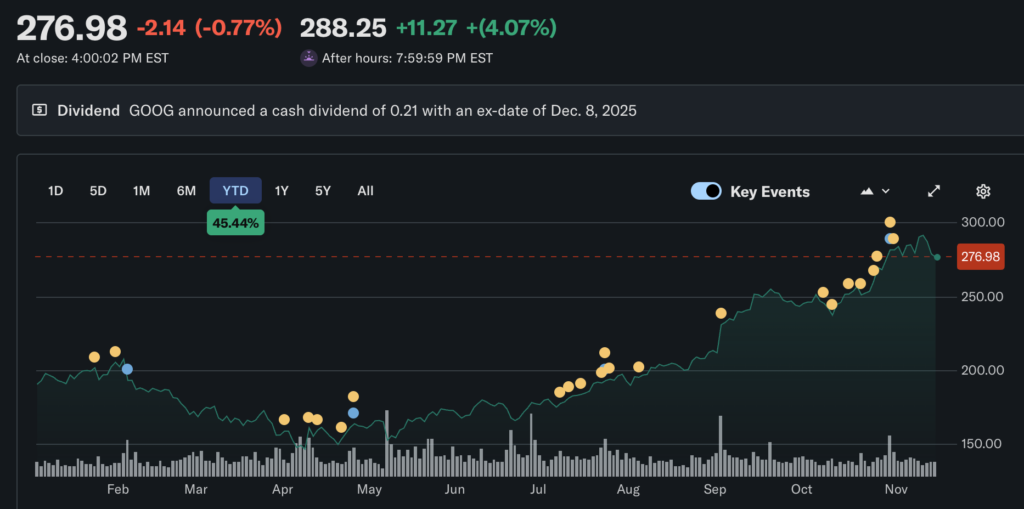
From Regret to Entering the Market: Price and Value After Six Years of Waiting
Back in the 2019 shareholders meeting, Buffett mentioned missing out on the Google investment opportunity, describing it as "a frustrating thing," but it seems he hasn't waited for the right time to enter the market for many years.
"Back then, we used Google services but never thought of buying its stock; that's one of the few decisions I truly regret."
We know that Berkshire Hathaway has seen net stock sales and record-high cash levels over the past year, but this latest move is noteworthy. It's widely believed that investment managers Todd Combs and Ted Weschler, with their expertise in the technology sector, played key roles, reflecting a shift in Berkshire's decision-making mechanism from a single driving force to a dual-core era. (Warren Buffett is set to step down from Berkshire's day-to-day operations by the end of this year.)
Portfolio thinking of reducing Apple holdings
On the other hand, Apple remains Berkshire Hathaway's largest holding, but its weighting once approached 40% of the portfolio.
However, the concentrated risks, coupled with slowing iPhone growth and a long-term valuation above 30 times earnings, led Berkshire Hathaway to choose to "continue to reduce its holdings." Apple relies on hardware update cycles, while Alphabet steadily amplifies cash flow through cloud subscriptions and advertising algorithms. The difference in their operating rhythms became the core basis for Berkshire Hathaway's portfolio adjustments.
Looking to the Future: The Next Page of Berkshire Hathaway Value Investing
This portfolio restructuring demonstrates that value investing is not detached from technology, but rather waits for the right moment when valuation and competitive advantages converge. As AI moves from concept to cash flow, Alphabet's strong corporate infrastructure has gained recognition from traditional value investors.