


- ETF outflows reflect institutional repositioning toward bonds and gold, but stablecoin supply growth shows crypto-native capital is still waiting, not exiting the market entirely.
- Current inflows remain small and exploratory, signaling hesitation rather than conviction; until stronger ETF recovery emerges, volatility and sideways movement remain likely.
- The market structure resembles a deep bull-cycle reset rather than a collapse, with Ethereum ETF inflow momentum likely becoming the key confirmation signal for trend reversal.
ETF outflows triggered the recent Bitcoin pullback, but rising stablecoin liquidity signals the market is still in a mid-cycle correction—not a new bear market.

Read More:
Maybe the Market Isn’t in a Bear Phase Yet
Bitcoin Rises on Fed Cut Expectations: Will the Crypto Rally Hold?
MARKET CONTEXT: A FADING TREND OR JUST A NECESSARY RESET?
Over the past few weeks, anyone tracking the crypto market with even mild attention has likely noticed a clear pattern: weakness. Charts softened, momentum faded, and sentiment pulled back from euphoria to caution. At first glance, the narrative seems simple—“ETF money is leaving, market goes down.” But when putting today’s signals next to a broader cycle view, the picture becomes far more nuanced.
One of the main triggers behind the current slowdown is undeniably the outflow from spot Bitcoin ETFs. Unlike retail-driven volatility, ETF flow trends come from large allocators—family offices, pension funds, and institutional players who allocate capital across multiple global markets. When Bitcoin briefly touched the $120K range in October and later sold off sharply in early November, the risk-reward balance shifted in the eyes of traditional capital. With safer yields returning in bonds and gold regaining narrative dominance, some of that capital simply rotated away.
Yet despite these movements, the market structure isn’t signaling the beginning of a new multi-year bear market. If anything, the behavior more closely mirrors a mid-cycle correction—similar to what happened earlier this year between January and April—rather than the sentiment collapse seen during the true bear cycle of 2021–2023.
ETF POSITIONING: THE MOST IMPORTANT SIGNAL RIGHT NOW
When reviewing ETF behavior, two metrics matter more than anything else:
- Total ETF BTC holdings (structural capital)
- Daily net inflows/outflows (short-term sentiment)
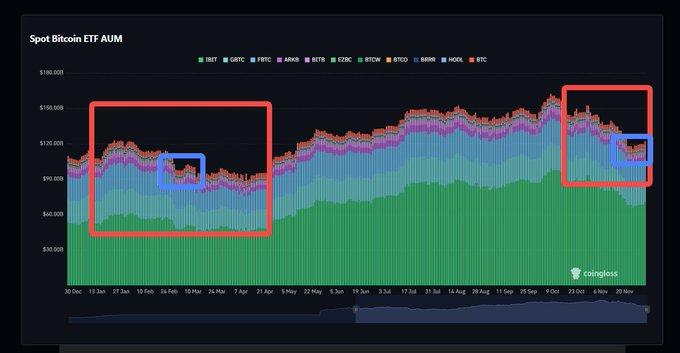
Looking at the bigger picture, the first indicator shows a noticeable decline in total holdings toward the right side of the dataset. This shift is meaningful because ETF capital behaves differently from short-term stablecoin liquidity. When an institution buys Bitcoin through an ETF—especially asset managers like BlackRock—that position is typically stored in custody and functionally removed from circulating supply. These purchases behave like long-term structural demand, effectively pushing up Bitcoin’s price floor over time.
Stablecoin buyers, in contrast, are often exchanges, market makers, or crypto-native funds. Their capital sits on-chain waiting for conditions to improve. They rotate, observe, and act opportunistically—but they rarely wipe exposure completely. That’s why the stablecoin market cap has been steadily growing while ETF allocations softened.
Interestingly, by comparing the recent decline in ETF holdings with earlier market behavior, a familiar rhythm emerges. In the circled regions—December 2024’s decline and the January–April pullback—the pattern looks almost identical: first a sharp correction, then a period of slower stabilization.
What’s even more notable is that the earlier correction lasted around four months, while the current one has only been unfolding for roughly one month. So even though inflow momentum has turned mildly positive again since November 25, it still looks like the early stage of re-accumulation rather than the final reversal.
NET INFLOWS: A SIGNAL TO WATCH, NOT CELEBRATE YET
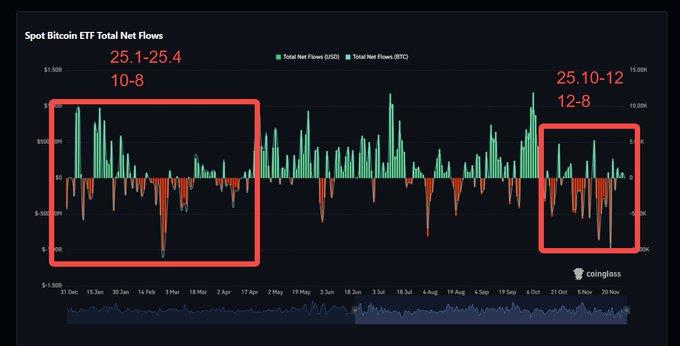
The second ETF metric—the daily net inflow/outflow line—offers the shorter-term tactical view. And here, too, the shift is subtle but important. Since November 25, inflows have once again turned slightly positive. However, they remain small in size and inconsistent in strength. Historically, before large trend reversals, ETF inflows not only return—they accelerate dramatically.
Right now, the market isn’t seeing that acceleration. Instead, what’s appearing looks more like institutional “testing the water,” similar to how smart money behaves near structural price inflection points. And just like last cycle, even after inflows turned positive, Bitcoin still experienced multiple additional pullbacks before the next leg of the bull market resumed.
So while the direction is improving, conviction is still missing.
STABLECOIN LIQUIDITY: A PARALLEL INDICATOR MAKING THE CASE
On the other side of the market, stablecoin supply has slowly continued rising. That matters, because stablecoins represent idle crypto purchasing power—capital waiting on-chain for signals rather than leaving the ecosystem. This type of capital behaves differently from ETF allocations. It does not need traditional compliance cycles or board approvals, and it rarely moves based on macro asset rotations like bonds or gold.
Instead, it’s patient capital.
And the slow but steady uptick in stablecoins suggests that crypto-native investors aren’t leaving—they’re watching, waiting, and preparing.
This is one of the clearest reasons why the current structure doesn’t resemble a full-scale market breakdown. In a true bear market, capital doesn’t sit in stablecoins—it exits the ecosystem entirely.
WHAT THIS MEANS FOR THE CYCLE
Bringing these insights together, the market is not signaling the start of a new long-term bear phase. Instead, it appears to be undergoing:
A mid-cycle correction + valuation reset.
It has many of the same characteristics as the early-2025 retracement:
- Fear instead of euphoria
- Reduced ETF exposure
- Stablecoin accumulation
- Sideways movement after a sharp correction
The market is still searching for direction, but early signs suggest that this phase is closer to consolidation than collapse.
WHAT NEEDS TO HAPPEN NEXT
To confirm a market recovery, one final signal must appear—and it’s not Bitcoin.
It’s Ethereum ETF flows.
If Ethereum begins showing consistent 10+ consecutive days of inflows averaging $1B or more per day, that would indicate conviction returning—not just curiosity. That would mark the transition from hesitation to commitment and would likely confirm the end of the retracement.
Until then, the most reasonable expectation is continued volatility, further testing of support, and a gradual build-up toward the next decisive move.
FINAL VIEW
Despite the uncertainty, the current structure points toward continuation—not reversal. The cycle is not ending; it’s recalibrating. Traditional capital is cautious and rotating, crypto-native capital is waiting, and the market is approaching a point where hesitation must give way to direction.
In other words:
This isn’t the beginning of a bear market.
It’s the part of a bull market where only conviction stays awake—and everyone else waits for proof.
〈Bitcoin Faces ETF Selling Pressure, But It’s Not a Bear Market〉這篇文章最早發佈於《CoinRank》。




