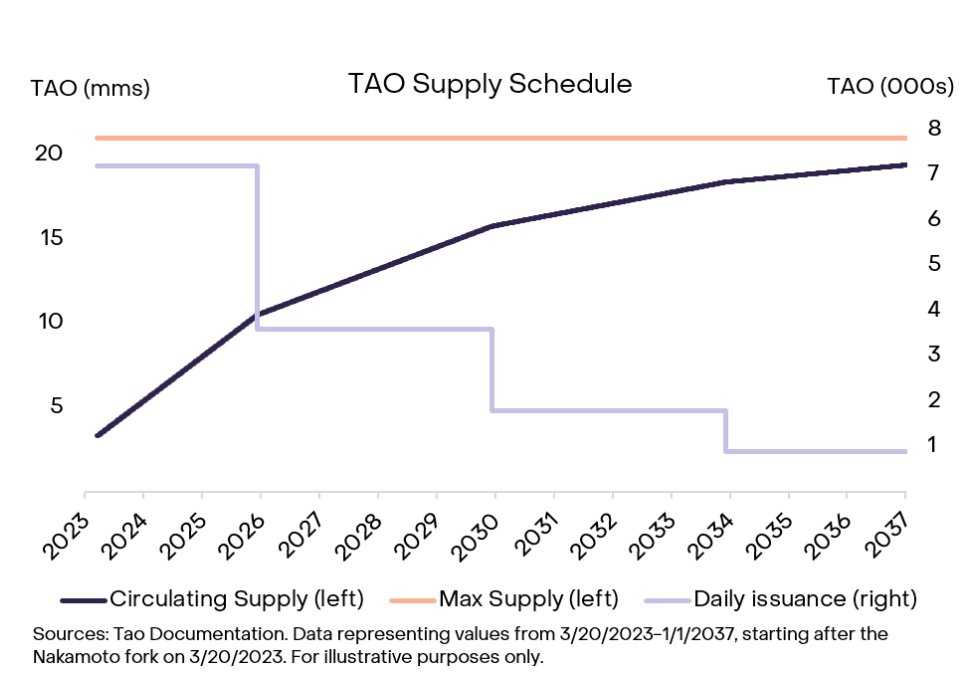
Decentralized AI network Bittensor (TAO) announced that it will begin its first halving as early as December 14, reducing daily new production from 7,200 to 3,600 coins. This comes as the Trump administration eases crypto regulations and Wall Street and Silicon Valley seek the next high-growth sector. A Grayscale report even described this supply cliff as the AI version of the "Bitcoin moment."
Halving Mechanism: The Watershed Among 21 Million Coins
Bittensor's halving isn't written on a calendar, but rather in the program's code. When the total supply reaches 10.5 million (half the maximum), the block reward will automatically be halved, thus entering a long-term deflationary cycle. Grayscale Research analyst William Ogden Moore described this moment as follows:
"This is a milestone in the maturity of the network, just like the key milestone of Bitcoin confirming the 21 million hard cap."
More importantly, official data shows that as much as 81% of TAO has been staked, leaving a very small circulating supply. If the daily supply were to drop by 50% instantly, the available tokens in the market would inevitably become even tighter. Such supply shocks are often a prelude to asset repricing, leading outsiders to bet that TAO may replicate Bitcoin's early scarcity narrative.
129 subnets: an incubator for decentralized AI
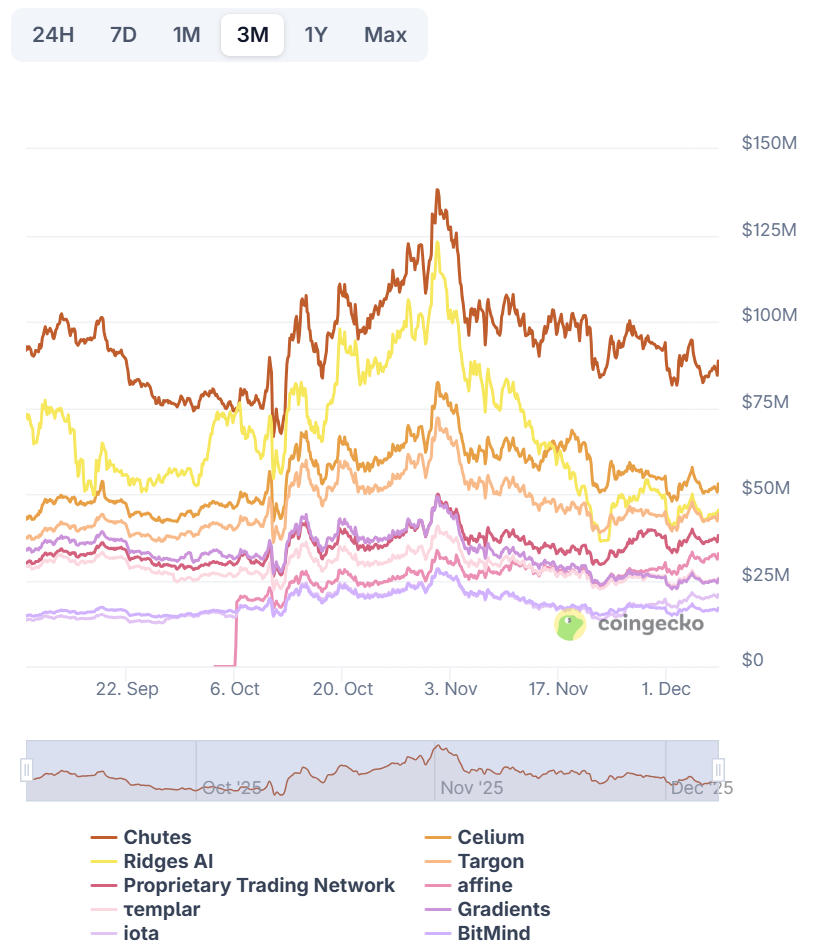
If Bitcoin is like digital gold, then Bittensor is like the "Y Combinator of decentralized AI." In just one year, the number of subnets has surged from over 50 to approximately 129, with a combined market capitalization approaching $3 billion. Each subnet is like an independent startup: Chutes specializes in serverless computing, while Ridges focuses on AI agent development. As the halving compresses the reward pool, competition between subnets will become more intense, weeding out ineffective models and shifting token incentives from speculation to real-world utility.
Institutional Funds: From Waiting to Entering the Market
Taking advantage of the Trump administration's accommodative policy environment, institutional activity has accelerated significantly. Polychain Capital and DCG have collectively invested over $350 million in TAO, with publicly traded company Oblong also following suit with a strategic investment. Meanwhile, the launch of TAO ETPs and Grayscale trust products in Europe has provided a compliance pathway, leading to a surge in inquiries from early adopters such as banks, insurance companies, and family offices. Market analysts believe that potential passive buying will gradually materialize after the halving.
The number of parameters in large-scale global models has exceeded 10 trillion, and computing power is seen as the new oil; while the scarce supply of TAO is like gold being forged. The halving reduces token "inflation" and also symbolizes an off-the-ground validation of the concept of tokenizing machine learning itself. For investors, Bittensor offers a long-term bet on "computing power as currency." As the rate of token dilution halve after December 14th, the market will use real money to measure whether decentralized AI can, like Bitcoin, multiply scarcity and utility.
The halving block height is still approaching, but the psychological effect of the countdown is already evident. Regardless of market fluctuations, at least two things are confirmed at this moment: AI computing power has become a tradable and configurable asset, and Bittensor has chosen to use a Bitcoin-style scarcity mechanism to set the record straight. As the supply gates are about to tighten, the next chapter of decentralized AI may be unveiled after the halving.