"Google just reduced the daily request limit for the free Gemini API from 250 to 20, and my n8n automation scripts are basically unusable now. This is a blow to anyone developing small projects," commented user Nilvarcus.
Recently, some netizens revealed that Google has tightened the restrictions on the free tiers of the Gemini API: the Pro series has been canceled, and the Flash series is limited to only 20 uses per day. This is far from enough for developers.
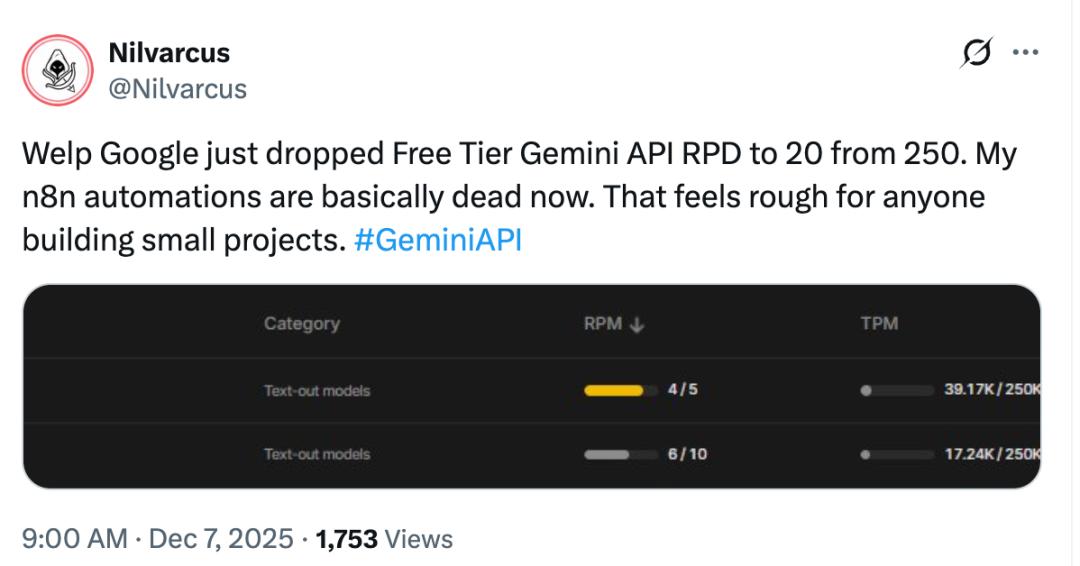
Some netizens also discovered that Google has removed the Gemini free API from its "Bulk API Rate Limits" list. "It's completely over."

In the fierce competition for large-scale models, Google has also used free and low-cost policies to attract users. For example, in January of this year, Google launched the Gemini 1.5 Flash free package for the Gemini API, providing developers with up to 1.5 billion free tokens per day. This free package includes 15 requests per minute, 1 million tokens per minute, and access to 1,500 requests per day. In addition, developers can also enjoy free context caching services, storing up to 1 million tokens per hour. Fine-tuning features are also completely free.
Besides the significant price reduction, what angered some developers was that the policy was implemented without any prior notice.
“I’ve always believed there’s no such thing as a free lunch. But Google’s approach this time is really unacceptable. Even though my system and use cases were experimental, it’s still very disheartening to see everything suddenly shut down without warning. Couldn’t they have said something like, ‘By the way, with the new model going live, we’ll be canceling developers’ free API call quotas in two weeks,’ when they released Gemini 3? A responsible and trustworthy company should have done that,” one developer said.
"Yes, Google has already collected enough data to be ahead of its competitors, so they are shifting their strategy and pushing for monetization. We all know the free plan was too generous at the beginning, but we paid for it with our own data and helped them train the model." One developer said, "AI little benefactor, the public domain fans are all gone, now it's time to pay for conversions."
This week may see another showdown with OpenAI.
Recently, Google gained a large number of users with Gemini 3. Furthermore, according to data from the Financial Times, by the end of 2025, the average time users spend on Gemini on desktop and mobile web will reach approximately 7.2 minutes, surpassing ChatGPT's approximately 6 minutes for the first time, and slightly exceeding Anthropic Claude's approximately 6 minutes.
But the fierce battle for large-scale models continues. OpenAI is reportedly planning its first response to Google's Gemini 3 with the upcoming GPT-5.2. Originally scheduled for release at the end of December, GPT-5.2 is expected to be released earlier, on December 9th. Benchmark results for GPT-5.2 have already circulated online. If these data are ultimately confirmed, the competitive advantage will once again be in OpenAI's hands.

Just as rumors of GPT-5.2's release were circulating online, netizens discovered that Gemini 3 Flash had already landed on LM Arena, with some even claiming that "Gemini 3 Flash seems to be Google's product to compete with GPT 5.2."
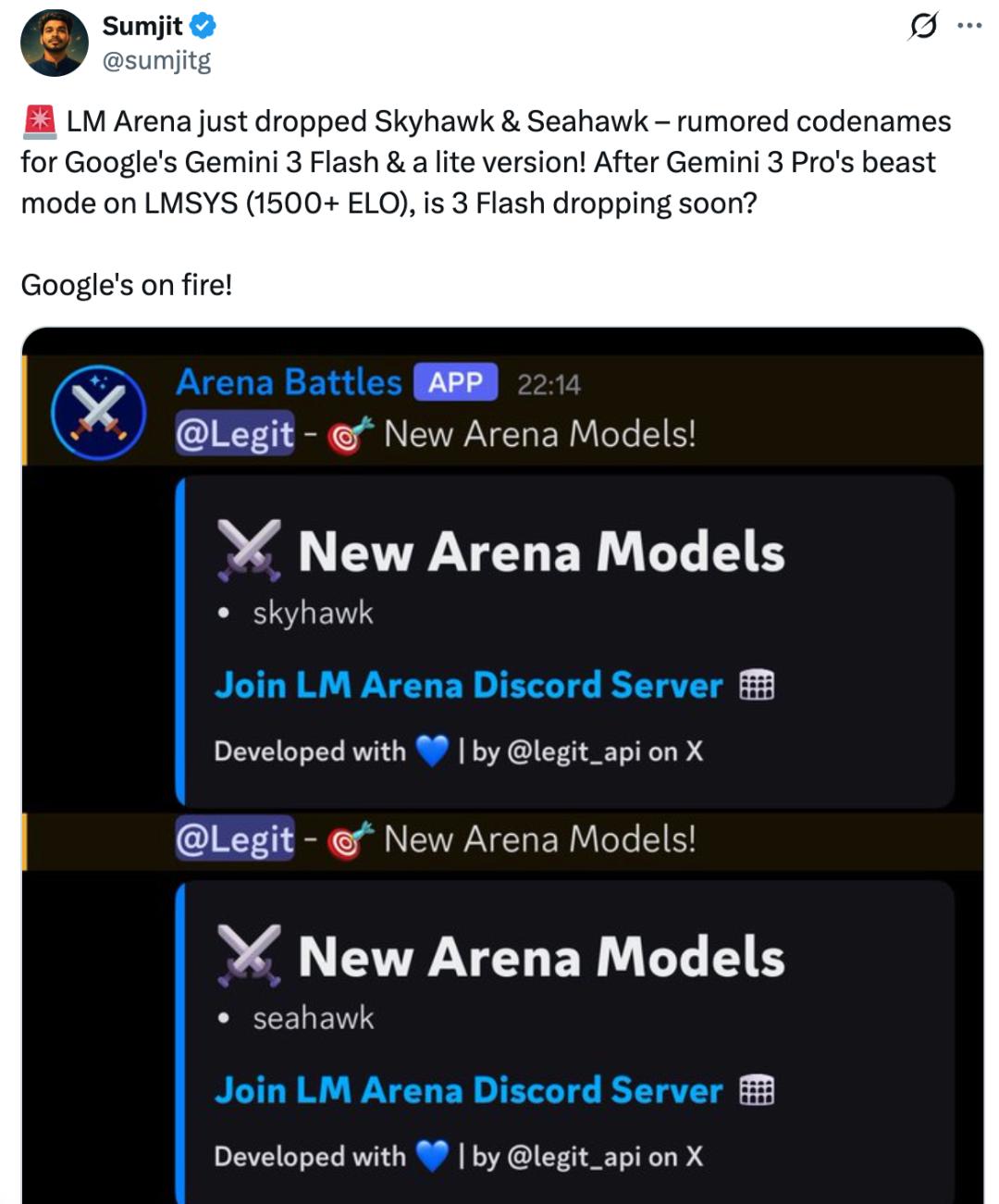
This has excited netizens: "This is fantastic! OpenAI and Google have successfully coordinated their offensive and defensive strategies. The Nano Banana Pro and Gemini 3 Flash are Google's backup plans to counter OpenAI's GPT-5.2 release this week."
“There may indeed be a bubble in some parts of the AI industry, such as the ridiculously high seed funding rounds, but I believe more than anyone that AI is the most transformative technology, and these investments are worthwhile in the long run. My job is that DeepMind and Google must remain at the top, regardless of whether the bubble bursts or not,” said Demis Hassabis, co-founder and CEO of Google DeepMind, at an Axios event, demonstrating his determination to compete head-on with OpenAI.
Google is satisfied with the performance of the Gemini 3.
In this competition, Google, which had a poor start, won a point with the Gemini 3.
“We are very happy with Gemini 3’s personality, style, and capabilities. I like how concise its responses are, and how it will refute you when necessary, rather than just agreeing with everything. If your point of view is not quite reasonable, it will gently push it back. I think people can feel that this is a leap in intelligence, and therefore more useful,” Hassabis said.
This inevitably brings to mind OpenAI's previous rollback of GPT-4o due to ChatGPT's overly sycophantic approach. It's clear that Google deliberately avoided this issue.
Hassabis enjoys seeing users experimenting with the Gemini 3. " Once you release a new technology, millions, even billions of users will immediately adopt it. We are constantly amazed by the cool uses that users quickly invent. That's why we love this era where research and products are so closely integrated."
His personal favorite feature is that Gemini 3 can complete game production "in one go".
"Going back to the early days of my work on game AI, I think we are now very close to being able to create commercial-grade games with models in hours, which used to take years. This demonstrates the incredible depth and capability of models: they can understand very high-level instructions and generate very detailed outputs. Another particularly strong area of Gemini 3 is front-end development and web development; it is excellent in aesthetics, creativity, and technology."
“It’s the same with all models. The pace of innovation is so fast that we spend so much time building new versions that we don’t have time to explore even a tenth of the capabilities of the existing models,” Hassabis said. “Every time we release a new version, I have this feeling that I haven’t even had time to explore a tenth of the existing system before I have to immediately jump into the development of the next generation and ensure security, reliability, and so on. So it’s actually the users who use them more deeply than we do internally.”
Pushing the Scaling Law to its extreme
Regarding the sudden restriction on the free Gemini API, some netizens expressed doubts, saying, "Is it because the computing power is insufficient? I've been playing with Nano Banana Pro in AI Studio for the past few days, and the speed has been very slow since the day before yesterday, taking forever to get a single image." Others guessed, "A new model was released, but the old model wasn't downloaded, so the memory is tight."
While the exact reason remains unknown, as Hassabis stated, Google will always need computing power: "We at Google, at DeepMind, certainly have a lot of resources, but they are not unlimited. We will always need more computing power, no matter how much we have now. The reason we are able to conduct such extensive research is because we have these resources."
He still advocates for the Scaling Law. When asked whether AGI could be achieved solely through improvements to large models and generative AI, Hassabis said, "We have to push the current system to its limits, and it will at least become a key component of AGI. It's also possible that scaling alone will be enough, but I suspect that looking back, we'll find that we still need one or two breakthroughs similar to Transformer or AlphaZero."
Hassabis believes it will take about five to ten years to reach AGI, but he has very high standards for AGI: it must possess all human cognitive abilities, including creativity and invention.
He explained that current LLMs are like PhDs or Olympiad champions in some aspects, but remain weak in others, such as consistency, continuous learning, long-term planning, and complex reasoning. They are sawtooth intelligence. They will eventually acquire these abilities, but it may require one or two major breakthroughs.
Hassabis recalled that during 2017 and 2018, Google had many projects: its own language model, Chinchilla, and the internally used Sparrow. The team was also the first to discover some scaling rules, namely the Chinchilla Scaling Law. There were also other directions: such as AlphaZero based on AlphaGo, pure reinforcement learning systems, and architectures inspired by cognitive science and neuroscience. "At that time, we were not sure which path would lead to AGI the fastest and safest. My task was to build AGI."
“I’m actually very pragmatic about the path: it has to work. When we see that scaling up really starts to work, we continue to put more resources into that branch of research and development,” Hassabis said. “That’s the beauty of the scientific method. If you’re a true scientist, you can’t dogmatically stick to your own ideas; you have to follow empirical evidence.”
Advantages of being a scientist
As a scientist, Hassabis's default approach to all problems is the scientific method. He believes that the scientific method is perhaps one of the most important ideas in human history, as it gave birth to the Enlightenment, modern science, and shaped modern civilization. The experimental spirit, hypothesis updating, and evidence-driven nature of the scientific method constitute an extremely powerful way of thinking, and it applies not only to science but also to daily life and even business.
“We are in what may be the most intense competition in the history of science and technology, but we stand out because of our rigor and precision, and scientific methodology is at the heart of our work. We combine cutting-edge research, cutting-edge engineering, and cutting-edge infrastructure, and in the forefront of AI, you have to have all three. I think there are very few institutions that have world-class capabilities in all three areas, and we are one of them,” Hassabis said. “I have always pushed it to the limit, and I think that is our strength as a research institution and engineering team.”
Regarding the competition for AI talent, Hassabis bluntly stated, "It's been really crazy lately, like some of Meta's practices." However, he indicated that Google is looking for "mission-driven" individuals. "DeepMind has the best mission, the full-stack capabilities, and if you want to do the most impactful work, this is the best place. The best scientists and engineers want to be involved in cutting-edge systems, which in turn attracts even more top talent."
Google's three main directions for the future
As one of the world's leading AI giants, Google's focus is worth paying close attention to in the industry.
According to Hassabis, Google is working on three directions.
First, there's modality fusion. Gemini has been a multimodal model from the start, capable of receiving images, videos, text, and audio, and is increasingly able to generate content across these modalities. Google is seeing cross-modal synergy. One example is the latest image model, Nano Banana Pro, which demonstrates amazing visual understanding capabilities, generating highly accurate infographics. Hassabis believes that in the coming year, we will see very interesting combinations of capabilities in video and language model fusion.
Among the technologies that Google is developing and has already deployed, Hassabis believes that what is amazing and underappreciated is the multimodal understanding capabilities of these models, especially their multimodal processing capabilities for video, images, and audio, with particular emphasis on video processing.
“If you let Gemini work on a YouTube video, you can ask it all sorts of questions, and its conceptual understanding of the video content often amazes me. While it doesn’t always understand perfectly, most of the time its performance is impressive.”
Hassabis cited his favorite movie, *Fight Club*, as an example, noting a scene where someone removes their ring before a fight. He once asked Gemini about the meaning of this gesture, and Gemini offered a very interesting philosophical interpretation: the gesture symbolizes detachment from daily life, demonstrating an attitude of letting go of worldly constraints. "This deep metacognitive insight is one of the powerful capabilities these systems possess today."
Additionally, Google has a feature called Gemini Live, which allows you to point your phone at an object, such as telling your phone "you are a mechanic," and it can handle the relevant tasks in front of you. Ideally, this feature should be applied to devices like glasses, freeing up your hands. However, Hassabis believes that people haven't fully realized the power of this multimodal capability yet.
Secondly, there's the world model, which Hassabis is personally driving. "We have a system called Genie 3, which is an interactive video model. You can generate a video and then enter it like stepping into a game or simulation world, and it can maintain continuity for about a minute, which is very exciting."
Finally, there's the intelligent agent system. Hassabis points out that current agents are not reliable enough to complete all tasks, but significant progress is expected in the coming year.
“We have a vision called ‘universal assistant,’ and we hope that Gemini will eventually become that. You’ll see it in more devices in the coming year,” Hassabis said. By ‘universal,’ he means not just computers, laptops, or phones, but also glasses or other devices.
"We want to create an assistant that helps you every day, that you consult multiple times a day, that becomes a part of your life, improves your work efficiency, and enhances your personal life, such as recommending books, movies, or activities you enjoy. However, the current agent doesn't allow you to fully delegate a complete task to it and be confident that it will reliably complete it. But I think in a year we will see an agent that comes close to doing that."
Hassabis also mentioned that as agents become stronger and more autonomous, they will become more useful, so various industries will inevitably build upon them. However, the more autonomous they are, the more likely they are to deviate from your original instructions or goals. Therefore, ensuring that continuously learning systems remain within the boundaries you set is a very active area of research.
He stated that the good news is that AI now possesses enormous commercial value. If you, as a model provider, sell agents to companies, those companies will demand guarantees of reliability, data processing, and customer behavior. If something goes wrong, it won't be "extinct," but you'll certainly lose business. Companies will choose more responsible suppliers with stronger guarantees. Therefore, capitalism itself incentivizes more responsible behavior to some extent. Of course, if things aren't done properly, it's possible to go against the grain. The probability isn't zero, and that's one of the biggest uncertainties. Since the probability isn't zero, it must be taken seriously, and resources must be invested to mitigate it.
In addition, Hassabis mentioned in the interview that in global competition, he believes the US and the West are still ahead, but China is not far behind. The latest DeepSeek and other models are very strong, with very capable teams. "The lead may only be 'months' rather than 'years'."
Hassabis stated that, even after removing the chip factor, the West still holds an advantage in AI algorithm innovation. "Chinese teams are very good at quickly catching up with the most advanced methods, but we haven't seen any breakthroughs in proposing entirely new algorithms that surpass the existing frontiers."
Reference link:
https://www.youtube.com/watch?v=tDSDR7QILLg
https://x.com/legit_api/status/1997792538074436066
https://x.com/miantiao_me/status/1997491016467709981?s=46
This article is from the WeChat public account "AI Frontline" , compiled by Chu Xingjuan, and published with authorization from 36Kr.