


“I did NOT build a new financial system. I built a casino.” This blunt admission from Ken Chan, former co-founder of the Derivative protocol Aevo, has resonated across Asian cryptocurrency communities this week.
What began as a single X-rated post has now transcended language boundaries, beingintroduced to the Chinese community by local media and widely Chia among Korean merchants , accumulating millions of XEM in the process.
From Ayn Rand to Disillusionment: A Liberal's Journey Through Cryptocurrency
Chan's confession is not merely a critique – it's the illumination of a personal ideology. He describes himself as a "liberal with starry eyes" who donated to Gary Johnson's 2016 presidential campaign after being radicalized by Ayn Rand's novels. Bitcoin's cypherpunk nature speaks directly to this worldview. "The possibility of walking across the border with a billion dollars in my head is, and will always be, a powerful idea to me," he writes.
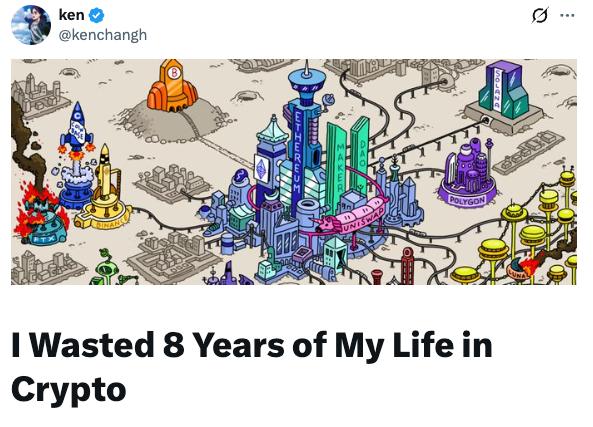
However, eight years of industry experience had eroded that idealism. Chan recounted how Layer 1 wars – the influx of Capital into Aptos, Sui, Sei, ICP , and countless others – failed to produce meaningful progress toward a new financial system. Instead, it “literally burned people’s money” in pursuit of becoming the next Solana . His verdict was unforgiving: “We don’t need to build a casino on Mars.”
According to his LinkedIn profile, Chan left Aevo in May of this year. His personal website states that he is currently working on KENSAT, a personal satellite project. It is expected to launch on a Falcon 9 in June 2026. His confession comes six months after he left. It appears as the AEVO Token trades at around $45 million in fully diluted market Capital — a drop of approximately 99% from its peak.
The "casino" metaphor lands in the context of a drying market.
Chan's central metaphor – that cryptocurrency has become “the biggest 24/7, multiplayer online casino our generation has ever created” – transcends technical complexity with visual clarity.
Time amplified the message. Following the market turmoil and Dai volatility of October, participants across the region were grappling with fatigue. Chinese media suggested the spread of the virus reflected “collective anxiety amid a liquidation drought and narrative vacuum.”
The responses in Chinese were Chia . Some strongly objected: “Eight years of the same old thing – some reach the top, others leave the stage. Wasting time is your own problem.” Others went further than Chan himself, with one commenter writing: “The entire cryptocurrency circle is stupid, without exception. After more than a decade, what blockchain product has an average person actually used?”
South Korea's reaction echoed a similar sense of exhaustion. “Aside from stablecoins, there are no real use cases,” one trader noted. Another was more blunt: “At the Dip of the cryptocurrency landscape, nobody is creating new value for society – only scammers are scrambling to siphon money from retail investors.”
Concerns arise as a generation finds its voice across borders.
Perhaps most striking is Chan's warning that “the toxic mentality of the industry will lead to a long-term collapse of social mobility for the younger generation.” This concern resonates deeply in East Asian societies. Traditional paths to wealth – real estate, stable employment – are becoming increasingly inaccessible. Cryptocurrency promises an alternative; Chan argues it may be accelerating the problem.
Korean analyst KKD Whale offered a parallel reflection without directly addressing Chan's post. “The era of standing alone with only one core skill is passing,” he wrote, recalling a talented colleague who could compress eight hours of work into one hour but never bothered to deepen his expertise. That skill became obsolete; that person continued.
While Chan questions what the industry has built, KKD Whale questions what individuals have accumulated within it. Both arrive at the same worrying destination.
Chan concluded with a quote from CMS Holdings: “Do you want to make money, or do you want to be right?” His answer: “This time I chose right.”
Six months after leaving the project he built, and with AEVO trading at a fraction of its former value, the question remains: Was this the clarity of hindsight, or the convenience of withdrawing? The trajectory of his confession reveals how many others are asking themselves the same question.




