Shaw, Jinse Finance
On December 11, the Federal Reserve ended the year with an interest rate cut, lowering the benchmark interest rate by 25 basis points to 3.50%-3.75% , marking the third consecutive rate cut at its meeting. This was in line with market expectations, bringing the total rate cuts for the year to 75 basis points. While the FOMC statement followed a standard pace of rate cuts, it revealed the biggest division among voting policymakers in six years, suggesting a slower pace of action next year and a possible inaction in the near term. Following the announcement, Fed Chairman Powell's press conference was more dovish than expected. After the Fed's decision, major global markets reacted differently: US stocks, short-term US Treasury bonds, and gold rose during the session, the dollar fell, and Bitcoin fluctuated, briefly rising to $94,500 before significantly retreating .
The Federal Reserve ended the year with a 25 basis point rate cut, but why are internal divisions still intensifying? The dot plot and Powell's press conference were more dovish than the market expected; what are the reasons behind this, and how should we interpret them? Where will the market go next?
I. The Federal Reserve concludes its year-end rate cuts; whether this trend will continue next year remains uncertain.
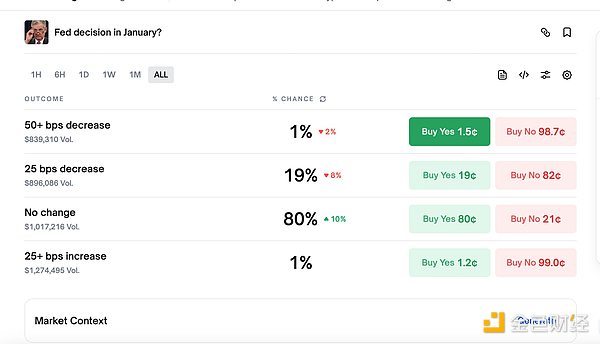
Early this morning, the Federal Reserve announced its final interest rate decision of the year, lowering the benchmark interest rate by 25 basis points to 3.50%-3.75%, marking the third consecutive rate cut and meeting market expectations. This brings the total rate cuts this year to 75 basis points. The subsequent FOMC statement revealed that the Fed's rate decision was rejected by all three votes for the first time since 2019 , exposing the biggest division among policymakers in six years and suggesting a slower pace of action next year, with no action likely in the near term. US interest rate futures indicate a 78% probability of the Fed pausing rate cuts at its January meeting, compared to 70% before the FOMC decision. The latest CME FedWatch tool shows a 22.1% probability of a 25 basis point rate cut in January and a 77.9% probability of keeping rates unchanged . By March, the probability of a cumulative 25 basis point rate cut is 40.7%, the probability of keeping rates unchanged is 52%, and the probability of a cumulative 50 basis point rate cut is 7.4%. Polymarket data shows that the market is betting on the Fed's January interest rate decision. Following the announcement of the decision , market expectations for the probability of keeping interest rates unchanged in January have risen to 80%, while the probability of a 25 basis point rate cut has fallen to 19% .
Following the interest rate decision, major global asset markets reacted differently. US stocks hit intraday highs, but near the end of Powell's press conference, the S&P 500's gains narrowed from 1.2% to 0.7%. The two-year US Treasury yield fell 7.5 basis points intraday. Spot gold rose 0.6%, hitting a new daily high and approaching $4239. The US dollar recorded its worst performance in nearly three months . The dollar index closed down 0.4%, its biggest drop since September 16. Bitcoin briefly rose towards $94,500, hitting a new daily high, but subsequently experienced significant volatility and a substantial pullback, briefly falling below $90,000 .
The market had already anticipated a 25 basis point rate cut at the Federal Reserve's final interest rate decision of the year. However, the subsequent FOMC statement and dot plot revealed growing divisions within the Fed, causing some concern about the Fed's future policy path and casting doubt on whether further rate cuts will be possible next year .
II. The FOMC statement highlighted growing divergence, with the dot plot leaning more dovish than expected.
The Federal Reserve's FOMC statement announced that it will begin purchasing Treasury bills on December 12, with a planned purchase of $40 billion over the next 30 days . The statement also announced that it will conduct standing overnight repurchase agreement operations at a rate of 3.75% and standing overnight reverse repurchase agreement operations at an operating rate of 3.50%, with a daily limit of $160 billion per counterparty. By purchasing Treasury bills and, if necessary, other U.S. Treasury securities with a remaining maturity of no more than three years, the FOMC will increase its securities holdings in its open market accounts to maintain adequate levels of reserves. The statement noted that inflation has risen since the beginning of the year and remains at a relatively high level. Uncertainty about the economic outlook remains high, and downside risks to employment have increased in recent months. In assessing the magnitude and timing of any further adjustments to the target range for the federal funds rate, the Committee will carefully evaluate the latest data, the evolving economic outlook, and the balance of risks.
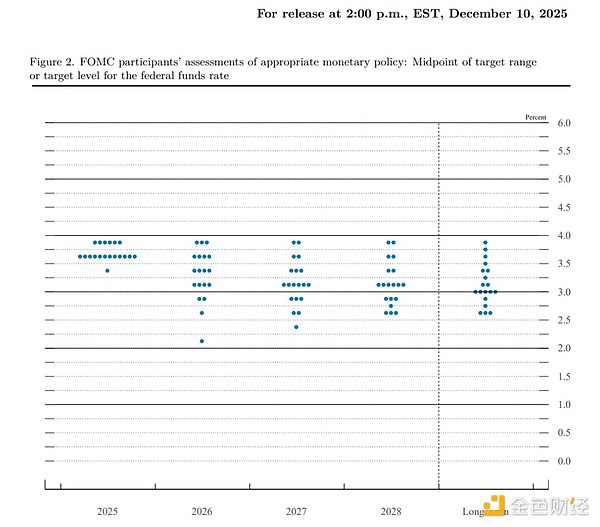
The dot plot released by the Federal Reserve after the meeting showed that among the 19 officials, 7 believed that interest rates should not be cut in 2026, 4 believed that there should be a cumulative rate cut of 25 basis points, 4 believed that there should be a cumulative rate cut of 50 basis points, 2 believed that there should be a cumulative rate cut of 75 basis points, 1 believed that there should be a cumulative rate cut of 100 basis points, and 1 believed that there should be a cumulative rate cut of 150 basis points.
The FOMC statement showed that this was the first time since 2019 that the Federal Reserve's interest rate decision was met with three dissenting votes. Federal Reserve Governor Stephen I. Miran continued to advocate for a 50-basis-point cut in the target range for the federal funds rate at this meeting; Kansas City Fed President Jeffrey Schmid and Chicago Fed President Austan Goolsbee advocated for maintaining the target range unchanged; all other FOMC voting members voted in favor of the Fed's interest rate decision.
This Federal Reserve interest rate decision highlighted the biggest division among its internal voting decision-makers in six years, suggesting a slower pace of action next year, which has further fueled market concerns about the Fed's future policy path.
III. Powell's press conference was more dovish than expected, indicating his intention to fulfill his final duty.
Federal Reserve Chairman Jerome Powell subsequently addressed the rate cut decision and the economic situation at a press conference, answering reporters' questions. Powell stated that current data indicates the outlook remains unchanged. The labor market appears to be gradually cooling, inflation remains high , consumer spending remains robust, and data shows the economy is expanding at a moderate pace. Most long-term inflation expectations are consistent with the 2% target. If tariffs are removed, the inflation rate will be at the lower end of the 2% range. The Fed is committed to achieving its 2% inflation target, but the labor market also faces pressure. Powell noted that the upward revision of the 2026 growth forecast partly reflects the end of the government shutdown; a large amount of data will be available between now and the January FOMC meeting; the baseline expectation is robust economic growth next year. Powell believes that a rate hike is not anyone's baseline expectation at present, and the current policy divergence lies in whether to maintain the current interest rate or cut it.
Powell also stated that there is no risk-free path for policy, and the balance of risks has shifted in recent months. The Fed has been adjusting towards the neutral interest rate, which is currently at the high end of the neutral range, and no decision has yet been made regarding January. He emphasized that the Fed will make decisions at each meeting, and there is no predetermined path for monetary policy ; the scale of Treasury bond purchases is likely to remain high in the coming months. During the Q&A session, Powell stated that he hopes to hand over the job to the next chairman when the economy is in a very good state, with inflation under control and falling back to 2%, and the labor market remaining strong. Regarding his personal future, Powell stated that he has no new plans after his term as Fed chairman ends.
In the final months of his term as Federal Reserve Chairman, Powell attempted a smooth transition. With Trump poised to announce his successor, the influence of the "shadow" Fed chairman is growing, making Powell's remarks at this press conference both expected and a sign of resignation .
IV. How to interpret the Fed's decision
In an article addressing the Federal Reserve's final interest rate decision of the year, Nick Timiraos, a Wall Street Journal reporter and often referred to as the "Federal Reserve mouthpiece," wrote that while Fed officials cut rates for the third consecutive meeting, an unusual division within the Fed suggests a reluctance to continue cutting rates, with officials hinting at a lack of willingness to do so. Recent public comments from Fed officials indicate a deep division within the committee, to the point that the final decision may depend on how Fed Chairman Powell wants to proceed. Powell's term expires next May, meaning he will only chair the next three interest rate-setting meetings. Firm price pressures coupled with a cooling labor market present the Fed with an unpleasant trade-off, a situation unseen for decades. During the so-called "stagflation" of the 1970s, when officials faced a similar dilemma, the Fed's stop-and-go approach allowed high inflation to take hold.
State Street analyst Marvin Loh said the Fed cut rates as expected, but this can only be interpreted as a hawkish move because officials did not change their forecasts for the next two years. He noted, "This will allow rates to slide very slowly toward the theoretical 3% neutral rate. Given the significant upward revision to GDP in the Summary of Economic Projections (SEP), the inclusion of the word 'extent' in the statement to describe the additional policy adjustment suggests that some members of the Federal Open Market Committee are considering the practical necessity of achieving the current 3% long-term 'dot plot' target."
Charles Schwab analyst Richard Flynn stated that by taking preemptive action, the Federal Reserve is signaling caution in the face of rising downside risks, particularly given sluggish global growth and persistent policy uncertainty. For investors, this represents a measured adjustment rather than a dramatic shift. While this rate cut may provide short-term support for risk assets and potentially trigger a seasonal 'Santa Claus rally,' volatility is likely to remain high as markets assess its impact on future policy and the broader economic outlook.
Goldman Sachs analyst Kay Haigh stated that the Federal Reserve has reached the end of its "precautionary rate cut" phase. She believes, "The next responsibility lies in labor market data weakening further to justify additional near-term easing. The 'hard dissent' from voting members and the 'soft dissent' in the 'dot plot' highlight the Fed's hawkish camp, and the reintroduction of language regarding the 'degree and timing' of future policy decisions in the statement is likely intended to reassure them. While this leaves room for future rate cuts, the weakness in the labor market must reach a high threshold."
Informa Global Markets commented on Powell's latest remarks : The so-called "hawkish rate cut" is nothing more than that. Powell pointed out the tension between the Fed's dual mandate, but also acknowledged that there hasn't been much change since the last meeting. His statements were generally similar to previous ones. The most memorable line from the press conference was: "The economy right now doesn't look like an overheated economy that's triggering labor-driven inflation."
Chris Grisanti, chief market strategist at MAI Capital Management in New York, commented on the Federal Reserve's interest rate decision : "The initial reaction was no surprise; rates were lowered as expected. But when you look ahead, you see a lot of uncertainty. As we move from today's rate cuts to 2026, the tailwind effect of these cuts will be less reliable. This could become a problem. Further, with the Fed's revised wording emphasizing the uncertainty surrounding the 'magnitude and timing' of future rate cuts, the Fed is essentially sending a signal to the market: don't take rate cuts for granted. In my view, this means we'll only see more rate cuts if the economy slows significantly. As a stock investor, I hope there won't be any rate cuts in 2026, because that would mean the economy is weakening. I'd rather have a robust economy than more rate cuts."
Analyst Anna Wong stated , “My assessment is that the overall tone of the policy statement and updated projections leans dovish—although there are some underlying hawkish messages. On the dovish side, the Committee significantly raised its growth trajectory while lowering its inflation outlook and keeping the ‘dot plot’ unchanged. The FOMC also announced the commencement of reserve management purchases. On the other hand, one signal in the policy statement suggests that the Committee is inclined to a prolonged pause in rate cuts.” She continued, “Although the ‘dot plot’ shows only one rate cut in 2026—while the market expects two—our view is that the Fed will eventually cut rates by 100 basis points next year. This is because we expect weak job growth and currently see no clear signs of a renewed inflation in the first half of 2026.”
Michael Rosen, chief investment officer at Angeles Investments, said , “This rate cut was expected, so there were no surprises. The 25-basis-point cut, which passed by a vote of 9 to 3, was also anticipated, with Schmid and Goolsby supporting no cut, while Milan wanted a 50-basis-point cut. Again, there were no surprises. The statement highlighted the weakness in the labor market, which was the main reason for the 25-basis-point cut. This detail was picked up by the market, suggesting that the Fed may continue to ease policy, although the expectation of an easing of 25-basis-point cut next year remains unchanged.”
Furthermore, Trump felt the Federal Reserve's 25-basis-point rate cut wasn't enough . Speaking at a White House event Wednesday afternoon, Trump said the 25-basis-point cut was "a rather small number that could have been doubled—at least doubled." He also reiterated his long-standing criticisms of Federal Reserve Chairman Powell.
V. Where will the market go in the future?
What will be the future of major asset markets, including cryptocurrencies, following the Fed's decision? Let's take a look at the main analyses and interpretations.
1. CryptoQuant analyst Axel posted on social media that Bitcoin has resumed its bullish structure after retracing to $80,000. This move comes against the backdrop of the market almost fully pricing in the Federal Reserve's third consecutive rate cut, which will improve financial conditions and open a window for further gains in the asset, barring any hawkish surprises from Powell. Since retracing to the $80,000 range from its October peak, the price has shown a steady upward trend over the past 14 days.
2. Fidelity Digital Assets, a subsidiary of Fidelity, stated that Bitcoin has regained upward momentum as macroeconomic expectations have shifted, and the price is currently fluctuating around $90,000. Trading data shows that approximately 430,000 Bitcoins were bought around $85,500 (down about 32% from its all-time high), indicating that this price level will be a significant support level. Market volatility has now stabilized, and Fidelity will closely monitor the market's reaction to today's Federal Reserve meeting.
3. Matrixport released a chart analysis stating that Bitcoin's implied volatility continues to decline, consequently reducing the likelihood of a significant upward breakout by the end of the year. Today's Federal Open Market Committee meeting is the last major catalyst, but once the meeting concludes, volatility is likely to continue its downward trend until the holidays. Without new Bitcoin ETF inflows to drive directional momentum, the market may return to range-bound trading. This outcome is typically associated with further declines in volatility. In fact, this adjustment process is already underway, with implied volatility steadily decreasing, gradually reducing the market's likelihood of an upward surprise at the end of December.
4. Research from XWIN Research Japan shows that institutional investors are actively adjusting their positions. On-chain data shows a decrease in BTC balances on major exchanges, while USDT and USDC reserves are increasing, indicating that institutions are reducing risk exposure and accumulating stablecoins. The research points out that this pattern is similar to that of August-October 2025: funding rates surged before the FOMC meeting, then plummeted after the announcement, while Bitcoin prices peaked and fell. The current stagnant CME futures open interest and stable large-volume spot positions further corroborate that professional funds are preparing for volatility. Analysts advise investors not to blindly chase pre-meeting rallies, but to manage risk in advance, as market volatility typically increases sharply around the FOMC meeting.
5. Binance founder CZ stated at the Bitcoin Middle East conference that the "four-year cycle" for Bitcoin may no longer apply, and mentioned that with increased institutional participation, the market may enter a "supercycle." A supercycle refers to a market where the impact of institutional and regulatory capital flows is stronger than the price cycle centered on traditional halving events. CZ also stated that discussions about national-level Bitcoin reserves may spread. He suggested that if the US engages in discussions about strategic reserves, other countries may follow suit.
6. Cathie Wood, founder of ARK Invest, said that Bitcoin's four-year cycle will be broken and we may have already seen the lowest point of this cycle.
7. Liquid Capital founder Yi Lihua stated that for long-term spot investment, a few hundred dollars makes no difference. The reason ETH is currently significantly undervalued is, from a macro perspective, due to expectations of interest rate cuts and monetary easing, and continuous crypto-friendly policies. From an industry perspective, stablecoins have long-term growth potential, and the trend of financial blockchain integration. ETH's fundamentals are completely different now, and these factors are also the reason for heavily investing in WLFI/USD1. After going all-in, the rest is up to time; there won't be any more short-term fluctuations. Finally, he reiterated that spot market volatility is high enough that it's best to avoid futures trading. First, most people lack the technical and psychological expertise. Second, futures trading is a nine-out-of-ten-win game, which will drain your energy; you'd be better off expanding your off-exchange business.