Too long to read
Lighter is undervalued compared to other Perp Dex products.
Currently, most of the circulating tokens are priced by Hyperliquid's early users. This group has become incredibly wealthy by holding Perp Dex tokens, and even to hedge against risk, they buy Lighter. 99% of VCs miss the pump on $HYPE, and they desperately need their next target.
Narrative accounts for the vast majority of token valuations, and Lighter's signal is already very clear.
Current cryptocurrency prices are entirely supported by programmatic spot buying (such as automatic buybacks). Unless spot buying is strong enough, it's difficult for tokens to rise (see the lessons of ETHFI and GRASS). Currently, only the Perp Dex sector has truly proven this logic.
Lighter's Vlad is closely related to Robinhood's Vlad, and Robinhood is very likely to direct orders to Lighter in the future.
The zero-fee business model is very popular with users.
Large investors all need privacy; no one wants their liquidation price to be scrutinized by the entire internet.
Valuation Analysis
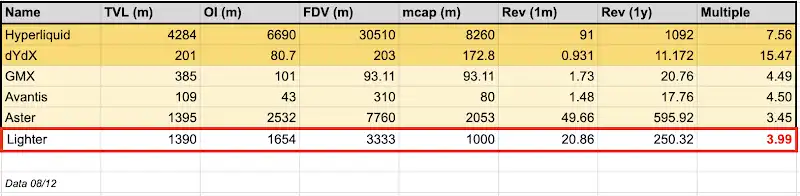
Currently, Lighter's FDV (Fundamental Direct Value) is approximately $3.3 billion in the over-the-counter market. Assuming a 30% airdrop, its initial circulating market capitalization would be around $750 million. In comparison, Hyperliquid's circulating market capitalization is a staggering $8.2 billion.
From a revenue perspective alone (note: Lighter's revenue has not yet been validated by the market over a year like Hyperliquid's), if we simply extrapolate based on the past month's revenue, Lighter's annualized revenue could reach $250 million. This means that Lighter's price-to-sales ratio (market capitalization/revenue) is only 2.5 times, far lower than Hyperliquid's 7.6 times, making it ridiculously cheap.
Let's look at a closer competitor, Aster. Aster's TVL is comparable to Lighter's, and its open interest (OI) is about a billion more than Lighter's, but its FDV is a whopping 7 billion, with a circulating market capitalization of approximately 2 billion. In comparison, Lighter's trading price is only one-third of Aster's.
Ask yourself: Even considering Aster's backing from Binance/CZ, is Lighter's price of only one-third of that of Aster reasonable? I believe that, based on its current valuation, Lighter is severely undervalued in terms of fundamentals.
Looking at the fundamentals, you'll find that only two tokens have been able to maintain high return multiples over the long term: Hyperliquid and DYDX. Why? The former has the most transparent buyback mechanism, and the latter has been a long-established player in the industry. Unlike other listed Perp Dex tokens, Lighter doesn't have a top-tier shill like CZ, nor does it have the liquidity support from Coinbase to artificially prop up its price, and it doesn't face the predicament of "lacking real users" that its competitors face.
It's also important to note that the over-the-counter (SOTC) market often has discounts because buyers bear the risk of default (if the opening price is twice the OTC transaction price, the seller has an incentive to default), which makes people hesitant to offer high prices on the OTC market and instead wait and see how the actual market performance unfolds.
My choice to annualize based on the most recent month's income is for a reason: in the crypto world, everyone only has a seven-second memory; no one can foresee or trade the future a year from now. Therefore, only the most recent month's immediate income is the most important indicator.
Fund Flow
Hyperliquid was able to move independently of the market because many market makers initially didn't believe in its model. This led astute retail investors to buy up all the tokens and then sell them at higher prices to belated buyers.
In my conversations with numerous VCs over the past few months, I've noticed a phenomenon: aside from Paradigm, almost everyone miss the pump on Hyperliquid. This means that every VC with a liquidity fund (and the vast majority do) is trying to catch the next $HYPE.
Who will be the next Hyperliquid? It's simple: do a "pattern matching" between Lighter's storyline and Hyperliquid's, and you'll find that it's Lighter.
Looking at the points distribution, you'll find that major Hyperliquid holders have also become major Lightner holders and heavy users. Their secret to wealth is simple: Hold.
What happens if these people are unwilling to sell their tokens, and even want to buy more (because Lighter's current momentum is comparable to HYPE's in its early days)? Selling pressure disappears, buying pressure increases. Even if you're a whale like Paradigm with $700 million in HYPE exposure, you still have to buy into its competitor—the one that could potentially dethrone you. If Lighter doubles, triples, or even tenfolds in value, and you don't allocate to it, that would be a dereliction of duty. Paradigm is currently only looking at trading infrastructure/exchange projects, which perfectly aligns with Lighter… Buying $50 million for protection isn't unreasonable, is it?
Yes, Lighter raised $68 million with a $1.5 billion FDV (equity valuation of $1 billion), which did indeed price in some VC funding. However, it's important to note that each LP's allocation in this round was capped at $2 million, with a 1-year lock-up period followed by a 3-year vesting period. This means many participants will still view the token from a liquidity trading perspective, not just as an investment. Furthermore, that round was oversubscribed 6 times; unless you have very strong connections with the team, it's virtually impossible to get in.
"Every year, there are always one or two tokens that force everyone to rebalance their positions."
Similarly, most retail investors missed out on Hyperliquid's wealth-creation myth, only able to watch enviously as Hyperliquid community members celebrated their victories on Twitter. For a whole year, Hyperliquid was the only option in the market, the sole outlet for expressing the "short CEX/ long DEX" view. That changed with Aster's TGE, but they botched post-TGE expectation management, causing massive capital outflows and idle funds waiting for the next attractive target.
Narrative Premium
I believe this is the biggest factor determining price, especially in the first two weeks after TGE. The pricing of any asset at TGE and its subsequent valuation are meaningless in the first two weeks because the market is flooded with price-insensitive buyers. This creates a dynamic where people shill and overvalue. As Jeff said, "Price is short-term human sentiment."
For this reason alone, Lighter deserves a higher valuation. By any metric, it is the most anticipated token launch of the year.
Token buyback
Passive spot buying is the only thing that can support a coin's price. BTC has Saylor's micro-strategy, ETH has Tom Lee, but for Altcoin, the market only recognizes revenue buybacks. If you want your coin's price to remain stable, you need passive buying in the form of buybacks. Hyperliquid understands this well.
Lighter is essentially a clone of Hyperliquid. Founder Vlad has explicitly stated that they will be conducting buybacks. While it's unrealistic to expect them to buy back 97% of the tokens, a buyback of 30% or 50% would be reasonable. With passive buying in the tens of millions, that would be attractive enough.
Note: Of their $68 million funding round (primarily for insurance funds), the team has allocated a portion for token buybacks on TGE. This is similar to Hyperliquid's early $75 million spot buy-in.
Deep integration with Robinhood
Vlad Tenev (Vlad1 of Robinhood) met Vlad (Vlad2 of Lighter) through an internship at Addepar. Robinhood is an investor in Lighter, and Vlad1 is also an advisor to Lighter.
There have been numerous rumors circulating about the use of Lighter on the Robinhood blockchain. Lighter aims for composability and will be integrated into Ethereum L1, ultimately enabling lending using collateralized LLP tokens. This composability aligns with Robinhood's vision of "tokenizing everything" and putting everything on-chain.
While this is speculative, I support the argument that Robinhood will acquire a significant stake in Lighter (whether through tokens or equity). Given the similarity of their "Pay for Flow" (PFOF) models, I speculate that once Robinhood holds a stake in Lighter, it will direct a large portion of its traffic to Lighter. This would further strengthen this storyline.
RWA Trading
While not limited to Lighter, RWA contract trading has proven to be a key early-stage product-market fit. Data shows that Lighter's total daily trading volume across all RWA products is $517 million, with open interest (OI) of $271 million. Compared to Hyperliquid, Lighter is rapidly catching up with and even surpassing it.
A key difference is that Lighter's RWA service is not provided by a third party in the ecosystem, but is operated in-house. This makes coordinating and listing new tokens smoother and faster. Furthermore, the majority of Lighter's trading volume comes from its forex contracts, while Hyperliquid primarily uses index contracts (80%). Ultimately, this will evolve into a pure competition of liquidity and order book depth to attract users.
Hyperliquid's first real rival
The derivatives market is growing extremely rapidly. Although there's a group of die-hard fans on Twitter chanting "Hyperliquid is the only one," the market is large enough to accommodate multiple top players. Robinhood has also opened up contract trading because contracts are so dominant in the crypto space and are indeed a superior trading method compared to options.
Solving the cross margin issue is the most significant challenge that Hyperliquid outsourced to Flood and Fullstack Trade. As far as I know, Flood is at least six months away from resolving this problem. Lighter, with its larger team, is likely to tackle it. Yes, Hyperliquid has a first-mover advantage, but if Lighter can quickly integrate this functionality, it could very well take a slice of their market share.
Privacy
While Hyperliquid has cultivated a cult-like community culture, its architecture has a fatal flaw for large users: complete transparency.
On Hyperliquid, leaderboards and on-chain data broadcast every large position, entry price, and liquidation point to the world. This turns trading into a PvP arena where predatory players like myself can specialize in hunting whale liquidation orders and preempting large sums of money. Using liquidation data to predict tops and bottoms on lower timeframes is a predictable strategy, and I know many traders who consistently profit from it.
Lighter positions itself as the antidote to this risk. By obfuscating transaction flows and masking position data, its operation is closer to an on-chain dark pool than a standard DEX. For "smart money" and large funds, anonymity is not just a feature—it's a necessity. If you have a large amount of capital, you absolutely cannot trade in a venue where you directly hand over your cards and liquidation points to your counterparties. As DeFi matures, venues that can protect users' alpha will inevitably attract the largest inflows of funds.
Click to learn about BlockBeats' job openings.
Welcome to the official BlockBeats community:
Telegram subscription group: https://t.me/theblockbeats
Telegram group: https://t.me/BlockBeats_App
Official Twitter account: https://twitter.com/BlockBeatsAsia