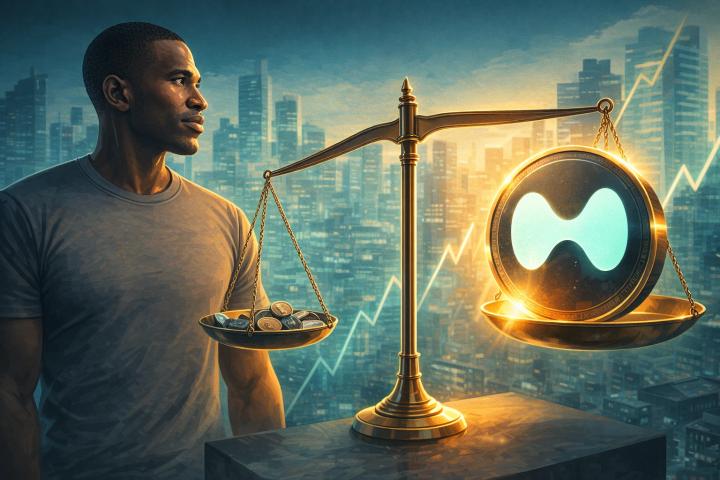
Howard Marks, author of "The Most Important Thing" and a master of value investing, recently addressed the question of whether there is a bubble in AI in an investment memo . He admitted that he is not a tech industry professional and therefore can only observe from a financial perspective. He pointed out that AI is currently in an "inflection point bubble," where innovative technologies will eventually prove their value, but investors often suffer significant losses. He noted that current AI investment is like buying lottery tickets—extremely uncertain and highly concentrated on a very small number of possible outcomes.
In this environment, investors easily fall into a lottery-like mentality: as long as I hold one ticket, I have a chance to bet on the ultimate winner who changes the world and monopolizes the market. Funds are flowing into everything related to AI, rather than rigorously examining business models, revenue sustainability, and competitive advantages. Investors are now willing to pay extremely high prices even before answers are available. He also warned of the problem in the AI industry where "customers are also investors," which masks the lack of genuine demand.
( AI may trigger a massive unemployment tsunami; what jobs does Howard Marks recommend? )
Value investing guru Howard Marks: The formula for the existence of bubbles
Howard Marks points out that the most interesting aspect of bubbles lies in their regularity. A bubble formula can almost be derived:
- Something new and seemingly revolutionary has emerged.
- It gradually seeps into people's minds. It stimulates imagination and evokes overwhelming excitement.
- Early participants reap huge rewards; onlookers, filled with envy and regret, flock in under the influence of FOMO.
They don't understand what the future holds, nor do they care about their costs or whether a reasonable return is possible with acceptable risk. For investors, the short to medium term is inevitably painful, but given a longer timeframe, there is still a possibility of profit. Since Howard Marks entered the investment market, he has personally experienced multiple bubbles and read other cases, all of which conform to the above description. People might think that society can always learn from the previous bubble. But this is not the case; risk aversion can never overcome the dream of getting rich through revolutionary technology.
Technological innovation itself is not a bubble, but rather investors' excessive optimism.
People often ask, "Is there an AI bubble?" But this question itself is ambiguous. Howard Marks believes there are two different perspectives: one is corporate behavior, and the other is reflected in investor behavior towards the industry. He cannot judge whether the aggressive behavior of AI companies is justified, so the following will primarily focus on the financial world regarding whether an AI bubble exists.
The core mission of the value investing school is:
- Research companies and assets to assess their intrinsic value and prospects.
- Make investment decisions based on this value.
The gap between short- and medium-term asset prices and intrinsic value depends on investor psychology. Bubbles typically revolve around new financial innovations (such as the South Sea Company in the early 18th century, or subprime mortgage-backed securities in 2005–06) or technological advancements (fiber optics in the late 1990s, the internet in 1998–2000). Novelty plays a key role in these bubbles. Because there is no history to refer to, imagination can run infinitely, and what is perceived as an unlimited future often supports valuations far exceeding historical norms.
However, market bubbles are not directly caused by technological or financial innovation, but rather by excessive optimism, which has developed into what former Federal Reserve Chairman Alan Greenspan called "irrational exuberance."
Debating whether or not to attach a foam label may actually interfere with the judgment.
Howard Marks, citing John Kenneth Galbraith's "A Brief History of Financial Mania," discusses the extreme transience of financial memory. He points out that in financial markets, "past experiences, if still remembered, are often seen as a primal refuge for those who cannot comprehend the miracles of the present." In other words, history can limit people's awe of the present and their fantasies about the future; in the absence of history, anything is possible.
The key point is that new things naturally ignite great enthusiasm, but when that enthusiasm reaches irrational levels, a bubble forms. Who can define the line between rationality and irrationality? Who can predict when an optimistic market will turn into a bubble?
Howard Marks, reflecting on his past, identified his two most successful predictions as alerting the tech and internet stock market in 2000 and before the 2005–07 global financial crisis. In both cases, he lacked expertise in the core bubble sectors—internet and subprime mortgage-backed securities—and simply observed surrounding behavior.
Obsessing over whether something is a bubble can actually cloud judgment; it's often sufficient to calmly assess what's happening and deduce appropriate actions accordingly. Howard Marks believes his value lies not in asserting "this is a bubble," but in describing the folly of these actions.
Inflection point bubbles: destroy investor wealth, but accelerate technological progress.
Howard Marks, citing the newsletter "The Benefits of Bubbles," categorizes bubbles into two types:
- Inflection Bubbles: Good bubbles.
- Mean-reversion bubbles: These are more destructive, such as the subprime mortgage bubble.
Financial frenzyes like the South Sea Company, portfolio insurance, and subprime mortgage-backed securities promised risk-free, high returns, not overall human progress. No one believed subprime mortgages would fundamentally change the housing system; they simply saw an opportunity to profit from new buyers. These are precisely what Hobart and Huber termed mean-reverting bubbles.
Conversely, bubbles based on technological advancements, such as those in the railroads and the internet, are called inflection point bubbles. After the bubble bursts, the world doesn't return to its starting point. Inflection point bubbles accelerate technological progress and lay the foundation for a prosperous future, but they can also destroy investors' wealth. The key is to avoid being the one who gets destroyed.
Investing in AI is like buying a lottery ticket: extremely high uncertainty, with only a few companies surviving.
So, is AI a good bubble? If we accept the classification of inflection point bubbles, then the next question is naturally: does AI belong to this category? Howard Marks believes the answer is almost certainly yes. AI is undoubtedly a general-purpose technology capable of changing the world, its impact spanning almost all industries, and altering productivity, cost structures, business models, and labor patterns in ways we don't yet fully understand.
This is why capital is pouring in at an unprecedented speed and scale. History tells us that almost every truly world-changing technology is accompanied by an investment bubble. Railroads, electricity, automobiles, aviation, telecommunications, the internet—no exceptions. The technology ultimately proves its worth, but most investors lose money or even go bankrupt in the process. Therefore, the question is never whether AI will change the world, but rather:
- Who will be the ultimate winner?
- Was the price paid reasonable?
- Is it possible to obtain a reasonable return on investment now, with acceptable risk?
- Is investing in AI more like buying lottery tickets?
The biggest challenge in AI investment right now lies in its extremely high uncertainty and concentration on a very small number of possible outcomes. In this environment, investors easily fall into a lottery-like mentality: as long as I hold one ticket, I have a chance to bet on the ultimate winner who will change the world and dominate the market. The problem is that when most investors think this way, the price of investment is driven to an extreme level.
During the dot-com bubble, people invested in the internet itself, not in a company with long-term stability, pricing power, and a moat. The current situation with AI is strikingly similar. Funds are flowing into everything related to AI, rather than strictly distinguishing between them:
- Is the business model clear?
- Is the income sustainable?
- Can competitive advantage be defended?
- Is long-term profitability possible?
This doesn't mean these questions will never be answered. Rather, it means that investors today are willing to pay extremely high prices even before the answers are available.
Howard Marks: Investment relationships across the AI industry require close monitoring.
Howard Marks warns of a highly alarming phenomenon in the AI industry, a pattern he has repeatedly observed in financial history in recent years, including but not limited to:
- Circular transactions
- Special Purpose Vehicle (SPV)
- Supplier financing
- Clients are also investors
- Investors are also customers
These structures may not be illegal in principle, but in reality, they often mask the lack of genuine demand. Historically, such behavior almost always emerges in the later stages of a bubble. Their existence is not the problem in itself; the real problem is that when they become necessary conditions for maintaining the growth narrative, the risks have already increased significantly.
Debt is becoming part of the AI race. Everything looks healthy in the early stages when there's still plenty of equity capital; but as valuations rise and returns on investment become less attractive, companies begin to leverage more. However, the introduction of debt dramatically increases the system's reliance on expectations. Once growth slows, funding costs rise, or commercialization falls short of expectations, adjustments can be swift and severe.
Looking back at past technological waves, one thing remains consistent: technology ultimately succeeds, and the world is indeed changed as a result, but most investors fail to profit from it. In the railway era, Britain laid too many tracks; in the early days of aviation, almost all airlines lost money; during the dot-com bubble, Amazon survived, but Pets.com did not. Successful technology does not guarantee a successful investment.
So what should investors do? Howard Marks frankly admits that he can't tell you which company will be the ultimate winner in the AI era; nor can he predict when or if current valuations will undergo a drastic correction. All you can do is maintain a sense of awe for AI, but not lose your judgment; be excited about the narrative of changing the world, but remain calm about prices, understanding that you are buying a company, not just the possibility of the future itself. Bubbles are often only confirmed in hindsight; but during the process, the risks are foreseeable.
This article, "Value Investing Master Howard Marks' Latest Memoir in 2025: AI Has an Inflection Point Bubble, and Investors Are Like Buying Lottery Tickets," first appeared on ABMedia ABMedia .