Early the day before yesterday, the Interop Labs team (the initial developers of Axelar Network) announced that it had been acquired by Circle to accelerate the development of its multi-chain infrastructure Arc and CCTP.
Logically, being acquired should be a good thing. However, the further details provided by the Interop Labs team in the same tweet caused a huge uproar. They stated that the Axelar network, foundation, and AXL token will continue to operate independently, and its development will be taken over by CommonPrefix.
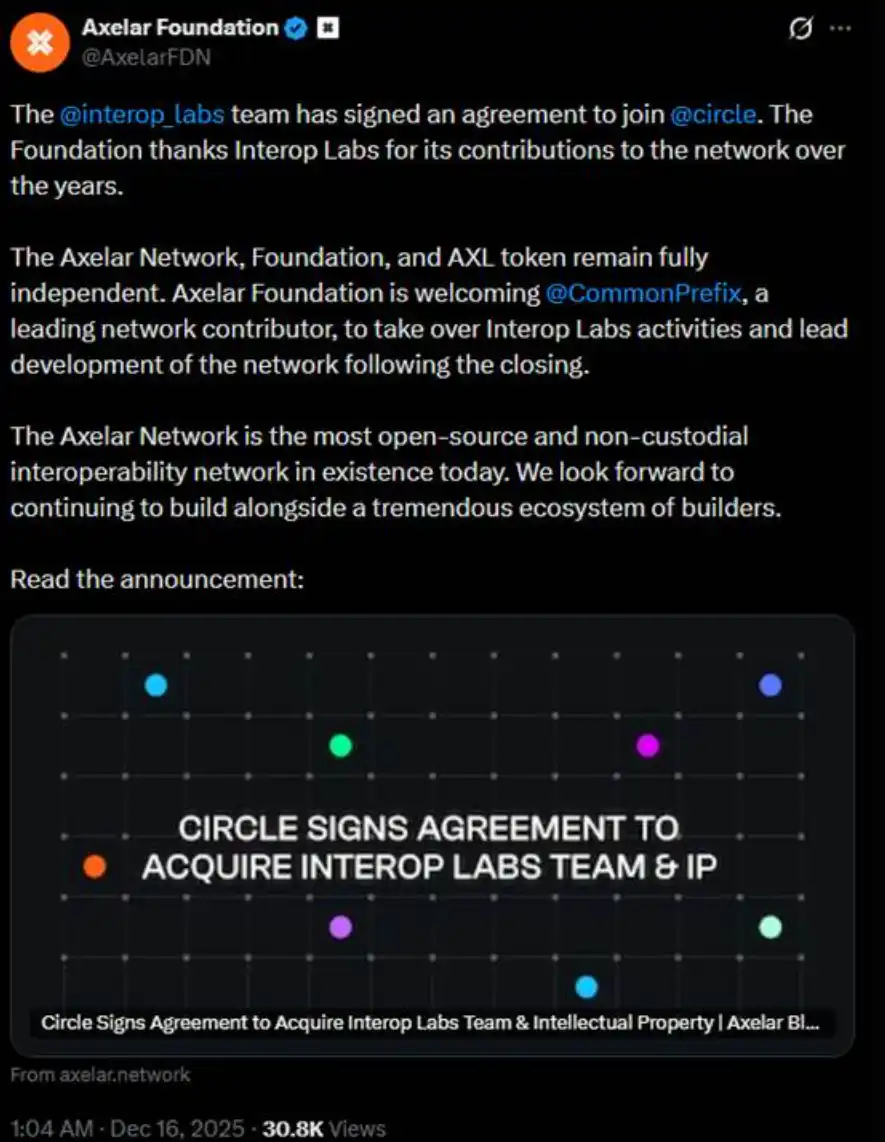
In other words, the core of this transaction lies in "integrating the team into Circle" to promote the application of USDC in the fields of privacy computing and compliant payments, rather than the complete acquisition of the Axelar network or its token system. Circle has bought the team and technology. Circle has no involvement in your original project.
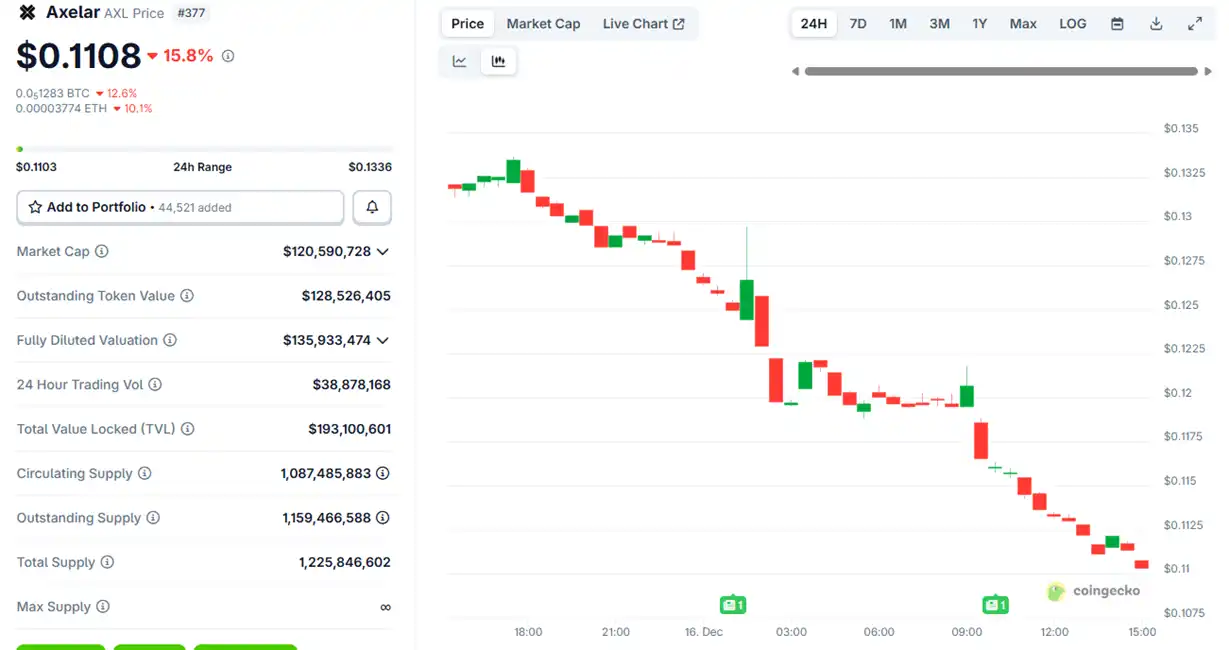
Following the announcement of the acquisition, the price of Axelar tokens ($AXL) initially rose slightly before starting to fall, and has since dropped by approximately 15%.
This arrangement quickly sparked heated discussions within the community regarding "token vs. equity." Many investors questioned whether Circle, through acquiring the team and intellectual property, had substantially acquired core assets while circumventing the rights of AXL token holders.
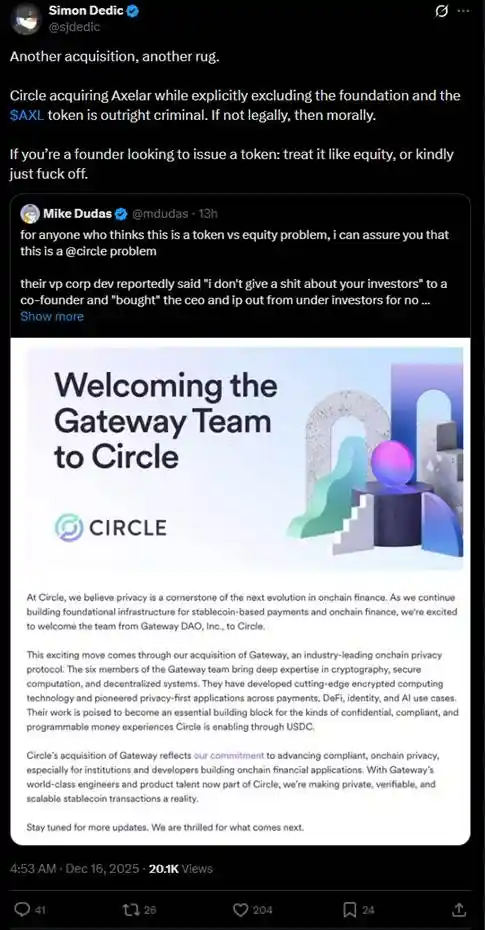
Over the past year, similar cases of "wanting the team, wanting the technology, but not the token" have occurred repeatedly in the crypto, causing serious harm to retail investors.
In July, the Kraken Layer 2 network Ink's foundation acquired Vertex Protocol, an Arbitrum-based decentralized exchange, taking over its engineering team and trading technology architecture, including the synchronized order book, perpetual contract engine, and money market code. Following the acquisition, Vertex shut down its services on nine EVM chains, and its token, $VRTX, was abandoned. After the announcement, $VRTX plummeted by over 75% that day, subsequently falling to zero (currently with a market capitalization of only $73,000).
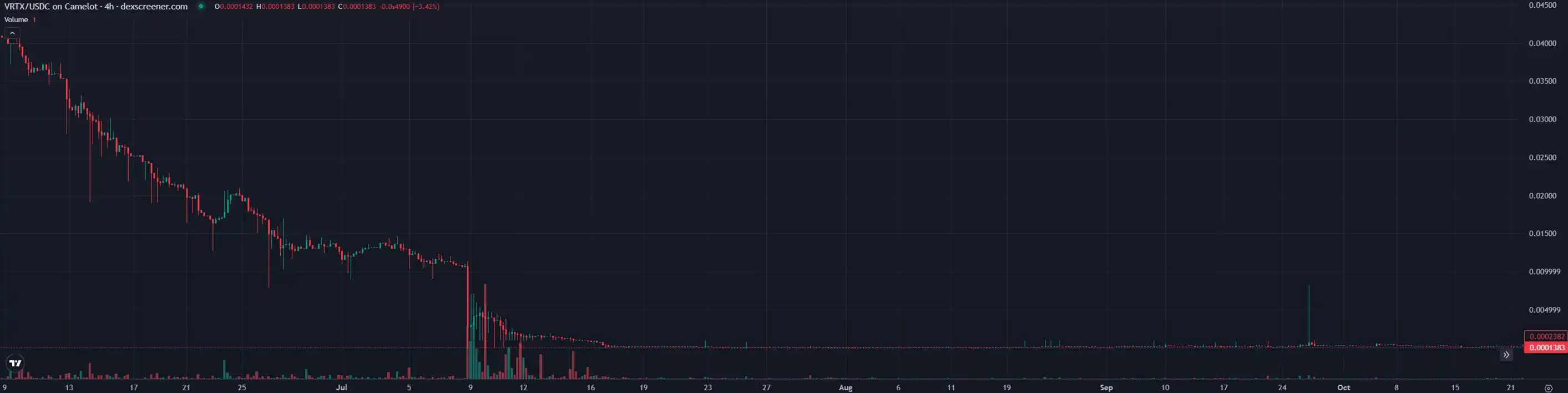
However, $VRTX holders have at least a sliver of comfort, as they will receive a 1% airdrop during Ink TGE (the snapshot has ended). Then comes something even worse: their tokens will be completely forfeited without any compensation.
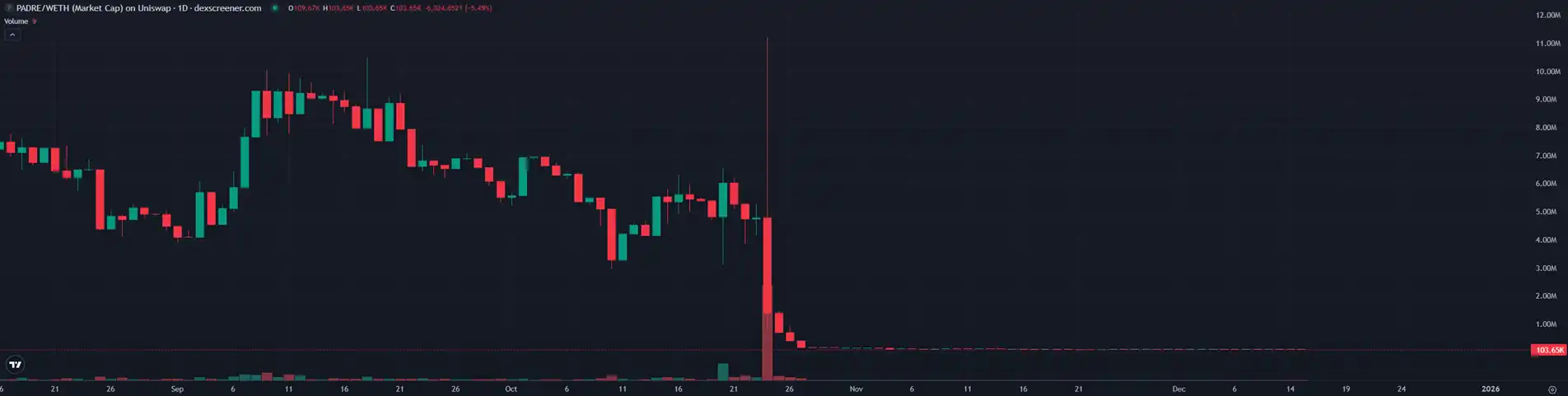
In October, pump.fun announced its acquisition of the trading platform Padre. Simultaneously, pump.fun also announced that the Padre token would no longer be used on the platform and stated directly that there were no future plans for the token. Due to the announcement of the token's invalidation appearing in the last reply to the thread, the token's value instantly doubled before plummeting, currently standing at only $100,000.
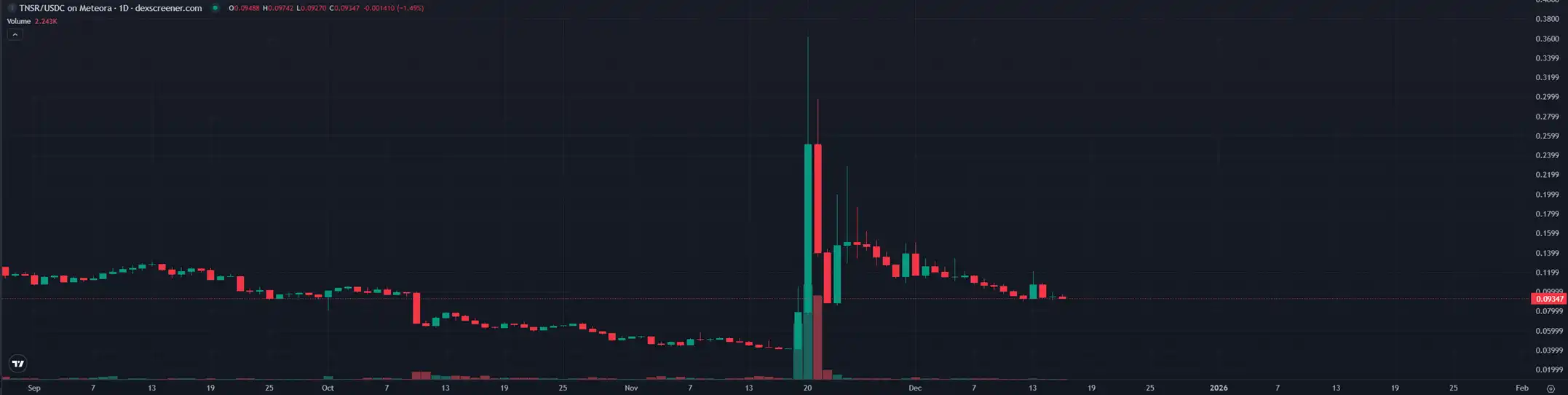
In November, Coinbase announced its acquisition of Vector.fun, the Solana trading terminal built by Tensor Labs. Coinbase integrated Vector's technology into its DEX infrastructure, but this did not involve the Tensor NFT marketplace itself or its token ownership. The Tensor Labs team partially moved to Coinbase or other projects.
The price movement of $TNSR is relatively stable compared to other examples, showing a rise followed by a fall. Currently, the price has returned to the level that an NFT market token should be at, and it is still higher than the low point before the acquisition news.
In the Web 2.0 era, it's legal for small companies to be acquired by large corporations in exchange for their teams, technology, and intellectual property, but not equity—a practice known as "acquihire." Particularly in the tech industry, acquihire allows large corporations to quickly integrate top-tier teams and technologies, avoiding the lengthy process of hiring from scratch or developing internally, thereby accelerating product development, entering new markets, or enhancing competitiveness. While detrimental to minority shareholders, it stimulates overall economic growth and technological innovation.
Nevertheless, "acquihire" must also adhere to the principle of "acting in the best interests of the company." The reason these examples in the crypto have angered the community so much is precisely because the "minority shareholders," as token holders, completely disagree with the idea that crypto project teams are "acting in the best interests of the company" and being acquired for the better development of the project. Project teams often dream of listing on the US stock market when the project itself is profitable, and then issue tokens to make money when everything is just starting out or on its last legs (the most typical example being OpenSea). Once these project teams have made money from the tokens, they immediately look for new owners, leaving their past projects only in their resumes.
So, are retail investors in the crypto destined to suffer in silence forever? Just the day before yesterday, Ernesto, the former Chief Technology Officer of Aave Labs, released a governance proposal called "$AAVE Alignment Phase 1: Ownership," firing a shot in the defense of token rights in the crypto.
The proposal advocates for Aave DAO and Aave token holders to have clear control over the protocol's core rights, including IP, brand, equity, and revenue. Representatives from Aave service providers, such as Marc Zeller, have publicly endorsed the proposal, calling it "one of the most influential proposals in Aave governance history."
In his proposal, Ernesto stated, "Due to some past events, previous posts and comments have been highly hostile towards Aave Labs, but this proposal aims to remain neutral. This proposal does not imply that Aave Labs should not be a contributor to the DAO, or lacks the legitimacy or ability to contribute, but the decision should be made by the Aave DAO."
According to crypto KOL @cmdefi, the conflict stemmed from Aave Labs replacing its front-end integration of ParaSwap with CoW Swap, resulting in fees flowing to Aave Labs' private address. Aave DAO supporters view this as predation, arguing that with the existence of the AAVE governance token, all benefits should prioritize AAVE holders or remain in the treasury for DAO voting. Furthermore, previously, ParaSwap revenue consistently flowed into the DAO; the new CoW Swap integration altered this, further reinforcing the DAO's perception of this as predation.
This directly reflects a conflict similar to that between "shareholders' meetings and management," and once again highlights the awkward position of token rights in the crypto industry. In the early days of the industry, many projects promoted the "value capture" of tokens (such as earning rewards through staking or simply sharing profits directly). However, since 2020, SEC enforcement actions (such as the lawsuits against Ripple and Telegram) have forced the industry to shift towards "utility tokens" or "governance tokens," which emphasize usage rights rather than economic rights. As a result, token holders often cannot directly share in project profits—project revenue may flow to equity held by the team or VCs, while token holders are like small shareholders generating electricity for free.
As in the examples above, project teams often sell their teams, technical resources, or equity to VCs or large corporations, while simultaneously selling tokens to retail investors. The end result is that resource and equity holders profit first, while token holders are marginalized or even receive nothing. This is because tokens do not possess legally recognized investor rights.
To circumvent regulations that prohibit tokens from being securities, tokens are being designed to become increasingly "useless." Because of this regulatory circumvention, retail investors are left in an extremely passive and unprotected position. The various cases that have occurred this year have, in a sense, reminded us that the current "narrative failure"in the crypto may not be that people have truly stopped believing in the narrative—the narrative is still compelling, and profits are still good—but what exactly can we expect when we buy tokens?
Click to learn about BlockBeats' job openings.
Welcome to the official BlockBeats community:
Telegram subscription group: https://t.me/theblockbeats
Telegram group: https://t.me/BlockBeats_App
Official Twitter account: https://twitter.com/BlockBeatsAsia