Author | Ethan ( @ethanzhang_web3 )

On December 12, 2025, the Office of the Comptroller of the Currency (OCC) in Washington, D.C., issued a notice conditionally approving five digital asset institutions—Ripple, Circle, Paxos, BitGo, and Fidelity Digital Assets—to transform into federally chartered national trust banks.
This decision, though not accompanied by dramatic market fluctuations, is widely regarded by regulators and the financial community as a watershed moment. For the first time, crypto companies, which have long operated on the fringes of the traditional financial system and frequently experienced banking service disruptions, have been formally incorporated into the U.S. federal banking regulatory framework as "banks."
The changes didn't come suddenly, but they were thorough enough. Ripple plans to establish the "Ripple National Trust Bank," and Circle will operate the "First National Digital Currency Bank." These names themselves clearly convey the signal from regulators: digital asset-related businesses are no longer just "high-risk exceptions" passively subject to review, but are allowed to enter the core of the federal financial system under clear rules.
This shift contrasts sharply with the regulatory environment of a few years ago. Particularly during the banking turmoil of 2023, the crypto industry was deeply mired in a so-called "de-banking" dilemma, systematically severed from the dollar settlement system. However, with President Trump signing the GENIUS Act in July 2025, stablecoins and related institutions gained a clear federal legal status for the first time, providing the institutional basis for the OCC's recent concentrated issuance of licenses.
This article will examine the institutional logic and real-world impact of this approval from four perspectives: "What is a Federal Trust Bank?", "Why is this license important?", "The regulatory shift in the Trump era", and "The response and challenges of traditional finance". The core judgment is that the crypto industry is shifting from being an "external user" reliant on the banking system to becoming part of the financial infrastructure. This is not only changing the cost structure of payments and clearing but also reshaping the definition of "bank" in the digital economy.
What is "Federal Trust Bank"?
To understand the true significance of this OCC approval, we first need to clarify an easily misunderstood issue: this does not mean that five crypto companies have obtained "commercial banking licenses" in the traditional sense.
The OCC approved the "National Trust Bank" designation. This is a type of banking license that has long existed in the US banking system, but historically primarily served businesses such as estate management and institutional trusteeship. Its core value lies not in "how much business it can do," but in its regulatory level and infrastructure status .
What does a federal charter mean?
Under the dual-track banking system in the United States, financial institutions can choose to be regulated by either state or federal governments. The two are not simply equal in terms of compliance strength, but rather there is a clear difference in the hierarchy of authority. A federally chartered banking license issued by the Office of the Comptroller of the Currency (OCC) means that the institution is directly regulated by the Treasury Department and enjoys "federal priority," eliminating the need to individually adapt to state regulations in terms of compliance and operations.
The legal basis for this can be traced back to the National Bank Act of 1864. For the next century and a half, this system was a crucial tool in shaping the unified financial market in the United States. This is especially critical for crypto companies.
Prior to this approval, Circle, Ripple, and Paxos all had to apply for Money Transmission Licenses (MTLs) in each of the 50 states to operate compliantly across the United States. This involved a completely different set of "puzzle-like" systems with varying regulatory standards, compliance requirements, and enforcement criteria. This was not only costly but also severely limited the efficiency of business expansion.
After becoming a Federal Trust Bank, the regulatory body shifted from state financial regulators to the OCC. For the company, this meant a unified compliance path, a passport to nationwide operations, and a structural increase in regulatory credibility .
Trust banks are not "scaled-down commercial banks".
It is important to emphasize that the Federal Trust Bank is not equivalent to a "full-service commercial bank." The five institutions approved this time are not permitted to accept FDIC-insured public deposits, nor can they issue commercial loans . This is one of the core reasons why traditional banking organizations (such as the Bank Policy Institute) have questioned this policy, arguing that it represents an "unequal distribution of rights and obligations."
However, from the perspective of the business structure of crypto companies themselves, this restriction is actually highly appropriate. Take stablecoin issuers as an example: whether it's Circle's USDC or Ripple's RLUSD, their business logic is built on 100% reserve asset backing . Stablecoins do not engage in credit expansion, nor do they rely on fractional-reserve lending models; therefore, they do not suffer from the systemic risks arising from the "maturity mismatch" of traditional banks. Under this premise, introducing FDIC deposit insurance is neither necessary nor would it significantly increase the compliance burden.
More importantly, the core of a trust banking license lies in fiduciary responsibility . This means that licensed institutions are legally obligated to strictly separate client assets from their own funds and prioritize client interests. This point has significant relevance to the entire crypto industry, especially after the FTX misappropriation of client assets; asset segregation is no longer just a company promise, but a mandatory obligation under federal law.

From "custodian" to "payment node"
Another significant aspect of this change lies in the crucial shift in regulators' interpretation of the scope of "trust banking" operations. Jonathan Gould, head of the OCC , explicitly stated that the new federal banking access "provides consumers with new sources of products, services, and credit, and ensures a vibrant, competitive, and diversified banking system." This lays the policy foundation for the inclusion of crypto institutions.
Within this framework, the strategic value of Paxos and BitGo's "conversion" from state-level trusts to federal trust banks far exceeds a change in name. At its core, the OCC regime grants federal trust banks a crucial right: the right to apply for access to the Federal Reserve's payment system . Therefore, their true objective is not the "bank" title, but rather the competition for direct access to the central bank's core settlement system .
Take Paxos as an example. Although it had become a compliance benchmark under the strict supervision of the New York State Department of Financial Services, the state license had inherent limitations: it could not directly integrate into the federal payment network . The OCC's approval document clearly states that the new entity after the conversion can continue to conduct businesses such as stablecoins, asset tokenization, and digital asset custody. This is equivalent to formally recognizing at the institutional level that the issuance of stablecoins and asset tokenization has become a legitimate "banking business." This is not a breakthrough for an individual company, but a substantial expansion of the scope of "banking" functions.
Once fully implemented, these institutions will be able to directly connect to central bank payment systems such as Fedwire or CHIPS, no longer needing to rely on traditional commercial banks as intermediaries. The most structurally significant breakthrough in this regulatory shift is the leap from "custodian asset managers" to "direct nodes in the payment network."
Why is this license plate so valuable?
The true value of a Federal Trust Bank license lies not in the identity of a "bank" itself, but in the fact that it may open a door to a direct channel to the Federal Reserve's clearing system.
This is why Ripple CEO Brad Garlinghouse called the approval a "huge step forward," while the traditional banking lobby (BPI) expressed considerable unease. For the former, it represents an improvement in efficiency and certainty; for the latter, it signifies a redistribution of long-monopolized financial infrastructure.
What does a direct connection to the Federal Reserve mean?
Prior to this, crypto companies had always been on the "outer layer" of the dollar system. Whether it was Circle issuing USDC or Ripple providing cross-border payment services, any final settlement involving dollars had to be completed through commercial banks as intermediaries. This model is known in financial terminology as the "correspondent banking system." On the surface, it's just a longer process, but in reality, it brings three long-standing problems that have plagued the industry.
First, there's the uncertainty surrounding their survival . In recent years, the crypto industry has repeatedly faced situations where banks unilaterally terminate their services. Once a correspondent bank withdraws, crypto companies' fiat currency channels are cut off very quickly, bringing their business to a standstill. This is precisely what the industry refers to as the risk of "de-banking."
Secondly, there are issues of cost and efficiency . The correspondent banking model means that every transaction must go through multiple layers of bank clearing, each layer incurring fees and time delays. This structure is inherently unfriendly to high-frequency payments and stablecoin settlements.
Thirdly, there is settlement risk . Traditional banking systems generally adopt a T+1 or T+2 settlement schedule. During the transit period, funds not only tie up liquidity but are also exposed to bank credit risk. When Silicon Valley Bank collapsed in 2023, Circle had approximately $3.3 billion in USDC reserves temporarily stranded in the banking system, an event still regarded as a cautionary tale for the industry.
The Federal Trust Bank designation changes this very structure. At the institutional level, licensed institutions are eligible to apply for a Federal Reserve "master account." Once approved, they can directly access federal-level clearing networks such as Fedwire , completing real-time, irrevocable final settlements within the dollar system, without relying on any commercial bank intermediaries.
This means that, for the first time, institutions like Circle and Ripple are on the same "system level" as JPMorgan Chase and Citibank in the crucial process of fund clearing.
Ultimate cost advantage , not marginal optimization
The cost reduction from obtaining a master account is structural, not marginal. The core principle is that direct connections to the Federal Reserve's payment system (such as Fedwire) completely bypass the multiple intermediaries of traditional correspondent banks, thereby eliminating the corresponding intermediary fees and markups.
We can extrapolate from industry practices and the Federal Reserve's open rate mechanism for 2026. Calculations show that in high-frequency, high-value scenarios such as stablecoin issuance and institutional payments, this direct connection model can reduce overall settlement costs by approximately 30%-50% . This cost reduction primarily stems from two aspects:
- Direct cost advantage : The Federal Reserve charges Fedwire far less per transaction for large payments than commercial banks charge for wire transfers.
- Simplified structure : Eliminates various fees, account maintenance fees, and liquidity management costs associated with the agent banking process.

Take Circle as an example. Its nearly $80 billion USDC reserves face massive daily cash flows. Achieving direct connectivity could save hundreds of millions of dollars annually just on channel fees alone. This is not a minor optimization, but a fundamental cost restructuring at the business model level.
Therefore, the cost advantage of obtaining master account status is certain and significant, directly translating into a core competitive advantage for stablecoin issuers in terms of fee competition and operational efficiency.
The legal and financial attributes of stablecoins are changing.
When stablecoin issuers operate as federal trust banks, the nature of their products changes. In the old model, USDC or RLUSD were closer to "digital certificates issued by technology companies," with their security heavily reliant on the issuer's governance and the soundness of the partner banks. In the new structure, stablecoin reserves will be placed under a trusteeship system within the OCC federal regulatory framework , and legally segregated from the issuer's own assets.
This is not the same as a central bank digital currency (CBDC), nor is it insured by the FDIC. However, with the combination of "100% full reserves + federal regulation + fiduciary responsibility", its credit rating is significantly higher than most offshore stablecoin products.
A more tangible impact lies in payments. Take Ripple as an example: its ODL (On-Demand Liquidity) products have long been constrained by bank operating hours and the pace of fiat currency channel openings. Once integrated into the federal clearing system, the switching between fiat currency and on-chain assets will no longer be limited by time windows, significantly improving the continuity and certainty of cross-border settlements.
The market's reaction was actually more rational.
While this development is seen as a milestone by the industry, the market reaction has not been dramatic. Price changes in both XRP and USDC-related assets have been relatively limited. However, this does not necessarily mean the license is undervalued; rather, it likely indicates that the market views it as a long-term institutional change rather than a short-term trading theme .
Ripple CEO Brad Garlinghouse defined this development as "the highest standard on the path to stablecoin compliance." He not only emphasized that RLUSD is now under dual regulation by both the federal (OCC) and state (NYDFS) authorities, but also directly attacked traditional banking lobbying groups: "Your anti-competitive tactics have been seen through. You complain that the crypto industry doesn't follow the rules, but now we're under the direct regulatory standards of the OCC. What are you afraid of?"
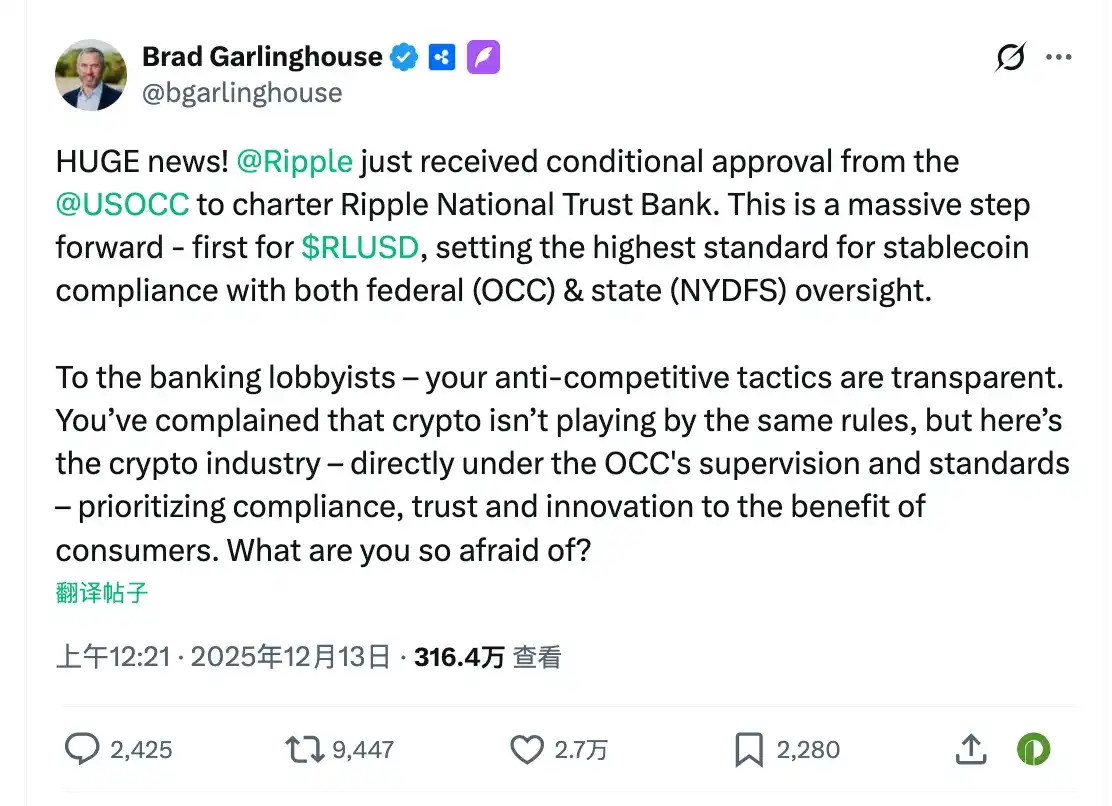
At the same time, Circle also pointed out in a related statement that the National Trust Bank franchise will fundamentally reshape institutional trust, enabling issuers to provide more fiduciary digital asset custody services to institutional clients.
Both statements lead to the same conclusion: from being "served by banks" to "becoming part of banks," crypto finance is entering a completely new phase. The Federal Trust Bank license is not just a permit, but also a safe channel for institutional capital hesitant due to compliance uncertainties to enter the crypto market.
The "Golden Age" of the Trump Era and the GENIUS Act
Rewind three or four years, and it would have been hard to imagine that crypto companies could gain federal recognition as "banks" by the end of 2025. This shift is not driven by technological breakthroughs, but by a fundamental change in the political and regulatory environment.
The return of the Trump administration and the enactment of the GENIUS Act have paved the way for crypto-finance to access the federal system.
From “de-banking” to institutional acceptance
During the Biden administration, the crypto industry has long been in an environment of heavy regulation and high uncertainty. Especially after the FTX crash in 2022, the main regulatory tone shifted to "risk isolation," and the banking system was required to stay away from crypto business.
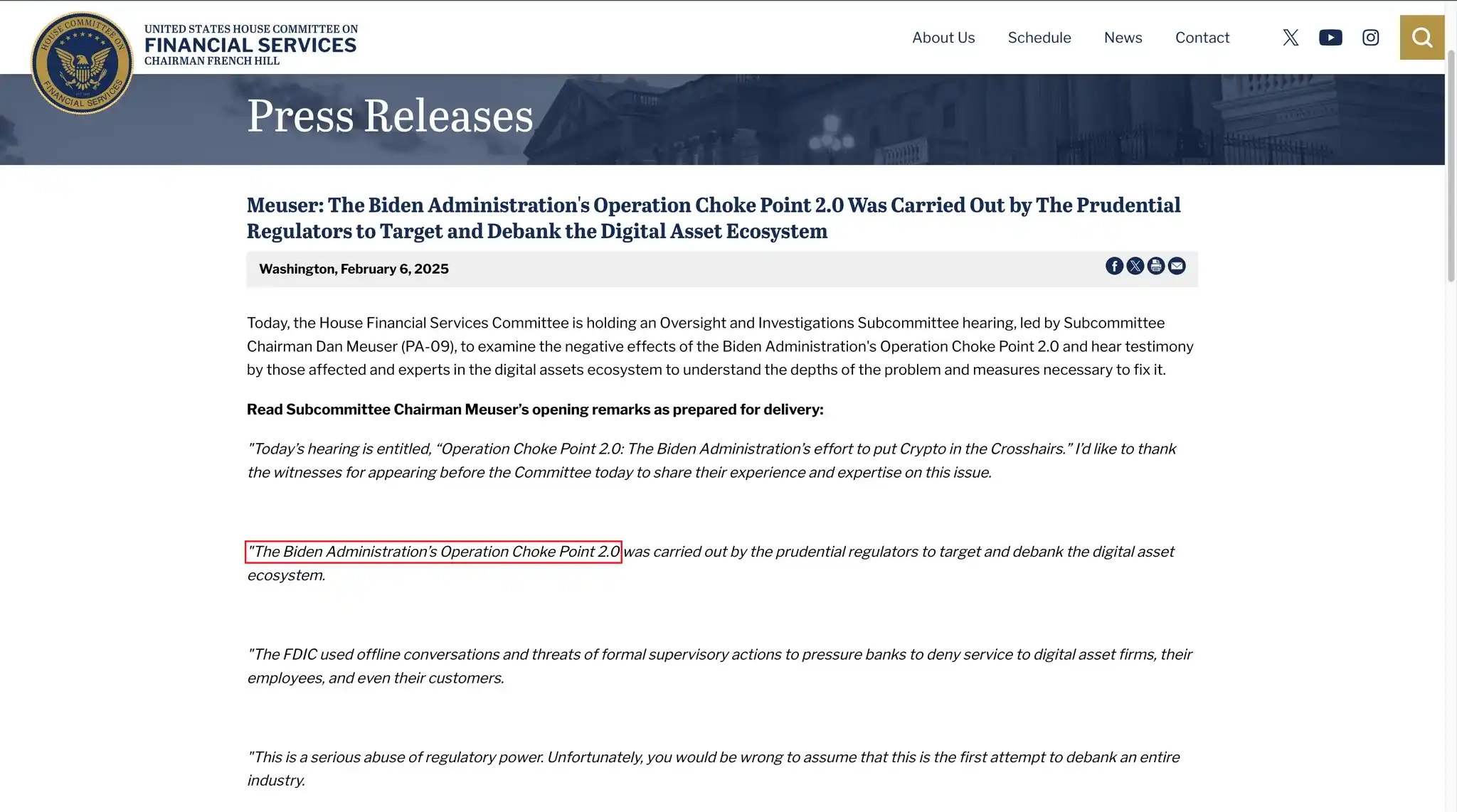
This phase is known within the industry as "de-banking," and has been described by some lawmakers as "Operation Choke Point 2.0." According to a subsequent investigation by the House Financial Services Committee, several banks, under informal regulatory pressure, severed ties with crypto companies. The exits of Silvergate Bank and Signature Bank are prime examples of this trend.
The regulatory logic at the time was clear: rather than going to great lengths to regulate encryption risks, it was better to keep them outside the banking system.
This logic was fundamentally reversed in 2025.
During his campaign, Trump repeatedly publicly supported the crypto industry, emphasizing his goal of making the United States a "global hub for crypto innovation." After returning to power, crypto assets are no longer simply viewed as a source of risk, but are being incorporated into broader financial and strategic considerations.
The key shift lies in the fact that stablecoins are now being viewed as an extension of the dollar system . On the day the GENIUS Act was signed, the White House statement explicitly stated that regulated dollar stablecoins would help expand demand for US Treasury bonds and solidify the dollar's international position in the digital age. This essentially redefines the role of stablecoin issuers in US finance.
The institutional role of the GENIUS Act
In July 2025, Trump signed the GENIUS Act. The significance of this act lies in establishing a clear legal status for stablecoins and related institutions at the federal level for the first time. The act explicitly allows non-bank institutions , after meeting certain conditions, to be subject to federal regulation as "qualified payment stablecoin issuers." This provides a regulatory entry point for companies like Circle and Paxos, which were previously outside the banking system, into the federal framework.
More importantly, the bill imposes strict requirements on reserve assets: stablecoins must be 100% backed by highly liquid assets such as US dollar cash or short-term US Treasury bonds. This effectively excludes algorithmic stablecoins from high-risk allocations and aligns closely with the "no deposits, no loans" trust bank model.
Furthermore, the bill establishes a priority right of stablecoin holders. Even if the issuing institution goes bankrupt, the relevant reserve assets must be used first to redeem stablecoins. This provision significantly reduces regulatory concerns about "moral hazard" and enhances the credibility of stablecoins at the institutional level.
Within this framework, the OCC's issuance of federal trust bank licenses to crypto companies is a natural and compliant implementation of the system.
The defenses of traditional finance and the challenges of the future
For the crypto industry, this is a belated regulatory breakthrough; but for Wall Street's vested interests, it's more like a territorial invasion that must be fought back. The OCC's approval of five crypto institutions to transform into federal trust banks did not elicit unanimous applause, but instead quickly triggered a fierce defense from the traditional banking alliance represented by the Bank Policy Institute (BPI). This war between "new and old banks" has only just begun.
BPI's fierce counterattack: three core accusations
BPI represents the interests of giants such as JPMorgan Chase, Bank of America, and Citigroup. Immediately after the OCC announced its decision, its senior management raised sharp questions, with the core argument pointing to a deep-seated conflict in regulatory philosophy.
First, there's the issue of regulatory arbitrage through deceptive practices. BPI points out that these crypto institutions applying for "trust" licenses are simply burying their heads in the sand; they are actually engaged in core banking businesses such as payment and clearing, and their systemic importance even surpasses that of many medium-sized commercial banks.
However, by using trust licenses, their parent companies (such as Circle Internet Financial) cleverly circumvent the Federal Reserve's consolidated supervision that is required for "bank holding companies." This means that regulators have no right to review the parent company's software development or external investments—if a vulnerability in the parent company's code leads to losses in bank assets, this would create a huge risk exposure in a regulatory blind spot.
Secondly, it undermines the sacred principle of "separation of banking and commerce." BPI warns that allowing tech companies like Ripple and Circle to own banks effectively breaks down the firewall preventing industrial giants from using bank funds for financial support. Even more frustrating for traditional banks is the unfair competition : tech companies can leverage their monopolistic advantage in social networks and data streams to squeeze out banks, without having to fulfill the community reinvestment (CRA) obligations that traditional banks must undertake.
Finally, there is the panic regarding systemic risk and the lack of a safety net . Because these new trust banks lack FDIC insurance, traditional deposit insurance will be ineffective in mitigating panic if the market panics over the de-pegging of stablecoins. BPI argues that this unprotected liquidity crunch could spread rapidly, evolving into a systemic crisis similar to that of 2008.
The Federal Reserve's "final hurdle"
The issuance of licenses by the OCC does not mean everything is settled. For these five newly established "Federal Trust Banks," the final and most crucial hurdle to the federal payment system— the right to open master accounts —remains firmly in the hands of the Federal Reserve.
While the OCC recognizes their banking status, the Federal Reserve retains independent discretion under the dual banking system in the United States. Previously, Wyoming-based crypto bank Custodia Bank filed a lengthy lawsuit after being refused a master account by the Federal Reserve , demonstrating that there remains a significant gap between obtaining a license and actually gaining access to Fedwire.
This is also the next major battleground for lobbying by traditional banks (BPI). Since they cannot stop the OCC from issuing licenses, traditional banking forces will inevitably put pressure on the Federal Reserve to set extremely high thresholds when approving master accounts—for example, requiring these institutions to prove that their anti-money laundering (AML) capabilities are on par with universal banks such as JPMorgan Chase, or requiring their parent companies to provide additional capital guarantees.
For Ripple and Circle, this game has only just entered its second half: if they obtain licenses but cannot open a main account with the Federal Reserve, they will still be able to operate through the correspondent banking model, and the prestige of this "national bank" title will be greatly diminished.
Conclusion: The future will be more than just a regulatory battle.
It is foreseeable that the future struggle surrounding crypto banks will not stop at the licensing level.
On the one hand, the attitude of state-level regulators remains uncertain. Powerful state regulators, represented by the New York State Department of Financial Services (NYDFS), have long played a dominant role in crypto regulation. With the expansion of federal priorities, whether state regulatory power is being weakened could trigger new legal controversies.
On the other hand, while the GENIUS Act has taken effect, numerous implementing rules still await formulation by regulatory agencies. Specific rules, including capital requirements, risk isolation, and cybersecurity standards, will be policy focuses for some time to come. The interplay of different stakeholders is likely to unfold within these technical provisions.
Furthermore, changes at the market level are also noteworthy. As crypto institutions gain banking status, they may become partners with traditional financial institutions or potential M&A targets. Whether traditional banks acquire crypto institutions to supplement their technological capabilities, or crypto companies enter the banking industry, the financial landscape may undergo structural adjustments as a result.
What is certain is that this approval from the OCC is not the end of the controversy, but a new beginning. Crypto finance has entered the regulatory framework, but how to find a balance between innovation, stability, and competition will remain a question that US financial regulators must answer in the coming years.