This article is machine translated
Show original
The market is completely bearish. Compared to crypto, everyone seems more interested in how to braise beef. Here's a tutorial for beginners with a zero-failure rate:
1/ Ingredient Selection
There are only two main ingredients:
Beef must be beef shank, preferably honeycomb shank. In southern China, you can usually buy freshly slaughtered domestic yellow cattle at markets or butcher shops. If you want to save time, just look for the Australian grain-fed, fully chilled beef from Hema Fresh, which costs around 80-90 RMB/kg. Other supermarkets like Sam's Club may offer seemingly chilled beef, but it's actually been frozen during transport and only thawed before sale, resulting in a significantly different taste.
Next is the braising spice packet. If you're looking for a richer flavor, go ahead and use a traditional braising sauce. But if you want to save time, just go for the [Jiangjianghao Chunxiang Sichuan-style Braising Spice Packet]. The advantage of this version is that it combines braising spices and sauce. If you want the standard five-spice flavor, just pour it in and you're done—nothing else needs to be added. If you want it spicier, add more Sichuan peppercorns and dried chilies; if you prefer a stronger flavor, just sprinkle some salt. Or, after braising, you can toss it with minced garlic, cilantro, chili oil, sesame oil, salt, MSG, light soy sauce, and vinegar—it'll make the neighbor's kids drool.
2/ Next is braising, which is even simpler.
1) Blanching. Online cooking tutorials will tell you to use scallions, ginger, and cooking wine to remove the fishy smell, and skim off the foam, etc. But in reality, if your ingredients are good enough, all of this is unnecessary. If you buy freshly slaughtered domestic yellow cattle or Australian beef shank from Hema Fresh that's always frozen, put the beef in a pot of cold water (if the pot is large, add plenty of water), add cooking wine as needed, and keep the heat high throughout. If there's not enough water, just cover the beef and stir it once in the middle. As for the time, it's not important if the ingredients are good; 5 to 10 minutes is enough.
Skimming the foam is the same. If you bought the two types of beef I used, which basically don't have foam, turn the heat to the highest setting before taking it out of the pot, and scoop it out while the water is boiling—you won't have to wash a spoon.
2) Braising. This step is even simpler. Find a stew pot and add water at a ratio of 1 pound of beef to 2 bottles of mineral water. If your pot is wide, add more. Refer to the instructions for the spice packet ratio.
Bring to a boil over high heat, then add the spice packet. Once it boils again, add the blanched beef. Cover the pot and simmer for five minutes, then reduce to a simmer.
Simmer for one and a half hours. If you're unsure about the heat, check every 20-30 minutes. If the water is about to cover the beef, the heat is too high. If there's no bubbling, the heat is too low.
A slow cooker is best because the beef needs to be completely submerged in water throughout the process. A rice cooker is also acceptable, followed by a pressure cooker (use a regular pot lid; a frying pan will easily boil away the water).
3/ Soaking
There are three steps in total:
1) Soaking: After simmering, turn off the heat and soak for one hour to allow the flavors to penetrate. Soak longer if you prefer a stronger flavor.
2) Draining: Place the soaked beef in a strainer with a bowl underneath to drain excess liquid. This prevents the beef from becoming soggy and helps with preservation. Don't worry about the juices still being there. If you prefer the tender, store-bought kind of braised beef, you can skip this step.
3) Freeze: Seal and refrigerate for at least 4 hours to set the shape.
When you're ready to eat, simply take it out and slice it horizontally.
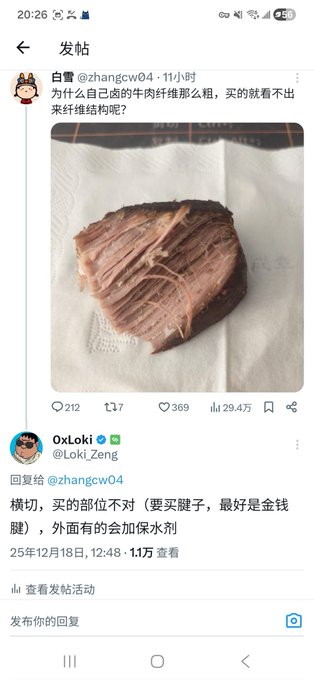
Are we all starting to talk about beef?
If I fall again, I'll have to deliver group meals; I need to familiarize myself with the process beforehand.

From Twitter
Disclaimer: The content above is only the author's opinion which does not represent any position of Followin, and is not intended as, and shall not be understood or construed as, investment advice from Followin.
Like
Add to Favorites
Comments
Share
Relevant content