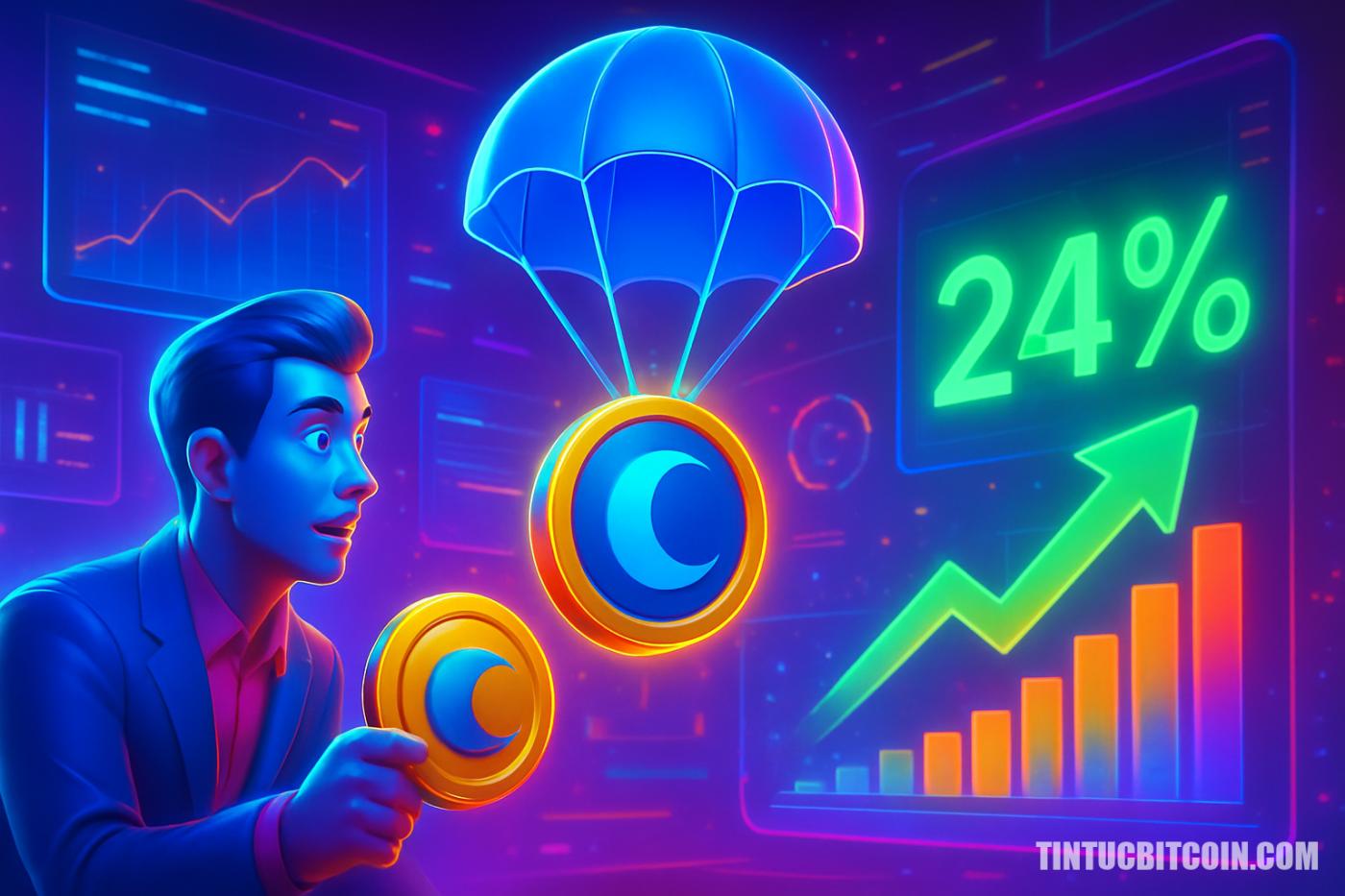
NIGHT surged 24% in 24 hours with volume soaring to $5.03 billion, indicating strong buying pressure despite the overall weakness in the privacy Token market.
Midnight's (NIGHT) surge is contrary to the trend of privacy Token, mainly driven by the Airdrop announcement and signals of ecosystem development. However, indicators of Capital flow quality and supply concentration suggest that the risk of overheating remains.
- NIGHT surged 24% with a trading volume of $5.03 billion, standing out amidst a broader privacy Token group that declined by an Medium of 0.5%.
- Inflows into the Derivative market increased to $106.05 million, but the negative funding rate indicates that Short positions still dominate in terms of contracts.
- Long-term risks stem from the decreasing number of holder and the concentration of supply: 10 wallets hold 94.13% of the circulating supply.
NIGHT surged thanks to the Airdrop despite the weak privacy Token group.
NIGHT recovered after nearly four weeks of weakness, surging 24% in 24 hours and becoming one of the strongest performing assets, in contrast to the Medium 0.5% decline of the privacy Token group according to Artemis.
The upward price momentum was accompanied by a surge in liquidation: volume during the observation period reached $5.03 billion. In market analysis, price increases accompanied by high volume usually reflect active buying pressure and high participation levels, helping the uptrend to potentially last longer in the short term.
However, NIGHT's "divergence" from the industry as a whole does not necessarily mean the trend is sustainable. The underlying strength of the rally is attributed to two factors: recent ecosystem development signals and the impact of the Token drop event, which caused speculative capital to flow in faster than the improvement in sentiment across the privacy Token group.
Momentum is increasing but it's still "tense".
NIGHT's surge was primarily driven by the Airdrop announcement, attracting a wide range of investors, including large Capital flows from the US, but the sustainability of this momentum remains unclear.
The Airdrop is expected to distribute approximately 4.5 billion NIGHT to eligible participants and officially begins on December 10th. This information has created a global effect, as investors from many regions are betting on the possibility of the price continuing to rise.
Exchange-specific data reveals a strong concentration of trading activity over the past 24 hours. Bybit recorded $3.33 billion in volume, while Binance reached $1.16 billion. These two exchanges accounted for 67.19% and 23.5% of the total market volume during the period, reflecting the concentration of liquidation in a few key trading platforms.
The volume-to- Capital capitalization ratio surged to 372% at the time of recording, indicating high trading intensity relative to Capital capitalization. This indicator could be a sign of a short-term euphoric phase: high liquidation fuels volatile prices, but it could also mean increased risk of a reversal if buying pressure weakens.
While cash inflows are increasing, the quality of Capital remains unconvincing.
Capital inflows into the Derivative market have increased sharply, but negative Funding Rate and negative Open Interest (OI)-Weighted Funding Rate indicate that Short selling still plays a significant Vai , implying that long-term confidence has not yet matched the price increase.
Perpetual market data shows circulating Capital inflow increased by over 56% in 24 hours to $106.05 million, meaning over $50 million in new Capital . This is a signal of "money inflow," which typically supports short-term price movements.
However, the Funding Rate and Open Interest–Weighted Funding Rate remain in negative territory, meaning the market structure is still skewed towards Short (based on the majority of open contracts). In this context, price increases may come from spot buying and/or Short squeezes, rather than a sustained upward consensus from leveraged Longing positions.
Profit/loss data shows that Short sellers suffered significant losses as prices rose. At the time of recording, Short traders lost $1.61 million, while Longing traders lost $418,000. Although the number of Short contracts may have been dominant, the overall Longing volume remained higher, as shown by the Longing-to- Short ratio and reinforcing the Vai of "bullish Volume" during this period.
Tokenomics deteriorates as holder decrease and supply becomes highly concentrated.
Despite the price increase, the number of holder decreased from 6,800 to 6,200, and 10 wallets hold 94.13% of the circulating supply, suggesting that concentration and distribution risks from whales could negatively impact long-term prospects.
CoinMarketCap noted a decrease in the number of holders from 6,800 to 6,200. This development is often interpreted as a tendency to "exit positions" or distribute Token to the market while the price is rising, reflecting a lack of strong confidence.
The greater risk lies in the ownership structure. Tokenomics data reveals a clear imbalance between retail investors and large wallet groups: approximately 94.13% of the circulating supply is held in 10 wallets, while retailers control only 5.87%.
This concentration is a long-term risk factor, as even a small fraction of the supply from large wallets being distributed back to the market can create significant selling pressure. In event-driven rallies like Airdrop/ Token drops, whale activity is often a crucial variable determining whether the trend shifts to sustained accumulation or reverses downward.
Conclude
NIGHT is being supported by the Airdrop narrative and very high trading volume, helping the price break out even as the privacy Token group generally weakens. However, Short -selling Derivative flows, a decrease in the number of holder , and the concentration of supply in 10 wallets are risk signals that need to be closely monitored before expecting a longer-term uptrend.
- NIGHT's ecosystem development over the past week has increased attention and Capital inflow.
- The declining number of holder and the strong tokenomics bias towards large investors remain a cause for concern.
Frequently Asked Questions
Why did NIGHT surge in 24 hours despite the privacy Token group declining?
NIGHT's rise was primarily driven by the Airdrop announcement and the ecosystem development narrative, attracting strong speculative capital inflows. Meanwhile, according to Artemis, the weighted Medium performance of the privacy asset group decreased by 0.5%, reflecting continued weak sentiment across the industry.
What is the size of the NIGHT Airdrop and when does it start?
The Airdrop is expected to distribute approximately 4.5 billion NIGHT to eligible participants and officially begins on December 10th.
Which exchanges have the highest volume ?
Over the past 24 hours, Bybit recorded $3.33 billion in volume and Binance recorded $1.16 billion. These two exchanges accounted for 67.19% and 23.5% of the total market volume during the aforementioned period, respectively.
What does a volume-to- Capital capitalization ratio of 372% tell us?
A 372% ratio indicates very high trading intensity relative to market Capital , often associated with periods of high volatility due to short-term cash flow. It can support short-term upward momentum, but also increases the risk of a reversal if "hot" liquidation is withdrawn.
Why is it said that while the inflow of capital is increasing, the quality of Capital is still not good?
Although the Capital flow into the perpetual market increased to $106.05 million, the Funding Rate and OI-Weighted Funding Rate remained negative. This implies that many open contracts are skewed towards Short, indicating that confidence in leveraged Longing positions is not yet truly dominant.
What is the biggest tokenomics risk of NIGHT?
The main risk is the concentration of supply: 10 wallets hold approximately 94.13% of the circulating supply, while retail only has 5.87%. If these large wallets distribute Token to the market, selling pressure could increase sharply and negatively impact the price.