
Summary of core viewpoints
Neura is a decentralized intelligent agent ecosystem that attempts to combine Web3 with emotional AI. Its core goal is to address the structural deficiencies of current AI products in terms of emotional continuity, asset ownership, and cross-application liquidity. In terms of project path, Neura did not start with the underlying protocol, but instead chose to begin with consumer-grade products, gradually transitioning to a developer platform, and ultimately evolving into a decentralized emotional AI protocol system. This "product first, protocol later" strategy is relatively rare in current AI + Crypto projects.
In terms of team and resource background, the Neura team possesses a relatively complete experience structure in artificial intelligence research, blockchain infrastructure, and the creator economy. It's worth noting that the project brought in former Microsoft AI and Research Vice President Harry Shum as a strategic advisor, which to some extent enhances its credibility in technology roadmap selection and industry resource connections; however, the related impact still needs further verification through product implementation.
In terms of product structure, Neura has planned a three-stage ecosystem consisting of Neura Social, Neura AI SDK, and Neura Protocol. The currently launched Neura Social serves as the front-end entry point of the entire system, its core selling point being allowing users to establish continuous relationships with AI agents possessing long-term memory and emotional feedback capabilities. Further, the Neura AI SDK aims to open up this emotional capability to third-party developers, while the underlying protocol is responsible for unifying the agent's assets, memory, and mobility, enabling users to maintain the continuity of emotions and data across different application scenarios.
It should be noted that although Neura Social has reached the usability stage, the overall ecosystem is still in the early market validation period, and the SDK and decentralized protocol are expected to be gradually rolled out in 2026. In the long term, the concept of an "emotional AI economy" presents the team with a dual challenge: on the one hand, whether users are willing to continue paying for emotional memories and relationships; on the other hand, how to transition from centralized applications to a decentralized system governed by DAO without compromising user experience.
In terms of token design, Neura adopts a dual-token structure. $NRA serves as the governance and general payment asset at the ecosystem level, while NAT acts as the exclusive asset for individual AI agents, binding their memories, relationships, and economic activities. This model aims to alleviate the problem of liquidity fragmentation of AI assets across different applications and introduce continuous token demand through a memory-locking mechanism. However, whether its economic closed loop is valid still depends on the verification of real-world use cases and user retention data.
From a sector perspective, the current AI token market generally suffers from insufficient utility and a lack of diverse product forms, with most projects remaining at the conceptual or emotion-driven stage. In contrast, Neura attempts to establish a differentiated positioning around "emotional continuity" and "asset composability," and explores application paths closer to the real economy by combining payment infrastructure with the creator economy. If this approach proves successful, its lifespan is expected to be longer than that of purely tool-based or narrative-driven AI projects.
Overall, Neura is still in its early stages, but its product-first, gradual decentralization strategy, and systematic attempts at an emotional AI economic model make it worthy of continued research and monitoring.
1. Development Background and Industry Pain Points
1.1 Introduction: The Intersection of AI, Creator Economy, and Crypto Market
Artificial intelligence, the creator economy, and the crypto market are reshaping technology production, content distribution, and value settlement systems, respectively, but the integration of these three remains highly fragmented. According to public data, the global AI market exceeded $150 billion in 2024 and continues to grow rapidly; the creator economy market surpassed $100 billion; and in the crypto space, the market capitalization of tokens related to AI-driven narratives alone has reached tens of billions of dollars. However, these markets remain disconnected in terms of user relationships, data ownership, and value capture, and a sustainable collaborative mechanism has yet to be established.
Against this backdrop, questions have gradually emerged across three major areas: how AI capabilities can be continuously used, how long-term user relationships can be formed, and how the value they create should be distributed within the network. This forms the macro-context that Neura is attempting to address.
1.2 The Centralized Structural Constraints of the Current AI Industry
While generative AI has driven rapid growth at the application layer, its underlying computing resources, model training, and inference capabilities are highly concentrated in the hands of a few large cloud services and model providers. Currently, most developers rely on centralized APIs for product building, and this structural dependence brings multiple constraints.
First, cost and predictability issues are becoming increasingly prominent. Some cloud service providers have significantly increased prices or imposed call restrictions due to demand fluctuations or adjustments in business strategies, making it difficult for startups to stably plan cost structures. Second, mainstream models lack verifiability in terms of training data, algorithmic decision-making, and bias control, creating trust barriers in high-risk application scenarios such as finance and healthcare. Finally, centralized architectures inherently carry the risk of single points of censorship and service interruptions; if core services are restricted, applications and users relying on them will face systemic shocks.
These problems are not short-term phenomena, but rather structural consequences of the current trend of centralization in AI infrastructure.
1.3 Early Exploration and Emotional Disconnect of "On-Chain AI"
In response to the challenges of centralization, the crypto space has begun exploring the "on-chain AI" path, rapidly forming new narratives and asset classes. However, in practice, most projects remain at a stage of loose combination of off-chain AI capabilities and on-chain token incentives. The core computation, data, and revenue streams of AI often still occur off-chain, with the on-chain portion primarily serving emotional trading and speculative functions, making it difficult for value to accumulate within the network.
More importantly, both Web2 AI assistants and on-chain AI agents generally lack long-term memory and emotional continuity. User interactions are often one-off, losing context once the conversation ends, which directly limits the depth and retention of user relationships. In contrast, some emotional AI applications demonstrate significantly higher user stickiness through enhanced memory and multi-turn interactions. This gap reveals a systemic deficiency in the emotional intelligence aspect of current AI products.
From this perspective, emotional capabilities and data ownership present two sides of the same challenge: without emotional continuity, AI struggles to generate long-term value; without verifiable on-chain mechanisms, emotional data is prone to repeating the concentration and exploitation seen in the Web2 model.
1.4 The core pain points that Neura addresses
Neura emerged precisely to systematically solve the aforementioned industry-level challenges. Through technological innovation and economic model design, it provides the market with a completely new and superior solution.
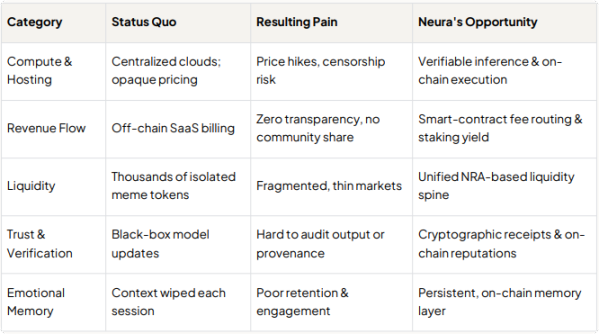
Source: Neura Whitepaper, Market Pain Points and Neura's Solutions
2. Neura Technology Principles and Architecture Explained
2.1 Technical Positioning and Boundaries of the HEI Protocol
Neura's underlying technical framework is defined as the HEI (Hyper Embodied Intelligence) protocol. Its core function is not to build general-purpose artificial intelligence, but to provide a unified management and settlement layer for intelligent agents with long-term state, inheritable memory, and verifiable identity. The design focus of HEI is not on the model capabilities themselves, but on how to continuously record and verify the state, behavior, and resource consumption of intelligent agents within the Web3 architecture.
In this framework, Xem is viewed as an intelligent process with a long-term running state, rather than a one-time AI service. HEI does not attempt to simulate complete human consciousness, but rather transforms the evolution of intelligent agents into a manageable and auditable system state through structured memory, emotional tags, and behavioral feedback.
2.2 Functional Division of HEI Four-Layer Architecture
The HEI protocol adopts a layered architecture to reduce system complexity and clearly define the responsibilities of different modules.
The data layer is responsible for managing multimodal interaction data and its access permissions, including text, voice, and behavioral feedback. The core function of this layer is not simply to store data, but to provide a continuously updated contextual foundation for models and agents, and to support verifiable referencing of data across different applications.
The model layer employs a strategy of parallel development of a general-purpose model and a personalized model. The general-purpose model provides stable foundational capabilities, while the personalized model is tailored based on long-term user interaction data. Both work collaboratively during the inference phase, thus avoiding the trade-off between generalization ability and personalization that can occur with a single model.
The Xem layer is responsible for the lifecycle management of agents, including creation, state updates, memory writing, and inter-agent collaboration. Its key role is to uniformly map behavioral changes, originally scattered across the model and application logic, to the state evolution of the agent.
The API layer serves as the external interface, providing third-party applications with capabilities for agent management, data access, and security verification. Through this layer, Xem can operate independently of a single application and maintain state continuity across different scenarios.
The following is a diagram illustrating the logical relationships within the HEI technical architecture:
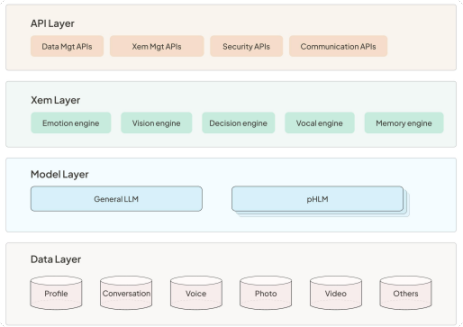
Source: Neura Yellowpaper, Logical relationship diagram of HEI technical architecture
2.3 Xem: Design of agents with long-term states
In the Neura architecture, Xem is defined as an intelligent agent with long-term state. Its core difference lies not in its conversational ability, but in whether the state accumulates over time and affects future behavior.
Xem's memory system structures and stores key information and emotional feedback from interactions, which then serve as weighting factors in subsequent decision-making. Relationship strength is not an abstract concept, but is quantified through interaction frequency, emotional feedback, and behavioral outcomes, thereby influencing the system's response path.
This design makes Xem's behavior no longer the result of a single-turn dialogue, but a function of its historical state, thus providing the technical foundation for a continuous experience across sessions and applications.
2.4 pHLM: The Boundary of Action of Personalized Mixture Models
pHLM (Personalized Hybrid Large Model) is the core model component that supports the long-term evolution of Xem. Its goal is not to build larger models, but to achieve personalized inference with controllable computational costs.
In terms of architecture, pHLM jointly models text, speech, and behavioral signals through multimodal input, and maps sentiment and contextual information into intermediate representations that can participate in reasoning. Personalized adjustments to the model are made incrementally, avoiding the performance and cost issues associated with frequent full-scale fine-tuning.
Through model compression and quantization techniques, pHLM is designed to operate in resource-constrained environments, a constraint that brings it closer to real-world deployment requirements rather than merely representing laboratory performance metrics.
In the Neura system, pHLM does not serve as an independent output value, but rather as the execution engine for the evolution of agent states, forming a complete operational loop together with the protocol layer.
3. Track Structure and Current Ecosystem
3.1 Track Positioning: From Emotional Interaction to Valuable Relationship Assets
Neura's market entry point is not in the traditional sense of AI tools or single encrypted applications, but rather in its attempt to structure "long-term emotional relationships" into quantifiable and settleable digital assets. This positioning is closer to a fundamental reconstruction of the creator economy and virtual social products, rather than opening up a new, proven track.
In the existing Web2 ecosystem, emotional relationships are always tied to platform accounts and recommendation systems, unable to be held by users or migrated across platforms. Neura's core assumption is that once emotional interactions are continuously recorded, modeled, and generate stable value output, they themselves have the potential to be abstracted into economic units. The so-called "emotional AI economy" is essentially an institutionalized attempt at this assumption, rather than a mature market classification.
From the perspective of research reports, this sector is still in the early stage where demand is established but the supply structure is not yet verified, with opportunities and uncertainties coexisting.
3.2 Ecosystem Structure: From Application Validation to Protocol Deposition
Neura's ecosystem design exhibits a clear phased approach, with its components not being parallel but rather serving as validation and refinement tools for different stages.
As a consumer-grade entry point, Neura Social undertakes the task of validating user behavior and interaction models. Its core value lies not in revenue scale, but in providing a real data environment for emotion modeling and agent evolution.
The Neura AI SDK is a technology spillover layer used to test whether Neura's emotion modeling capabilities are adaptable across different scenarios, rather than being limited to its own applications.
The Neura Protocol is the abstract endpoint of the entire system, based on the premise that the former two have proven that emotional interaction can be structured, reusable, and has stable settlement logic.
Neura Pay and Neura Wallet are not simply payment tools, but key components used to test whether the value within the ecosystem is externally exchangeable. Their significance lies in "whether there is real-world acceptance," rather than the technical complexity of the payment itself.
Overall, this ecosystem structure is more like a path for the accumulation of behavioral data into protocol-based value, rather than a one-time construction of a complete decentralized system.
3.3 The Boundaries of Web3 Mechanisms: Minimizing Trust Rather Than Maximizing Experience
Neura's use of Web3 is not an attempt to improve user experience, but rather to reduce trust costs, which is a more restrained and rational aspect of its design.
At the data level, only hashes and state proofs are stored on the chain, rather than the original interaction content. This design is in line with the current real-world constraints of blockchain in terms of cost and privacy.
At the identity level, breaking down Xem's appearance, behavior, and capabilities into modular NFTs essentially reduces the migration costs of digital identities, rather than simply emphasizing an "ownership narrative." Its value depends on whether these modules are actually adopted by third-party applications, not on their existence on the blockchain.
At the collaboration level, smart contracts serve to automate task allocation and revenue settlement, rather than attempting to replace complex organizational governance. This positioning avoids systemic friction caused by excessive on-chain implementation.
Structurally, Neura does not abuse decentralization, but rather limits it to processes that require verifiability and settlement.
The following is a flowchart illustrating decentralized collaboration and task automation:
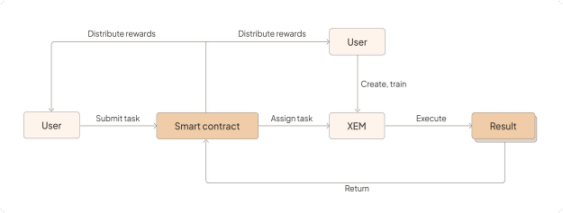
Source: Neura Yellowpaper, Decentralized Collaboration and Task Automation Flowchart
3.4 Data Economy and Governance Structure: Incentives Exist, Constraints Still Need Observation
Neura's data incentive mechanism revolves around a core premise: high-quality sentiment data is a scarce asset, and users are willing to continue contributing under a clear reward structure. Token incentives can theoretically align this behavior, but their actual effectiveness still heavily depends on data quality assessment and the design of costs for cheating.
At the governance level, viewing Xem as an on-chain asset that can be collectively held and its benefits distributed represents a somewhat experimental organizational form. Its advantage lies in directly linking benefits to contributions, but a potential problem is whether collaboration efficiency and decision-making complexity will rapidly increase as the number of participants grows; empirical evidence for this remains lacking.
Overall, Neura's economic and governance model has a complete structure, but it is still in the stage where the mechanism is established and the game outcome has not been verified.
4. Representative Project Analysis and Competitor Comparison
4.1 Competitive Landscape: Neura faces a dual competitive landscape.
Neura's competitive environment is not a single track, but rather spans two significantly different competitive curves. One comes from mature centralized emotion AI platforms, and the other comes from crypto AI projects that are still in the early stages of exploration.
The former possesses clear user demand validation and a mature product form, but its business model and ownership structure are highly centralized; the latter is more aggressive in its decentralized narrative and on-chain mechanisms, but most have not yet formed stable consumer demand. Neura's strategy is to find the intersection between these two curves, rather than confronting them head-on.
4.2 Neura's Core Differentiation Structure
Before making a comparison, it is necessary to clarify that Neura's core difference does not lie in leading in a single metric, but rather in the choice of system structure.
First, at the level of emotional interaction, Neura emphasizes modeling emotional states across conversations and time. This design is not inherently superior to short-term responsive AI, but it is based on the assumption that long-term relationships inherently possess the potential for economic value accumulation.
Secondly, in terms of economic structure, Neura adopts a two-tier design with macro liquidity tokens and micro proxy assets. The purpose is to avoid the functional conflicts caused by a single token simultaneously undertaking payment, governance and value capture, rather than simply pursuing complexity.
Third, in terms of compliance and auditing, Neura prioritizes verifiability as a system attribute rather than an ex-post patch, which is significant in reducing the reconstruction costs in the future in case of conflicts with the regulatory framework.
Finally, on the path to decentralization, Neura explicitly chose to postpone protocolization, prioritizing user and data verification—a conservative but realistic approach.
These structural choices do not necessarily constitute a moat, but they determine Neura's different solutions to problems compared to its competitors.
4.3 Comparison with Centralized Emotional AI Platforms
Centralized emotional AI platforms, such as Character.AI, excel in model response quality, content security control, and user growth efficiency. These platforms have demonstrated that users are willing to invest time in AI that provides emotional companionship.
However, its structural limitations are equally clear: emotional relationships and historical data are completely tied to platform accounts; creators cannot migrate user assets, and users cannot take the relationships themselves. For the platform, this is an efficient growth model; for creators and users, it means that long-term value depends entirely on the platform's rules.
Neura's difference lies not in whether its emotional AI capabilities are stronger, but in its attempt to separate "relationships themselves" from platform accounts, transforming them into independently settleable asset units. The success of this attempt depends on whether users truly care about this ownership difference.
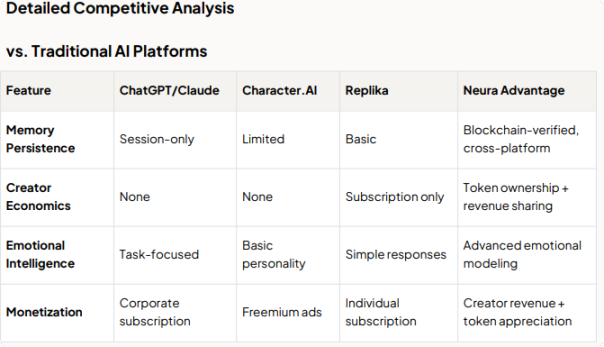
Source: Neura Whitepaper, comparison with centralized emotion AI platforms
4.4 Comparison of Encrypted AI Projects
Most current crypto AI projects focus on computing power, data markets, or model invocation layers. They are characterized by clear narratives and straightforward token structures, but user-side needs have not yet been fully met.
Neura differs in that it invests its main resources in consumer-grade applications, using this as a basis to develop protocol abstractions. The risk of this approach lies in the high product complexity and long verification cycle; however, its potential benefit is that once the demand is met, the protocol layer will have higher real-world stickiness.
From the perspective of research reports, this is not a matter of "good or bad", but rather two different choices of risk preference.
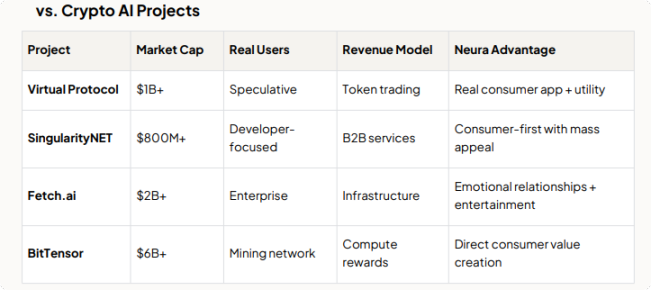
Source: Neura Whitepaper, comparison with encrypted emotion AI projects
4.5 A Practical Interpretation of Market Positioning and Offensive/Defensive Logic
Neura's market positioning is not to compete for existing AI or crypto users, but to try to verify a premise: whether long-term emotional interaction is sufficient to form a sustainable economic system.
Its defensive capabilities mainly come from three types of costs:
Users' time and emotional investment in relationships, creators' path dependence on revenue structures, and the continued shaping effect of early data on model behavior. These factors theoretically constitute switching costs, but their strength still needs time to be verified.
Their offensive strategy is more reflected in their timing: first verify the demand, then expand the ecosystem, and finally solidify the protocol, rather than going completely decentralized from the start. This strategy reduces the probability of early failure, but it also means giving up some narrative advantages.
5. Risks, Challenges, and Potential Problems
5.1 Risk Assessment Prerequisites
Neura's overall design encompasses emotional AI, consumer applications, token economics, and decentralized infrastructure, making it significantly more complex than projects in a single sector. This means its risk does not stem from a single point of failure, but is more likely to arise from the failure of coupling between multiple subsystems.
5.2 Technical Layer Risks: The Tension Between Quality Consistency and Scalability
- The quality of emotional interaction cannot be linearly scaled.
The core risk of emotional AI lies not in whether the model is "smart," but in whether it can maintain consistent and credible behavioral patterns over the long term. Once Xem's emotional feedback shows obvious repetition, logical breaks, or personality drift, users' perception of the "authenticity of the relationship" will collapse rapidly.
This problem is often masked in small-scale testing, but it is easily exposed when the user base expands, and the cost of fixing it is higher than that of traditional functional AI.
- Verifiable design introduces system load risks.
Neura puts memory hashes and key interactions on-chain in exchange for verifiability. This design is logically sound, but as the user base grows, it will put continuous pressure on on-chain throughput, fee structure, and end-user experience.
Even on high-performance chains, if the frequency cannot be effectively reduced through batch processing, asynchronous verification, or off-chain proof mechanisms, its "verifiability advantage" may instead turn into a growth bottleneck.
- The combined security aspect of AI + Web3
Neura is simultaneously exposed to three attack surfaces: model security, contract security, and data privacy. A systemic vulnerability in any of these areas could lead to irreversible damage to trust. Unlike individual Web3 projects, the risk of leaked sentiment data has far greater social and compliance consequences.
5.3 Market and GTM Risks
- Learning and transfer costs for creators
Neura's requirements for creators go beyond just providing content; they also include participation in AI training, economic design, and long-term maintenance. This "deeply participatory" creator model naturally raises the barrier to entry.
If a platform cannot attract top creators with the ability to continuously invest in their work in the early stages, it will be difficult to create a successful model that can be exemplified, which will affect its subsequent expansion.
- The psychological risks of the "memory lock" mechanism
Memory locks are essentially a relationship subscription mechanism, and their success depends on users' willingness to pay for "relationship continuity." This assumption may hold true among a small group of highly engaged users, but it remains uncertain for a broader population.
Once users develop negative feelings about "forgetting when payments stop," the mechanism may reverse from a retention tool to a churn trigger.
- Asymmetry of competitive response
Once the commercial value of emotional AI is validated, large tech companies have the ability to quickly follow suit through product integration, cross-subsidization, and distribution channels. Whether Neura's structural advantages are sufficient to withstand this asymmetric competition remains to be empirically proven.
5.4 Economic Models and Regulatory Risks
- Behavioral bias risk of dual-token models
The design of $NRA + $NAT logically solves the problem of separating liquidity from value capture, but in the real market, the behavior of users and speculators often deviates from the original design intention.
If the price of $NAT fluctuates too much, it may negatively affect users' perception of the value of relationships; if it is more often regarded as a trading asset, its governance function will be weakened.
- Uncertainty exposure across regulatory areas
Neura's involvement in AI-generated content, user sentiment data, and cryptocurrency issuance makes it significantly more vulnerable to regulatory scrutiny than projects operating in a single sector. Future changes in data compliance, content responsibility, or token characterization could force the project to make costly adjustments to its product or economic structure.
6. Future Potential, Trend Outlook, and Investment Logic
6.1 Strategic Positioning and Phase Planning
Neura employs a progressive decentralization strategy, sequentially completing three phases: market validation, ecosystem expansion, and protocol decentralization.
- Phase 1: Market Validation (Q4 2025)
By leveraging Neura Social, we validate product-market fit, collect user and creator interaction data, and optimize the core experience of emotional AI.
- Phase Two: Ecosystem Expansion (Q1-Q2 2026)
The company released the Neura AI SDK, opening up its emotional AI capabilities to third-party developers, and conducted a token generation event (TGE) to expand its developer ecosystem and replenish its cash flow.
- Phase 3: Full Decentralization (Q3 2026 – Q2 2027)
The decentralized protocol transitions to community governance, with core infrastructure running by distributed network nodes and key decisions being executed by veNRA holders through on-chain governance.
Key time points:
2025.11: Neura Social Release
February 2026: Neura AI SDK Released
2026.07: Token Generation Event (TGE)
2026.08: Decentralized protocol testnet launched
January 2027: The mainnet officially launches, achieving complete decentralization.
6.2 Investment Logic and Value Capture
Token economic model
$NRA Value Driven
- In-platform interaction, subscriptions, and SDK usage fee payments
- veNRA lock-in participation protocol governance
- Infrastructure pledging and liquidity anchoring
- Part of the revenue from the agreement was used for buybacks and burns, creating a deflationary effect.
NAT Value-Driven
- Economic ownership representing a specific AI agent
- The proceeds will be distributed to NAT holders, and NATs will be repurchased.
- This is directly linked to the popularity of the agency, forming a closed loop of creator incentives and community engagement.
Network effects and user stickiness
- Increased user base and number of creators → Increased data volume → Enhanced personalization capabilities of the pHLM model
- A superior AI experience attracts more users, creating a positive growth cycle.
- The deep emotional connection between users and agents increases conversion costs, creating a competitive advantage that is not easily replicated.
Network growth flywheel:
Flywheel 1: Ecosystem Growth
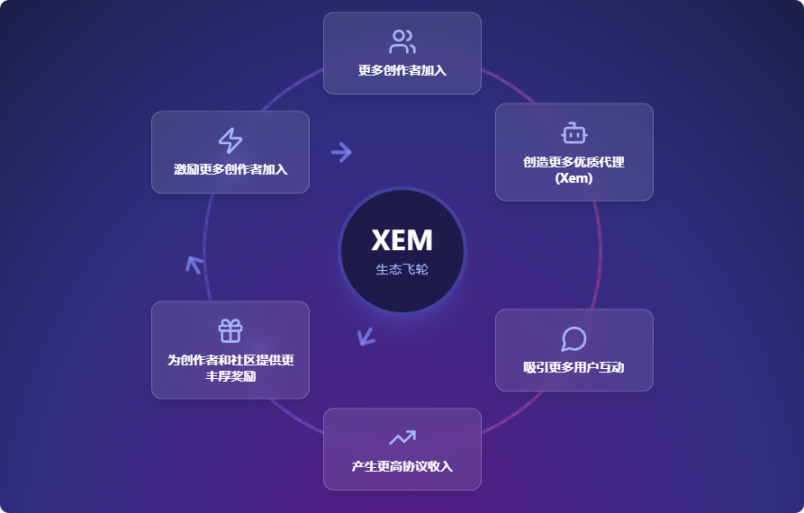
Image source: Self-made image
Flywheel 2: Token Value Growth
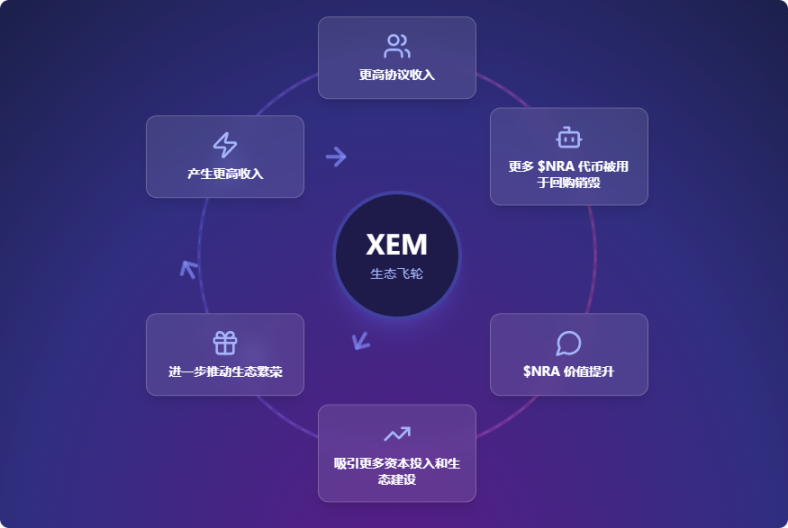
Image source: Self-made image
7. Summary and Outlook
Neura has established a decentralized intelligent economic framework centered on emotional relationships by combining Web3 with emotional AI technology. Its core value lies in:
Technical and architectural verifiability: The four-layer HEI architecture and pHLM engine provide quantifiable emotional interaction capabilities, and the on-chain recording of interaction records ensures verifiability and transparency.
Economic Model Design: The $NRA + NAT dual-token system combines macroeconomics and microeconomics to achieve value flow and liquidity anchoring, providing clear economic incentives for creators and the community.
A gradual decentralization path: Through a three-stage strategy of Neura Social → SDK → Protocol, the project first verifies the product's market fit, then expands the ecosystem, and finally achieves complete decentralization.
Amid multiple challenges from technology, market conditions, and regulations, Neura's value capture logic relies on: user growth, creator activity, the NAT revenue cycle, and the healthy operation of on-chain economic flows. If these key metrics materialize as designed, Neura has the potential to become the first verifiable case of combining emotional AI with a decentralized smart economy, capturing real value at the intersection of AI, the creator economy, and the crypto market.
The above are personal opinions and are for reference only. (DYOR)