Author: TechFlow TechFlow
Yesterday's Market Dynamics
Spot gold rose above $4,450 per ounce this morning, setting a new all-time high.
According to Jinshi Data, spot gold rose above $4,450 per ounce this morning, setting a new historical high, up 0.15% on the day.
Michael Selig has been officially sworn in as Chairman of the U.S. CFTC.
According to Cryptobriefing, pro-Bitcoin figure Michael Selig has been officially sworn in as chairman of the U.S. Commodity Futures Trading Commission (CFTC), after being confirmed by the U.S. Senate.
In a statement, Selig said the CFTC is undergoing a major transformation, driven by increased retail participation and the emergence of new products and platforms. He noted that the agency will play a greater role in developing practical regulatory standards for the digital asset market, while maintaining the stability and security of the U.S. derivatives market. Selig emphasized, "We are at a unique moment, with a surge of new technologies, products, and platforms, record-high retail participation in commodities markets, and Congress about to submit legislation to the President on the structure of the digital asset market, solidifying the U.S. as the 'crypto capital'."
Prior to joining the CFTC, Selig served as Chief Legal Counsel and Senior Advisor to Paul Atkins, Chairman of the Cryptocurrency Task Force at the U.S. Securities and Exchange Commission (SEC).
Federal Reserve Governor Milan: The need for a 50- basis-point rate cut has diminished.
Federal Reserve Governor Milan stated that with the recent adjustments to monetary policy, the necessity for his previous advocacy of a 50-basis-point rate cut has diminished. Milan pointed out that some unusual fluctuations in previous inflation data were partly related to the government shutdown. These unusual signals indicate that the Fed's policy stance should be adjusted towards a more accommodative direction. He emphasized that he does not currently see the risk of an economic recession in the short term, but believes that the neutral interest rate level has clearly shifted downward, and monetary policy must reflect this structural change. If the policy rate fails to continue to decline to approach the new neutral level, it may actually increase the risk of an economic recession. Furthermore, regarding his own term, Milan admitted that he is still uncertain whether he will remain in office. He stated: "If no successor is confirmed by the end of January, I will assume that I will continue to serve."
Uniswap's "UNIFication" fee switch proposal has reached the 40 million vote threshold for passage and will take effect this week.
According to Cointelegraph, Uniswap's fee switch proposal "UNIfication" has reached the threshold of 40 million votes and will take effect this week.
As of Monday, the proposal had garnered nearly 69 million votes in favor, with voting ending on Thursday (Christmas). After its passage, there will be a two-day lock-up period, after which the Uniswap v2 and v3 fee switches will be activated on the Unichain mainnet, triggering the burning of UNI tokens.
The proposal would burn 100 million UNI tokens from the Uniswap Foundation treasury and implement a protocol fee discount auction system to increase returns for liquidity providers. These changes are expected to significantly improve the supply and demand dynamics of the UNI token, enhancing its long-term holding value.
Since voting began, the price of UNI has risen by more than 25%, and it is currently trading at $6.19.
Espresso: The ESP airdrop eligibility check portal is now open; token redemption will begin in early 2026.
According to an official announcement, the Espresso Foundation, the blockchain infrastructure provider, has officially launched its token registration portal. Users can now connect their wallets to check their eligibility for Espresso airdrops. The token claim page will open in early 2026.
Previously, it was reported that Espresso completed a $28 million Series B funding round in 2024, led by a16z.
Hyperliquid responded to transparency concerns, emphasizing that its on-chain solvency is fully verifiable.
Hyperliquid has released a statement responding to a recent article that raised several questions about its platform. The statement emphasizes that Hyperliquid is built on on-chain transparency, the platform is fully reimbursable, and every dollar is traceable and verifiable. The official statement points out that critics have ignored the existence of HyperEVM USDC and incorrectly claimed that the system is short $362 million.
The statement clarifies that the testnet functionality is only for testing environments and cannot be executed on the mainnet; the platform has no privileged users or fee waivers; the CoreWriter functionality has been misunderstood and cannot arbitrarily mint tokens or move user funds.
Hyperliquid emphasizes that as the only major perpetual contract platform with complete transparency of all states and transactions, anyone can run a node to verify the on-chain state, and every order, transaction, and settlement can be verified in real time. This transparency advantage is not available to other major trading platforms.
Sources say Polymarket plans to launch its own L2.
Polymarket trader PredictTrader (@polymarketbet) summarized recent information released by Polymarket team member Mustafa in a social media post, with the following key points:
Polymarket plans to migrate away from Polygon and launch its own Ethereum L2 service, POLY. Launching POLY is a "top priority."
Polymarket plans to abandon all third-party vendors (GoldSky, Alchemy, etc.).
This week, Polymarket will launch a 5-minute market.
Metaplanet, Japan's largest Bitcoin holder, approves issuance of dividend- paying preferred stock.
According to Cointelegraph, Metaplanet, Japan's largest corporate Bitcoin holder, approved a comprehensive overhaul of its capital structure on Monday, allowing it to raise funds from institutional investors through the issuance of dividend-paying preferred shares. The approved proposals include reclassifying capital reserves, doubling the authorized number of Class A and Class B preferred shares, and modifying the dividend structure to introduce floating and periodic dividends. Class A preferred shares will adopt a monthly floating dividend mechanism, while Class B preferred shares will offer quarterly dividends and be open to international institutional investors. Metaplanet reportedly currently holds approximately 30,823 bitcoins, worth $2.75 billion, making it the largest corporate Bitcoin holder in Asia. The company also announced it will further expand its global market presence by trading American Depositary Receipts (ADRs) on the US over-the-counter market.
JPMorgan Chase is considering offering cryptocurrency trading services to institutional clients.
According to Bloomberg, Wall Street giant JPMorgan Chase is evaluating the possibility of offering cryptocurrency trading services to its institutional clients. Sources familiar with the matter said the bank's markets division is exploring products and services to expand its cryptocurrency offerings, potentially including spot and derivatives trading.
Coinbase acquires prediction market startup The Clearing Company
According to The Block, Coinbase has reached an agreement to acquire prediction market startup The Clearing Company, with the transaction expected to close in January 2026. This acquisition is part of Coinbase's "all-in-one exchange" strategy, aimed at deepening its presence in the event trading space. The Clearing Company team will join Coinbase to help expand its prediction market product. Founded this year, the startup raised $15 million in seed funding in August, with investors including Coinbase Ventures.
Trump Media invests $13.44 million to acquire 150 BTC.
According to Arkham monitoring data, about 9 minutes ago, Trump Media, owned by Trump, spent $13.44 million to increase its holdings of 150 BTC. Trump Media's current Bitcoin holdings have reached 11,241, worth about $1 billion.
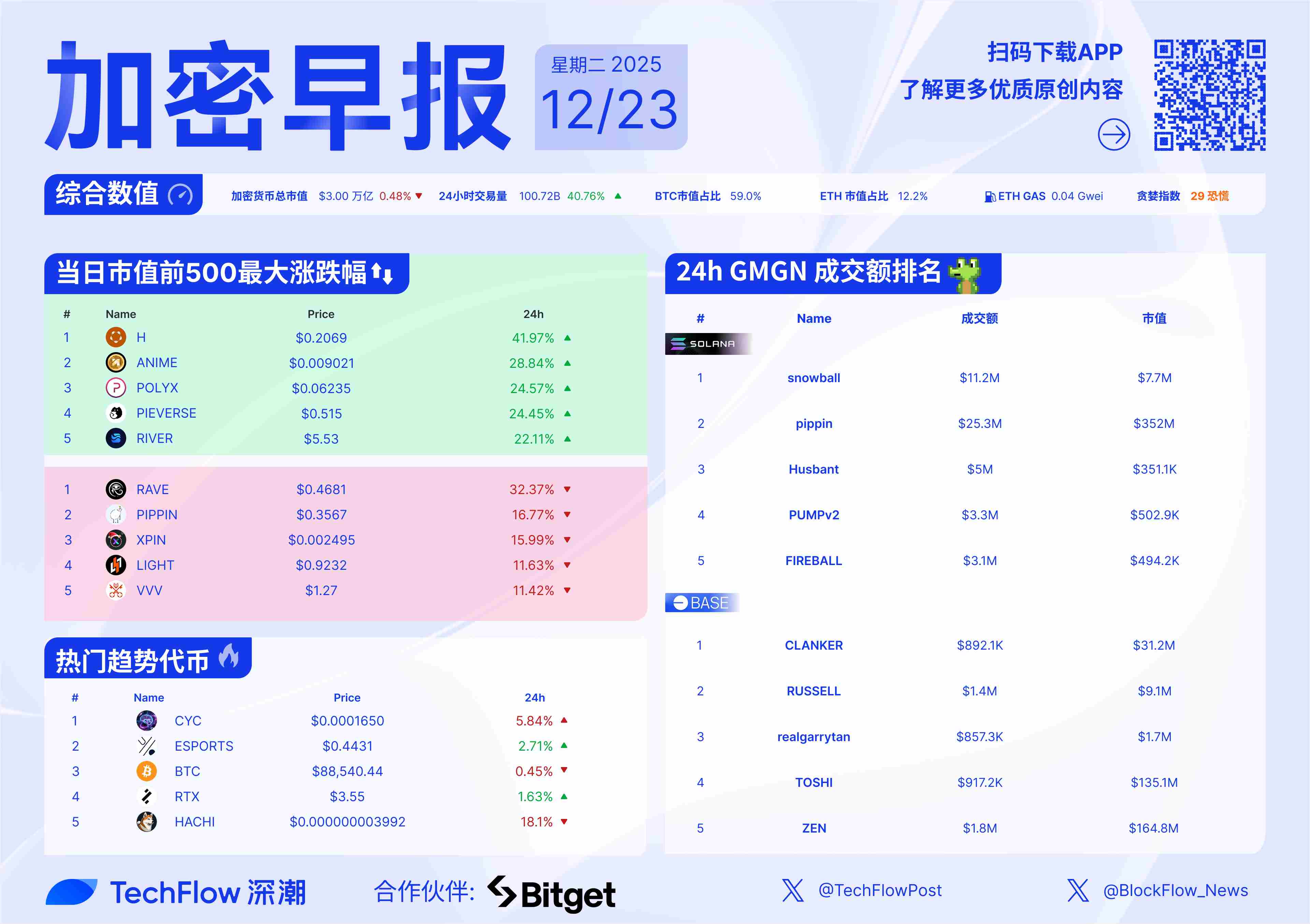
Market Dynamics
Recommended reading
This article details Snowball, a new type of meme coin that uses an automated market maker (AMM) mechanism to convert transaction fees into buying power and liquidity, preventing developers from simply absconding with the funds. Snowball's mechanism includes: automatic token buybacks, increasing liquidity pool depth, and token burning to create deflation; its creator fee percentage fluctuates with market capitalization. This mechanism relies on continuous growth in trading volume to maintain its snowball effect, but may face challenges in the current sluggish market environment.
Coinbase 2026 Crypto Market Outlook: Deep Financial Integration, Innovation Amid Cautious Optimism
This article discusses the critical stage at which the crypto industry is deeply integrating with the core of finance. It primarily explores the outlook for the crypto market in 2026, including analysis of market structure, tokenization, technological changes, and regulatory dynamics, and proposes key directions for future development. Furthermore, the article mentions specific crypto industry trends such as the rapid growth of stablecoins, the potential of prediction markets, and the composability of crypto derivatives.
This article, based on Messari's annual report "The Crypto Theses 2026," analyzes the reasons for the comprehensive collapse of crypto market sentiment in 2025. While there was no systemic market crash, sentiment plummeted to historic lows. The report points out that this phenomenon reflects a deep misalignment between market participants and market structure, particularly the oppression of savers by imbalances in the monetary system. Furthermore, the report explores the establishment of Bitcoin's (BTC) status as "real money" and its impact on other Layer 1 blockchains.
Tracking 118 cryptocurrencies launched in 2025, 85% are trading below their initial valuation.
This article analyzes token generation data released in 2025. 85% of tokens are currently valued lower than their initial offering value, with the median token showing a 71% drop in fully diluted valuation and a 67% decrease in market capitalization. The crypto market is undergoing a transformation from a retail-speculated model to an institutionally-dominated ecosystem. Stablecoin payments are becoming increasingly centralized, with significant growth in transaction volume and frequency. Furthermore, the AI agent economy and crypto finance sectors also demonstrate both future potential and challenges.
This paper analyzes the use of stablecoins in blockchain payments, focusing on the transaction patterns of USDT and USDC, two major stablecoins on the Ethereum network. Through data filtering methods and tagging techniques, the paper explores the adoption rate, transaction type distribution, payment drivers, and future trends of stablecoin payments.