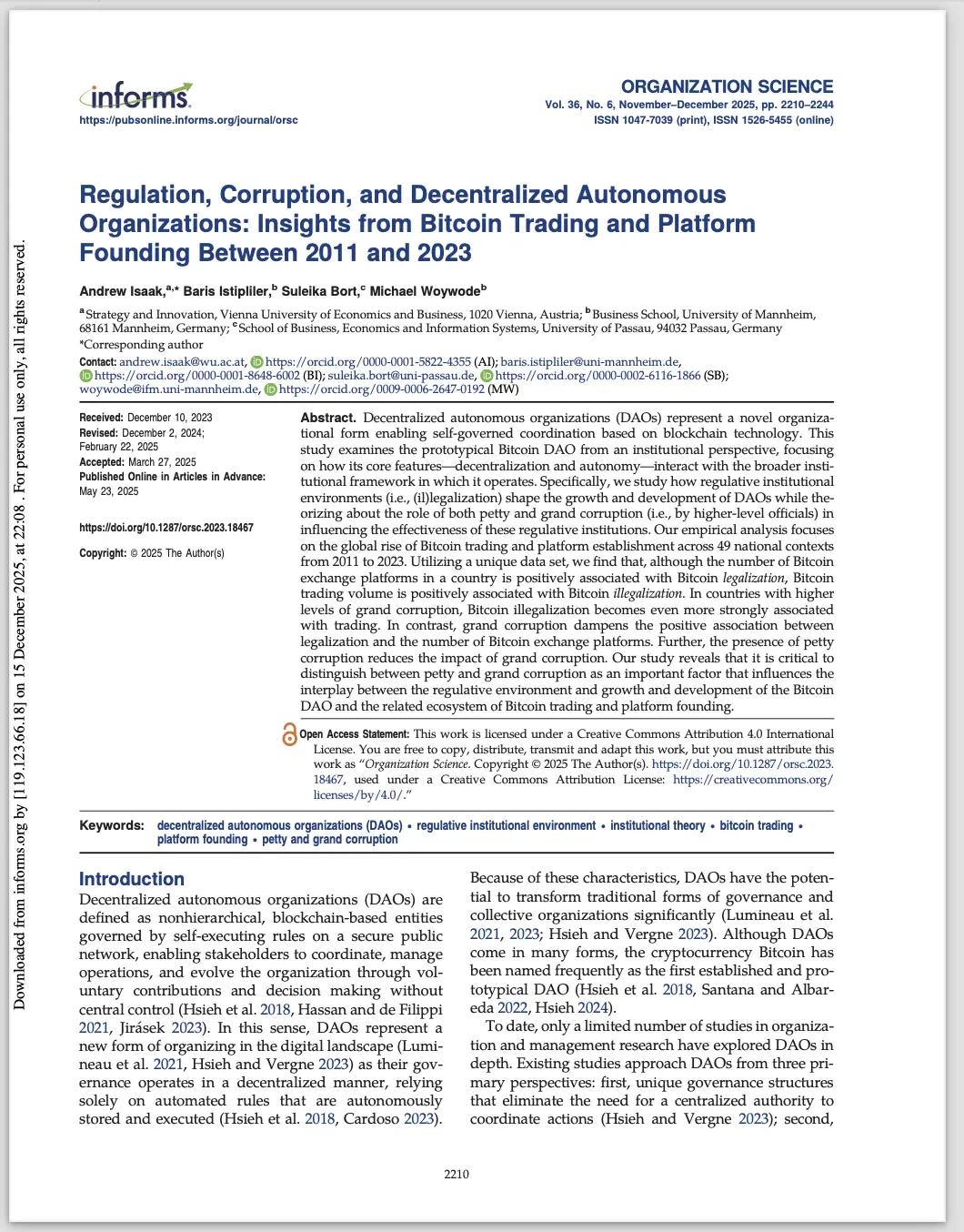
Author | Andrew Isaak, Baris Istipliler, Suleika Bort, Michael Woywode
Source | Organization Science
This study analyzed Bitcoin data from 49 countries from 2011 to 2023, revealing a counterintuitive finding: while Bitcoin legalization promotes the establishment of trading platforms, countries that declared it illegal actually saw a more than 130% increase in trading volume. The study found that Bitcoin's decentralized and anonymous nature renders traditional regulatory logic ineffective. Large-scale corruption weakens the positive effects of legalization but amplifies the surge in transactions resulting from illegality. Small-scale corruption acts as a "lubricant" in environments of large-scale corruption, helping entrepreneurs circumvent bureaucratic obstacles. More interestingly, decentralized Bitcoin actually relies on centralized trading platforms for its development, with 92.3% of transactions occurring on centralized exchanges. This study suggests that simple bans may be counterproductive. Governments need more refined, tiered regulatory strategies; entrepreneurs should choose legal and well-regulated markets; and investors need to understand the profound impact of the institutional environment on the market. This study provides an important empirical foundation for understanding the interaction between decentralized organizations and traditional institutional environments. The Financial Technology Research Institute of Renmin University of China (WeChat ID: ruc_fintech) has compiled the core parts of the research.
I. What is a decentralized autonomous organization?
Imagine an organization without a CEO, headquarters, or board of directors, yet capable of coordinating millions of people globally, processing trillions of dollars in transactions, and operating stably for over a decade. This is the reality of Bitcoin as the first decentralized autonomous organization (DAO).
DAOs are based on blockchain technology and automatically execute decisions through pre-written code. All transactions are recorded on a public, transparent, and immutable ledger. Thousands of nodes worldwide maintain the network, ensuring the system continues to function even if some nodes are shut down. The total supply of Bitcoin is limited to 21 million, gradually released through "mining."
As of October 2024, Bitcoin's market capitalization reached $1.34 trillion, accounting for 54.92% of the cryptocurrency market. However, it has been controversial from the beginning, being seen as a pioneer of financial innovation while also being accused of being a tool for money laundering and crime. Governments around the world have vastly different attitudes—the United States and Japan have legalized it, China and India have banned it, while South Africa and Italy are in a gray area.
II. Regulatory Dilemmas and Challenges
The vast divergence in global regulation
Japan became the first country to officially recognize Bitcoin as a legal payment method in 2017. However, China has banned financial institutions from participating in Bitcoin transactions since 2013, and India implemented a ban in 2018 (which was lifted in 2020). This fragmentation of regulation provides opportunities for "natural experiments" in research.
Traditional regulatory frameworks have failed.
Governments worldwide face unprecedented challenges. The Bitcoin network comprises thousands of nodes globally, meaning it continues to operate even if a country shuts down all its nodes. There is no headquarters to seize, no CEO to arrest. While every transaction on the blockchain is publicly verifiable, the real identities of participants are cryptographically protected, making it extremely difficult to trace specific individuals.
"In this type of business, regulation is always key," said the co-founder of the Localbitcoins platform. He addressed traders' motivations: "There's certainly profit-driven motives, but there's also ideological one. Some people want to make cryptocurrency more widespread."
III. The Two Faces of Corruption
Research has found that to understand how corruption affects Bitcoin, it is necessary to distinguish between two forms:
Large-scale corruption : Occurs at the top of power, involving high-ranking officials abusing their power to formulate policies for specific interest groups. It is large in scale and involves high sums of money, but infrequent, and its impact is systemic.
Small-scale corruption occurs at the lower levels of the bureaucracy and involves civil servants who directly interact with the public. A "fast-track fee" expedites permit approvals; it is frequent, small in amount, and seen as a "lubricant" to keep the rigid machine running.
There are four key differences between the two: scale and frequency, legal regulation, enforcement strength, and cultural attitudes. Large-scale corruption is explicitly condemned, while small-scale corruption has an ambiguous moral standing and is even regarded as "social etiquette" in some cultures.
When significant corruption exists, even if Bitcoin is declared legal, entrepreneurs will not trust the decision, as policies could change at any time for special interests. Data shows that for every 2.5 points increase in significant corruption, the platform growth resulting from legalization decreases by approximately one.
Conversely, while petty corruption is also a systemic flaw, it provides opportunities for ordinary entrepreneurs. In countries where both large-scale and small-scale corruption are rampant, entrepreneurs have found ways to survive in the cracks.
IV. Four Core Discoveries
Finding 1: Legalization Promotes Platform Creation
When a country officially legalizes Bitcoin, the number of trading platforms increases significantly, averaging about seven more. Legalization eliminates the biggest uncertainty for startups; banks are willing to provide services, lawyers can offer advice with confidence, and all supporting services are readily available. Early legalization countries like Singapore, the UK, the US, and Hong Kong have an average of more than 10 trading platforms.
Finding 2: The ban actually boosted transactions.
The most counterintuitive finding: In countries that have declared Bitcoin illegal, trading volume has actually increased by over 130%. Countries that have implemented bans, such as Venezuela, Vietnam, and Nigeria, are among the top in global trading volume.
There are three mechanisms behind this. First is the psychological "forbidden fruit effect"—when people feel their freedom is threatened, they actually want what is forbidden. Second is ideological drive—early adopters distrusted traditional finance and saw Bitcoin as a tool of resistance; government bans only confirmed its disruptive nature. Third is the technological nature—Bitcoin's anonymity makes bans difficult to enforce, and tracking specific individuals is extremely costly.
Finding 3: The Dividing Effect of Large-Scale Corruption
Large-scale corruption exhibits a divisive effect on regulatory effectiveness. Even when legalized, countries with severe large-scale corruption struggle to gain the trust of entrepreneurs. When the large-scale corruption index exceeds 20 points (including nearly 80% of the sampled countries), the growth effect of legalized platforms is essentially negated.
However, in the context of illegality, large-scale corruption has the opposite effect. In countries with an average level of large-scale corruption (around 40 points), if Bitcoin is illegal, for every additional point of corruption, individual transaction volume increases by 30%. When a corrupt government declares an activity illegal, the public questions the legality of the ban: "You corrupt officials don't follow the rules yourselves, so why should we?"
Evidence suggests that some countries that have declared Bitcoin illegal are actually secretly holding or trading it themselves. For example, China bans domestic trading, but reportedly controls approximately 21% of the global mining market. Once this inconsistency is exposed, the moral basis for the ban vanishes.
Finding 4: The lubricating effect of small-scale putrefaction
In countries where large-scale corruption is at an average level and Bitcoin is legal, every additional cent in small-scale corruption can offset the negative impact of large-scale corruption on approximately one platform. In institutional environments already distorted by large-scale corruption, small-scale corruption offers a degree of flexibility.
When entrepreneurs face complex licensing procedures and vague regulatory requirements, some "flexible approaches" make things easier. This is like "oiling the wheels"—the bureaucratic machine is inherently rigid and inefficient, but small-scale corruption provides lubrication, allowing the machine to at least barely keep running.
In countries where large-scale corruption is rampant and Bitcoin is banned, smaller-scale corruption further inflates transaction volumes. Local officials responsible for enforcing the ban, accustomed to petty rent-seeking, may turn a blind eye to prohibited transactions. Data shows that for every additional cent of small-scale corruption, individual transaction volume increases by approximately 30%.
V. The Paradox of Centralization and Decentralization
This study found that the development of Bitcoin as a decentralized organization is actually heavily reliant on centralized trading platforms.
In theory, anyone can obtain Bitcoin through "mining." However, in reality, the computational effort required for a single Bitcoin transaction is equivalent to a household's monthly electricity consumption. Effective mining necessitates investing in expensive equipment and incurring enormous electricity costs (in some countries, the cost of mining one Bitcoin can reach $245,000). This is completely impractical for the average person.
Therefore, for the vast majority of people, entering the world of Bitcoin is through trading platforms—buying Bitcoin with fiat currency. And the vast majority of these platforms are centralized, with clearly defined corporate entities, and must comply with the laws of the countries in which they operate. Data shows that 92.3% of Bitcoin transactions occur on centralized exchanges.
This is the paradox—Bitcoin's philosophy is decentralization and censorship resistance, yet its growth relies on centralized platforms that can be regulated and shut down. These platforms are Bitcoin's bridge to the masses, but also its greatest vulnerability.
The collapse of Mt. Gox serves as a warning. In 2013, the exchange handled 70% of global Bitcoin transactions, but suddenly went bankrupt in 2014, with 850,000 Bitcoins disappearing. The 2022 collapse of FTX also shocked the world; the exchange, once valued at $32 billion, collapsed within days due to the misappropriation of customer funds.
Decentralized exchanges (DEXs) are indeed developing, but so far they only account for about 7.7% of total trading volume and face challenges such as slow trading speeds, poor user experience, and insufficient liquidity.
VI. Lessons Learned from Practice
To policymakers:
Data shows that simply declaring Bitcoin illegal will not stop transactions; on the contrary, it may stimulate growth. Instead of a blanket ban, a tiered approach is better: strict regulation of trading platforms, leniency towards ordinary individual holders, and enhanced monitoring of suspicious large transactions.
In environments rife with corruption, the effectiveness of either legalization or illegalization is significantly diminished. Before introducing any new regulatory policy, the first question to ask is: Does our institutional environment have sufficient credibility to support this policy? Anti-corruption efforts and regulatory innovation need to proceed in parallel.
While Bitcoin is decentralized, trading platforms are centralized, meaning they can be regulated. Rather than viewing all activity as a threat, compliant platforms should be seen as regulatory tools and partners.
For entrepreneurs:
Establishing a trading platform in a country where it is legalized has a much higher probability of success. Countries like Singapore, Switzerland, the UK, and Japan not only have clear legal status but also mature regulatory frameworks. Although compliance costs may be higher, it is a more prudent choice in the long run.
In countries with vague regulations or where legal practices are rife with corruption, greater caution is needed. Large-scale corruption can render even nominally legitimate businesses highly uncertain. Unless there are deep political and business connections, the risks are extremely high.
Even in regulatory-friendly countries, the cryptocurrency industry remains volatile. A strong compliance team is essential to quickly adapt to policy changes. Diversifying market presence can mitigate risk; avoid betting all resources on a single country.
To investors:
As a trader, you need to choose based on your risk appetite and available resources. If you prioritize security and convenience, choose a licensed, large platform in a country where trading is legal. If you value privacy and autonomy more, peer-to-peer trading or decentralized exchanges may be more suitable.
Many Bitcoin holders are motivated not only by economics, but also by distrust of traditional finance and an affinity for the decentralized ideal. It's crucial to be aware of one's motivations and avoid letting emotions dictate decisions. A common pitfall is "confirmation bias"—selectively focusing on information supporting one's viewpoint while ignoring negative news.
When choosing a platform, don't just look at transaction fees and the number of cryptocurrencies available; pay more attention to its security record, regulatory compliance, transparency, and risk control mechanisms. Don't keep all your assets on one platform; for cryptocurrencies held long-term, transferring them to a hardware wallet you control is safer.
The following are partial screenshots of the article: