Written by: Shao Jiadian
Note before reading: This article is based on the perspective of international law and does not apply to or pertain to the legal environment of mainland China.
This year, I've heard traditional entrepreneurs ask me more and more frequently, "I don't understand the crypto market, but I want to understand what crypto funds are all about?"
Some people do it for asset diversification; some do it to hedge against exchange rate fluctuations; and some simply feel that "institutions are starting to invest, so I can't ignore it."
But as soon as they opened the fund application materials, the bosses were immediately intimidated by the various technical terms:
Long Only?
Market Neutral?
Funding Rate?
Multi-Strategy?
Web3 VC?
CTA? Factor model?
More importantly:
What exactly are these strategies doing? Which one is the most stable? Which one has the biggest drawdown? Who actually made money over the past five years?
This article is written for you:
Explaining the classification of crypto funds in the most intuitive language
What exactly makes each strategy profitable?
What are the advantages and disadvantages?
What are the actual performance trends over the past five years?
How should entrepreneurs choose crypto funds?
After reading it, you can basically make a judgment:
"Is investing in crypto funds suitable for me, and which type is right for me?"
Why are more and more traditional entrepreneurs starting to look at crypto funds?
The reason is actually quite simple: crypto funds have transformed from a "speculator's private domain" into an asset class recognized by institutions. Three major trends are underway:
Trend 1: Global institutions are quietly increasing their holdings in cryptocurrencies.
BlackRock and Fidelity issued Bitcoin/Ethereum ETFs.
JPMorgan Chase, Deutsche Bank, and others are beginning to enhance their crypto-related custody services.
Sovereign wealth funds, pension funds, and insurance funds are starting to allocate digital assets.
Once institutional investors entered the market, the status of crypto assets changed. They are no longer considered off-the-beaten-path assets, but rather part of the alternative asset class.
Trend 2: Crypto funds are far more professional than individual cryptocurrency traders.
The crypto market is highly volatile, trades 24/7, has complex derivatives, and is characterized by rapid innovation.
But for professional teams, this is not a problem, but an opportunity:
Clear trend signals → Suitable for quantitative analysis
Decentralized exchanges → Arbitrage opportunities exist
Perpetual contract mechanism → with funding fee income
Short innovation cycle → Steep returns for VCs
Data transparency → Verifiable strategies
Therefore, crypto funds can do far more than ordinary investors.
Trend 3: Entrepreneurs need "new vehicles" for asset allocation.
The real estate cycle is weakening, A-shares are experiencing prolonged volatility, Hong Kong stocks are undervalued, and dollar assets have high interest rates but their future is uncertain.
Many business owners are asking:
"Where will the incremental growth come from in the next five years?"
Crypto funds offer a new possibility:
Possible attack (taking advantage of the trend)
Can be defended (arbitrage)
You can bet on innovation (VC).
The degree of institutionalization is increasing rapidly.
Hostable, auditable, and compliant
This is why crypto foundations are becoming a new option for entrepreneurs' asset allocation.
Six major strategy types of crypto funds
The following six categories are the most common classification methods in the industry and the easiest for entrepreneurs to understand (based on Crypto Fund Research + Galaxy VisionTrack):
1. Long-term perspective – betting on the cycle to profit from the major trend.
How do I make money?
Buy mainstream crypto assets (BTC, ETH, leading Altcoin), hold them long-term, and add to your position when prices are low.
The core logic can be summed up in one sentence:
"I believe crypto will continue to rise in the long term, and I'm confident I can hold onto it."
advantage:
Highest returns in a bull market
Simple, transparent, and low-cost
shortcoming:
The bear market pullback was extremely deep.
Requires extremely high risk tolerance
Suitable for: Investors who are willing to accept volatility and focus on long-term trends.
2. Subjective Long/Short Trading – Can trade both rising and falling markets; trading skills are crucial.
How do I make money?
Relying on the team to judge market trends:
Bullish → Add to position
Bearish → Reduce positions or short
Event-driven → Capitalizing on trending topics, airdrops, and upgrades
Simply put: "A professional trader helps you manage your positions."
advantage:
Hedging during a downturn
Fluctuation ratio is smaller than long
shortcoming:
Success or failure depends heavily on the trading team.
The ability to identify is a core competency.
Suitable for: People who want to take advantage of the market but dare not go completely naked.
3. Quantitative Direction – The Model Decides, Sentiment Takes a Backseat
How do I make money?
Running trades using mathematical models:
Trend CTA
Momentum strategy
Multifactor model
Statistical characteristic signals
You can understand it as:
"Robot trading doesn't rely on news or emotions; it simply follows a model."
advantage:
Strong discipline
Good returns when the trend is clear
Less human error
shortcoming:
The model may suddenly fail.
Transaction cost sensitive
Suitable for: Investors who want "more stable trend returns".
4. Market Neutral/Arbitrage – One of the strategies with the lowest directional risk.
How do I make money?
Construct a portfolio that doesn't gamble on price increases or decreases, but instead profits from price and interest rate spreads.
Typical strategy:
Funding Rate Arbitrage
Spot – Perpetual Basis Arbitrage
Cross-exchange spread
Market making
On-chain low-risk return strategy
You can understand it as:
"Cryptocurrency money market fund + arbitrage fund".
advantage:
Lowest fluctuation
Lowest risk
Minimum drawdown
shortcoming:
Limited upside potential
The risks lie in the counterparty (exchange) and the on-chain technology.
Suitable for: Entrepreneurs with idle company funds who need stable returns.
5. Crypto VC (Venture/SAFT) – Betting on Innovation
How do I make money?
Investing in early-stage Web3 projects relies on:
Equity appreciation resulting from project growth
Token Generation Event
Secondary market premium exit after token unlocking
Similar to traditional venture capital, but with shorter cycles and greater volatility.
advantage:
One big project can eat up all the costs
Master the future direction of the industry
shortcoming:
Low survival rate
Long lock-up period
Valuation is not transparent
Suitable for: Large sums of money who want to bet on a particular trend or innovation.
6. Multi-Strategy – Combining several advantages
Doing it simultaneously:
Long
Quantification
arbitrage
VC
Event-driven
Purpose:
"Pursue comprehensive benefits under controllable risks."
advantage:
How much smaller is the pullback?
Higher returns than arbitrage
shortcoming:
Complex structure
High management skills required
Suitable for: Entrepreneurs who are new to crypto funds and want a safe entry point.
Summary: The advantages and disadvantages of the different strategies mentioned above are summarized below:
The real profit logic of crypto funds
Why is the crypto market suitable for fund strategies? Because it has three structural characteristics that traditional markets lack:
1. Perpetual contract mechanism → Arbitrage opportunities in funding rates
Perpetual contracts are a structure unique to the crypto market.
Every 8 hours, long and short positions have to pay each other "interest" (funding rate).
This means:
"As long as the market is bullish, the bulls pay and the bears profit."
Funds can be used:
spot buying
Perpetual short
To "lock in the price" and only earn the funding rate.
This is one of the most stable sources of profit from crypto arbitrage.
2. Multi-exchange structure → Natural price arbitrage opportunities
because:
Many exchanges
Liquidity fragmentation
Different aesthetics and preferences
The stablecoin system is not unified.
There are often price differences between different exchanges.
The fund operates through algorithmic trading:
Cross-exchange arbitrage
Spot-futures arbitrage
Futures – Perpetual Arbitrage
These kinds of profits don't rely on "betting on direction," but on "mathematics and speed."
3. High volatility → Trend-following strategies are more effective
In highly volatile markets:
The trend is becoming more obvious
The signal is clearer
Quantitative models have more "funding" resources.
This is a key reason for the rise of crypto-quantitative trading.
Performance of various strategies over the past five years
According to data from VisionTrack Crypto Hedge Fund Indices, the annual returns of its four strategies over the past five years are as follows:
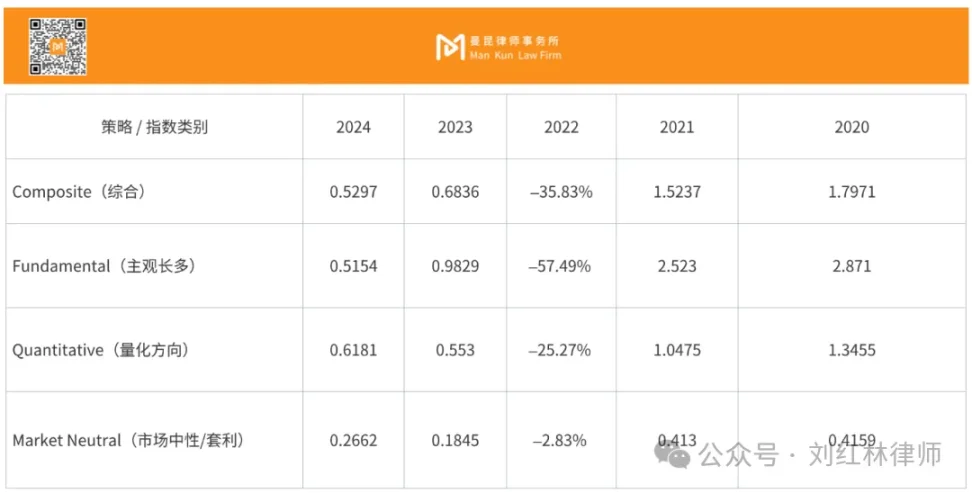
Based on a summary of trends from widely cited industry indices, we summarize the returns of six types of strategies as follows:
1. Subjective long-term trend: the most rapid rises and the most severe falls.
Bull markets: Best performing (e.g., 2017, 2020–2021, 2023)
Bear markets: characterized by the largest pullbacks (e.g., 2018, 2022).
High elasticity, high volatility, high returns, high risk.
2. Quantitative Directionality: Medium to High Returns, Controllable Drawdowns
Bull Market: Capturing the Trend
Bear Market: Model-based liquidation reduces losses
The curve is smoother, making it suitable for those who want to "steadily ride the trend".
3. Market-neutral arbitrage: the most robust strategy type.
Overall characteristics:
Annualized returns may not be high, but they are stable.
Minimum drawdown
Suitable for asset holding or corporate cash management
The industry's past trends have been very clear:
"Stability, stability, stability."
4. Crypto VC: Extremely Divergent Returns
Top-performing funds have incredibly high IRRs (because they've successfully bet on one or two mega-projects).
Median funds have performed relatively poorly.
Long cycle, high risk, high uncertainty
Suitable for long-term funds, but not for short-term expectations.
5. Multi-strategy funds: The most accessible combination for entrepreneurs.
Stable, balanced, controllable, and suitable for entry-level configurations.
How should traditional entrepreneurs choose crypto funds?
Many business owners' first reaction is, "Which one should I choose?" Actually, you should ask yourself three things first:
1. Is this money "spare money" or "money you need"?
Idle cash → Market neutral, multi-strategy
Intending to increase value but able to withstand volatility → Quantitative, long-term strategies
Intending to bet on innovation → VC
The nature of money determines strategy, not the other way around.
2. How much volatility can you tolerate?
Can you accept a long-term fund with a maximum drawdown of -70%?
If not, then this type of strategy is not suitable for you.
3. What do you really want: stability, balance, or explosive growth?
Three paths:
Stable: Arbitrage/Market Neutral
Balance: Multi-strategy/Quantitative
Outbreak: Subjective long-term bullish/VC
Figure out your goals before choosing a fund.
Crypto funds are becoming the next generation of hedge funds.
Today's crypto market is no longer the wilderness it was in 2018:
There are ETFs
There is a custodian
Audit
Regulated
Large organizations
Industrial applications have been implemented.
It has a mature strategy system
Crypto funds represent not speculation, but a "window of opportunity for a new generation of asset management strategies." Over the next five years, crypto funds will become increasingly important in entrepreneurs' asset allocation systems. Not because they are mysterious, but because they have already become mainstream. If you want to understand the crypto industry, you don't necessarily need to trade cryptocurrencies yourself. You only need to understand: who is using what strategies, and under what logic, to make money for you.
I'm still conflicted and unsure of myself. What should I do?
If you've read this far, you've already grasped the basic logic behind crypto fund strategies. But the real challenge isn't "understanding the concepts," but rather:
Which funds are worth investing in?
Which strategies are suitable for your asset type?
Which "minor clauses" in the documents, structure, and fee design will affect your future exit?
Which risks are controllable, and which are structural risks?
Which teams are truly institutionalized, and which are just "retail investor schemes disguised as institutional ones"?
There are no standard answers to these questions, but they are all directly related to the safety of your funds and the stability of your returns. I've seen many entrepreneurs struggle with these choices, and I've accompanied many LPs through fund due diligence, structure breakdown, term modification, and risk disclosure. I've noticed a pattern:
If you understand the strategy, structure, and terms before investing, your experience in crypto funds will be much better.