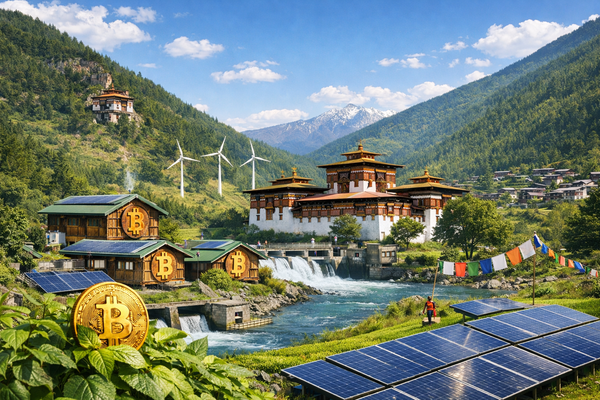
The Himalayan mountainous nation of Bhutan is quietly building a "green Bitcoin economy" through a state-led Bitcoin mining strategy leveraging surplus hydropower. While the initiative is being implemented without extensive publicity or policy announcements, it is being hailed as a unique model that combines energy, finance, and digital asset strategies.
Bhutan relies on hydropower for most of its electricity production. During the rainy season, a significant amount of electricity is generated, exceeding domestic consumption. However, storage is difficult and cross-border transmission is limited, leading to a significant portion being exported at low prices or left unused. The government has chosen to address this structural issue by channeling excess electricity into Bitcoin mining. This effectively transforms electricity, which loses value if not used, into a global liquid asset.
Bhutan's mining model stands out sharply from the sprawling, private-sector model. Government agencies and state-owned enterprises are central to the operation, with strict restrictions on the scope and size of participation. Power used for mining is also restricted to renewable energy sources, minimizing environmental concerns. The digital assets generated in this process are used to fund national finances and expand foreign exchange reserves.
This approach aligns with Bhutan's national philosophy. Bhutan is known for prioritizing Gross National Happiness (GNH) over Gross Domestic Product (GDP). Bitcoin mining, too, focuses on strategic goals—utilizing eco-friendly energy, diversifying foreign exchange earnings, and accumulating long-term digital assets—rather than maximizing short-term profits.
The Bhutan case overturns the perception that Bitcoin necessarily entails environmental destruction. At the same time, it demonstrates the potential for digital assets to be leveraged as an extension of energy policy in countries with a high proportion of renewable energy and a structural power surplus. Converting electricity, rather than gold or raw materials, into Bitcoin offers a model for countries seeking to reduce their dependence on the dollar.
Although quietly underway, Bhutan's choice is clear. It is using Bitcoin not simply as an investment asset, but as a means to transform its surplus energy into a national asset. The message this small nation's experiment sends to the global digital asset debate is by no means insignificant.