My brother started his Christmas holiday and came to visit me in town. Yesterday we talked about cryptocurrency.
We were wondering why the crypto market had remained so weak despite the strong stock market. Then he offered a completely unexpected perspective.
He said, "Cryptocurrency is no longer cool."
I was truly shocked by that statement. He was only 22 years old.
He continued, "Predicting the market is more fun, and stocks are better because you won't get 'ruged' (run away with the money) 24/7."
Last night I looked at it more closely and found that the problem I observed was neither technical nor fundamental.
It's a cultural issue, a social shift, a change in attention.
It all started on YouTube. Viewership for all cryptocurrency-related content is declining.
One encrypted YouTuber with 139,000 subscribers said that his viewership decline over the past two weeks was the worst he had seen in five years.

Second observation: Attention is slipping away from the top.
The biggest crypto KOLs are starting to publicly state that they are "losing interest in cryptocurrencies" and turning to stocks instead.

Thirdly, the allure of unregulated practices has vanished.
For a long time, cryptocurrency has been a free-spirited, lawless game for young people.
But with the entry of traditional brokerages like Schwab and JPMorgan Chase, coupled with government attention and intervention, is cryptocurrency losing the group of people who initially made it popular?

That might really be the case... because the market's "impression" of it has changed.
Fourth point: Optionality
Almost all investment instruments have become more accessible. From the addition of stock trading and the introduction of 0DTE options by $HOOD, to the rise of the entire prediction market…
Everything is laid out before you, without the risk of being "rugated at any time," and without the feeling of "lawlessness" of the past, which is precisely the source of the allure of cryptocurrency.
The question is: can real-world encryption applications generate enough demand to fill the gap left by the long-term withdrawal of retail investors?
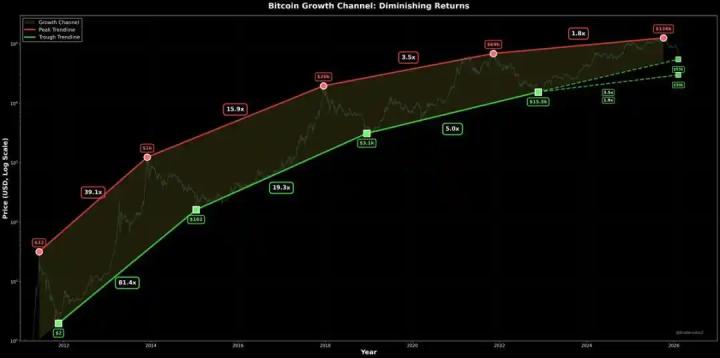
I'm just saying that the once highly interconnected $BTC and $QQQ are now showing a clear divergence, which is highly suspicious, and the gap will only widen.
You could argue that these phenomena occur in every crypto bear market, but now there are new variables and structural changes (selectivity + participation of traditional brokerages + government intervention), and the rules of the game are different.
Cryptocurrencies appear to be in a transition period, shifting from "kinetic assets" to "infrastructure assets".
This kind of fundamental transformation is usually not very price-friendly in the medium term.
In the long run, I remain optimistic about the practical applications of cryptocurrencies and believe they will become ubiquitous; however, real-world applications and adoption (and the accompanying growing pains) will be a key focus for me in 2026.