Recently, the name Lighter has been all over the community, with strong sentiment surrounding it in everything from valuation discussions and calculations of points farm rewards to speculation on TGE timing and pre-market price fluctuations.
Article author: Zhou
Article source: ChainCatcher
Exchanges such as Binance and OKX have successively announced the listing of LIT token pre-market trading. Polymarket predicts that there is a greater than 50% probability that its post-TGE valuation will exceed $3 billion. The on-chain transfer signal of 250 million LIT tokens has completely ignited FOMO sentiment. Everything seems to be going smoothly, and Lighter is undoubtedly one of the most anticipated projects in the crypto market at the end of the year.
However, while everyone is calculating how many LITs and TGEs can be exchanged for and how much the price will rise, the more fundamental questions are being forgotten: How much of this airdrop frenzy is real growth, and how much is just a fleeting illusion fueled by a bubble? Does the Perp DEX track truly possess sustainable value?
Valuation Anchors and the Zero-Fee Trap
In the fiercely competitive Perp DEX sector of 2025, Lighter forged a unique expansion path. Compared to Hyperliquid's breakthrough through exceptional operational capabilities and a fair narrative with zero VC backing, and Aster's brand premium backed by the Binance ecosystem, Lighter chose to deeply embrace top-tier capital.
According to RootData, Lighter completed a massive $68 million funding round in November of this year, led by Founders Fund and Ribbit Capital, with Robinhood also participating. Its pre-TGE valuation has reached $1.5 billion , and prior to this, it had been backed by established institutions such as Dragonfly and Haun Ventures.

Looking at the metrics, Defillama shows that Lighter's open interest (OI) reached $1.572 billion, with monthly revenue of $10.27 million and annualized revenue approaching $125 million. In terms of trading volume, Lighter recorded $227.19 billion in the past 30 days, even surpassing industry benchmarks Hyperliquid ($175.05 billion) and Aster ($189.034 billion), and was once considered by the market as a dark horse in the perp DEX this year.
Market analysts believe that Lighter's ambitions extend far beyond simply being a perpetual contract exchange; it aims to build a decentralized trading infrastructure that connects brokerages, fintech companies, and professional market makers. On the retail side, Lighter implements a Robinhood-like "zero-fee" strategy, but this comes with a 200-300 millisecond latency . This undoubtedly creates an excellent arbitrage window for high-frequency market makers. While ordinary retail investors drawn by the "low fees" avoid explicit fees, they may incur several times the normal trading costs due to hidden slippage.
Therefore, there is some controversy surrounding its business model, and its valuation logic goes beyond a simple comparison based on Perp DEX. Although Polymarket indicates that its post-TGE valuation is expected to be in the range of $2 billion to $3 billion , whether it can support a long-term institutional narrative remains questionable.
On the other hand, historical experience has repeatedly proven that "peak performance upon launch" has become an inescapable fate for star VC projects. Data from 2025 shows that the performance of highly publicized "VC-backed projects" in the secondary market is severely disconnected from their valuations . For example, Humanity Protocol, valued at $1 billion by VCs, now has a market capitalization of approximately $285 million, Fuel Network approximately $11 million, and Bubblemaps approximately $6 million—a difference of tens of times. Other projects such as Plasmas and DoubleZero have market capitalizations that are only 10% to 30% of their VC valuations.
Faced with the "vanity metrics" inflated by capital, Lighter may just be the next case.
Prep DEX: A False Boom
The persistent concerns about Lighter essentially reflect the deep-seated bottlenecks in the entire Perp DEX track.
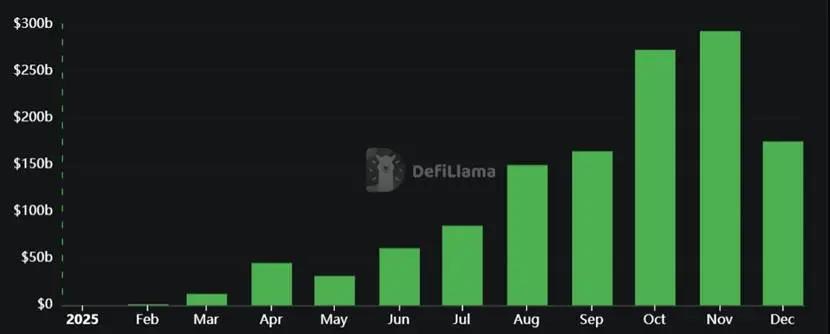
First, Perp DEX's core user group should theoretically consist of leveraged traders and institutional arbitrageurs, but in reality , its activity level falls far short of the narrative . According to DeFiLlama data, even in October, when the entire sector's monthly trading volume hit a record high of $1.2 trillion, the number of truly active addresses globally (referring to effective users with directional positions each day) only remained in the tens of thousands to hundreds of thousands. This is a significant gap compared to the hundreds of millions of users on CEXs like Binance and Bybit.
The reason for this is that while users choose DEXs for low fees and on-chain privacy, most retail investors are not particularly sensitive to privacy due to their limited capital. Moreover, with Hyperliquid establishing a strong liquidity moat through its self-built Layer 1 platform, it is difficult for new players to break through in the same dimensions.
The limited user base means that growth in this sector heavily relies on "temporary farmers" rather than loyal users. A CoinGecko report points out that airdrop farming became prevalent at the end of 2025, with most users flocking in to acquire points rather than engage in long-term trading, leading to a general halving of retention rates after TGE (token generation). For example, while Lighter attracted over 500,000 new users in Season 2, analysis shows that 80% were multi-wallet Sybil accounts, meaning the actual number of active addresses was far less impressive than it appeared.
Secondly, the awkward situation of the track is reflected in the "short-term cycle" formed by the game of interests of multiple parties : project teams urgently need TVL and transaction volume to support valuation narratives, and induce traffic through points and zero fees; VCs bet on high valuations to seek exit; while farmers flock to farm points, cash out and leave after airdrop.
Forklog's analysis suggests that while the "profit roulette" inflates on-paper figures, it is essentially a short-term game between various parties, rather than a win-win situation for the ecosystem. A typical example is Aster's adjustment of its points multiplier in November 2025, which led to the rapid migration of 400,000 wallets to Lighter, directly causing a surge in gas fees and a deep platform collapse.
BitMEX CEO Stephan Lutz warned that the Perp DEX craze may be unsustainable because centralized exchanges (CEXs) still control 95% of open interest (OI), and the DEX model's over-reliance on incentive mechanisms makes its business logic extremely fragile. 21Shares' mid-year report for 2025 also emphasized that although Perp DEX's market share rose from 5% at the beginning of the year to 26%, this bullish sentiment-driven growth was accompanied by severe fragmentation in competition.
Furthermore, the apparent surge in trading volume on Perp DEX is a product of users incentivized by points for airdrop rewards . By the end of 2025, the popularity of airdrop mining on tokenless Perp DEX had soared, which explains why Lighter and Aster both surpassed $180 billion in monthly trading volume. Although Aster has issued its own token, it still has to maintain its paper growth through continuous reward programs; this "subsidy-for-retention" model is tantamount to mortgaging its future.
As it turns out, projects fueled by capital and sustained by a points-based system often face brutal valuation corrections after the TGE (Trading for Enterprises) event. Looking back at Vana, a project backed by top-tier VCs, while its FDV (Funds-to-Value) surged briefly after the 2024 TGE, it subsequently plummeted by 70% due to the loss of incentives, quickly becoming a liquidity-depleted "ghost project." The current data surges of Lighter and Aster follow a similar path to these VC-backed projects with inverted valuations.
In the current market landscape, the leading effect of Perp DEX has been basically established . Hyperliquid has secured the top position with its first-mover advantage in organic revenue and depth. The remaining players can only seek differentiation and survival in extremely narrow niche areas such as mobile optimization, insurance mechanisms, or RWA integration.
Ultimately, the Perp DEX sector is still in a zero-sum game phase . For small retail investors with low privacy sensitivity, DEXs still lack sufficient incentive to migrate. Beneath its apparent popularity, its true value may be far less than the data suggests.
Conclusion
Within the booming logic woven by points, venture capital, and airdrops, Perp DEX seems to have fallen into a self-sufficient illusion. However, when the tide of subsidies recedes, those "dark horses" lacking genuine user stickiness and relying solely on capital narratives will ultimately be exposed in the face of the liquidity test in the secondary market.
Lighter's story continues, but it serves as a reminder to crypto investors that the DeFi space is never short of spectacular feasts, but rather of truths that can weather the bubble. In chasing the next moment of glory, it's worthwhile to ask ourselves: for whom is this frenzy truly burning?