Vitalik Buterin warns that the regulatory approach under the European Union's Digital Services Act could stifle diversity on the internet by attempting to leave no "space" for controversial speech or products.
In a detailed post on X, the Ethereum co-founder argued that a free society shouldn't try to completely eliminate ideas deemed harmful. Instead, he suggested that regulators should focus on preventing such content from being amplified through algorithms and dominating public discourse.
The significance of the EU's "No-Space" strategy
The Digital Services Act applies to the entire online ecosystem. Any service that reaches users in the European Union must comply with this law, regardless of size or location. The level of requirement will depend on the scope of impact and risk, but no platform is exempt from regulation.
This design aims to close the legal and technical loopholes that previously allowed the platform to avoid liability.
Many argue that this is a "zero-gap" approach, meaning it leaves no digital "loopholes" through which harmful content can slip through without being held accountable.
The goal here is not to censor all content. The DSA Act focuses on risk assessment, process transparency, and platform design to control how content spreads.
Buterin argues that the biggest failure of social media today is not because there are too many conflicting opinions, but because algorithms often make those opinions spread easily.
He also warned that an uncompromising mindset could lead to abuse of power, create more conflict, and increase reliance on technocratic intervention.
Buterin warned that treating controversial ideas as diseases to be eradicated goes against the spirit of pluralism. He argued that disagreement is inevitable in an open society, and attempts to completely eliminate controversial opinions only lead to greater oversight and control.
He advocates for providing users with more choices, increasing transparency, and promoting competition. He believes platforms should reduce the "rewards" for dangerous content, rather than trying to eliminate it entirely.
A positive sign for cryptocurrency?
This topic also drew more attention to privacy coins like Monero and Zcash .
As managers increase activity monitoring and demand more data storage, users will realize that tight control often means more personal data is exposed.
This makes the story of potentially anonymous and hard-to-trace financial tools increasingly compelling.
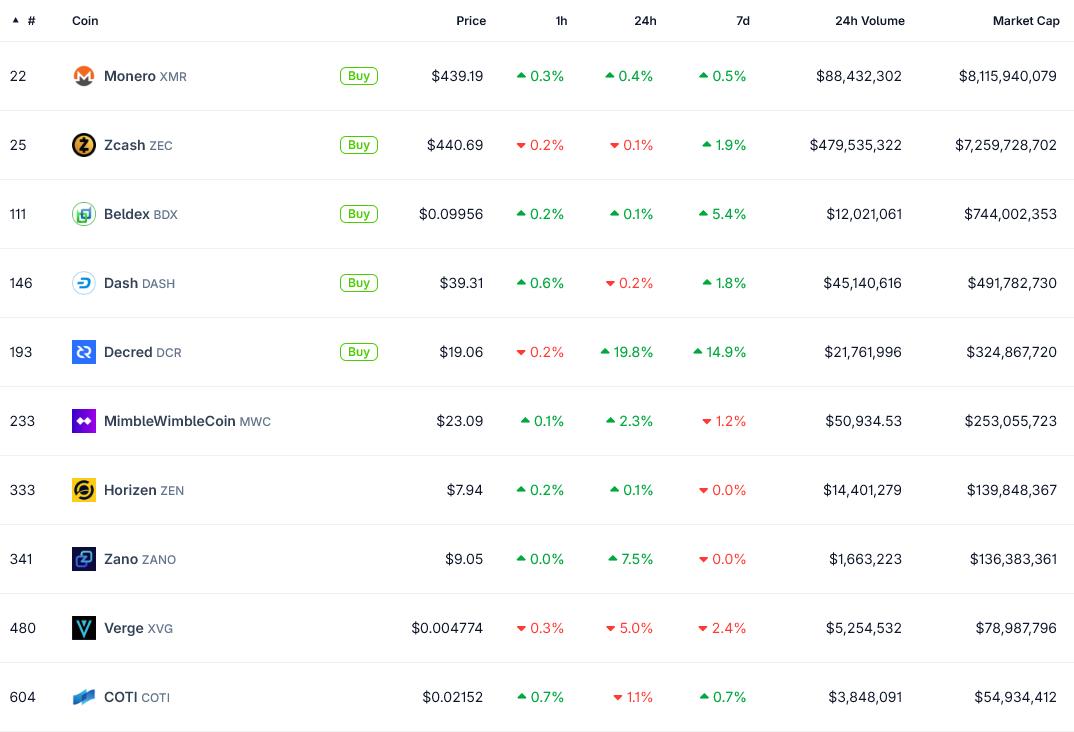 Top security coins by market Capital . Source: CoinGecko
However, the impact is uneven. While philosophical support for security coins is growing, their access in European Union markets remains restricted by numerous regulations. Exchanges continue to limit or exclude them due to legal compliance risks.
In summary, the European approach demonstrates why privacy remains crucial, while simultaneously limiting the scope of security-focused tools.