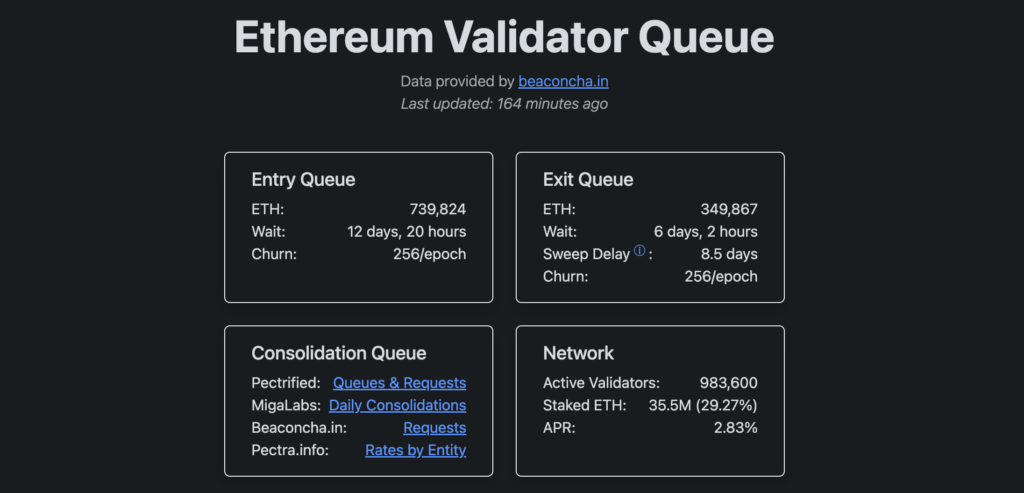
On the last weekend of 2025 , while most Wall Street screens were dark, the Ethereum blockchain suddenly displayed a crucial signal. On December 29th, validators "entering the queue" surged to 745,619 ETH, with an average wait time of 13 days; "leaving the queue" dropped to 360,518 ETH, requiring only 8 days. This marked the first time in six months that inflows exceeded outflows at twice the rate of outflows, a golden cross indicating that market selling pressure was rapidly drying up, sparking heated discussions within the crypto community before New Year's Eve.
Golden Cross Signal: Selling Pressure About to Bottom
On-chain observation platforms show that a five-month net outflow trend that began in July 2025 ended over the weekend. Analysts point out that if the outflow continues at its current slowdown, the indicator will reach zero on January 3, 2026, at which point the selling pressure vacuum could make prices extremely sensitive to buying. Monad executive Abdul reviewed the price action following a similar crossover in June:
Once the signal is confirmed, prices often double to make up for it.
BitMine's billion-dollar bet ignites
The reversal in Ethereum 's price action wasn't driven by retail investor impulsiveness, but rather by a major shift in asset allocation by large institutional investors, with the actions of digital asset treasury provider BitMine becoming a focal point. Between December 27th and 29th, BitMine transferred 342,560 ETH, approximately $1 billion, into its staking contracts in batches. This company controls about 4% of the global Ethereum supply and has now adopted a "hold and yield" strategy. With an annualized return of 3.12%, this could generate $371 million in passive income annually, demonstrating that institutions now view Ethereum as a cash-generating internet bond rather than a purely speculative asset.
Why are whale making a major entry at the end of the year? Firstly, the Pectra upgrade , effective in May 2025, will increase the maximum balance for a single validator from 32 ETH to 2,048 ETH, significantly reducing the complexity and transaction costs of managing hundreds of millions of ETH. Secondly, after a year in office, the US regulatory environment has become clearer, legal concerns have lessened, and the willingness to lock up long-term assets has increased. With these obstacles removed, capital may enter the market in large quantities when it senses a market bottom.
Liquidity Tightening: The 2026 Repricing Scenario
The sell-off triggered in September by security concerns surrounding staking service provider Kiln has been completely absorbed and relocked by institutional buying. The rapidly decreasing tradable supply and the congested entry and closed exit structure are brewing a new round of "liquidity tightening." Market participants generally believe that this year-end staking resurgence lays the foundation for a revaluation of Ethereum's price in 2026. On-chain data has already sent a clear signal: there are far more people waiting to enter than wanting to leave, and when a selling pressure vacuum forms, the price may respond with sharp fluctuations to the supply-demand imbalance.
Ethereum underwent a structural shift in the final 48 hours of 2025. Entering queues outpaced exit queues, BitMine made a significant bet, and technology and regulation worked in tandem—three forces intertwined to usher in the new year. The next step will be for the market to see if this supply compression, like in June, will trigger another surge in 2026.