If readers weren't paying attention during the last weekend of December, they might have missed the most dramatic price movement of 2025: silver futures rose 6% to a record high of $84 less than 70 minutes after opening in New York on Sunday evening, before plunging 10% back to the $75 range.
Such unprecedented volatility left even seasoned traders speechless. The Kobeissi Letter, a market newsletter, published an article on X stating bluntly:
"This is absolutely insane. Silver's performance in just one hour makes cryptocurrencies look stable."
Large short-term liquidity orders ignited demand, coupled with automated order book manipulation and safe-haven buying, pushing silver to historical highs. Profit-taking and hedging selling pressure then surged, triggering a flash crash. This scenario, often seen in memes, is now playing out in a precious metal with a 4,000-year trading history, indicating that silver trading logic is increasingly resembling that of the crypto.
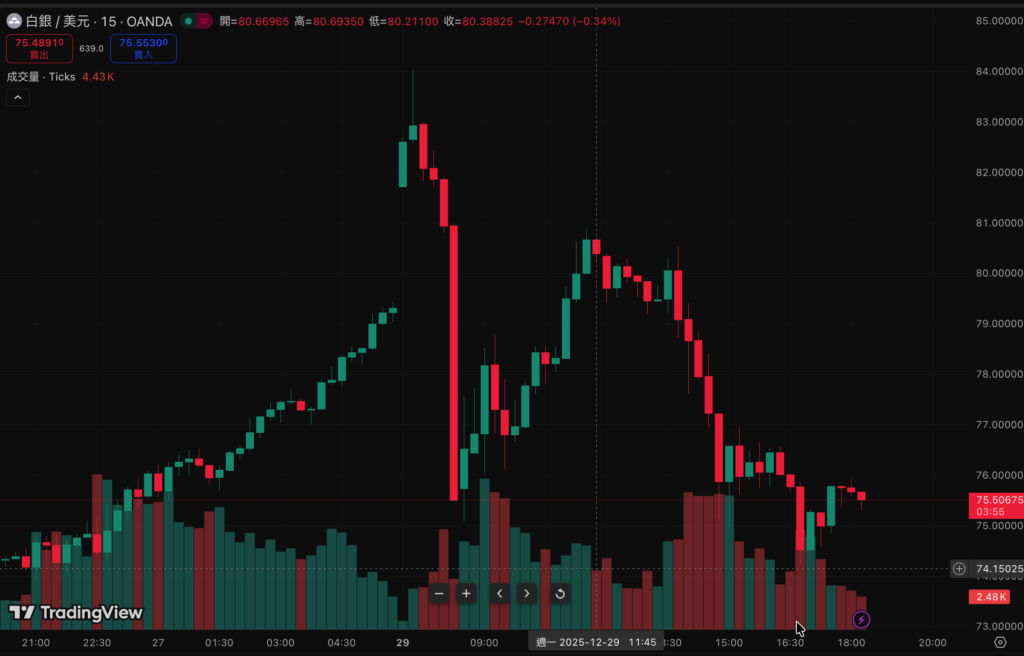
With Powell's term nearing its end, the market is betting on a rate cut in 2026.
Technical factors are driving the market. At the macro level, current Federal Reserve Chairman Jerome Powell's term expires in 2026, and investors anticipate President Trump may nominate a more dovish successor, paving the way for low interest rates. According to the CME FedWatch tool, the futures market already implies at least two more rate cuts. Low interest rates reduce the opportunity cost of holding non-interest-bearing assets, leading to a shift of funds towards silver and gold to hedge against future debt expansion and currency devaluation risks.
Gold also hit a high of $4,530 over the weekend, but silver was clearly more favored by short-term traders in terms of momentum and volatility indicators, and its nickname "devil metal" was once again brought to the market's attention.
Geopolitical tensions and low inventory levels: Two-way news amplifies volatility
The fundamentals weren't absent, but their effect was more like an accelerant. Fortune reported that the US military operation in Nigeria and the escalating situation in Venezuela on Friday boosted safe-haven buying; however, according to FXStreet, after positive progress was reported in the Russia-Ukraine peace talks on Sunday, the original war premium was quickly withdrawn, becoming the trigger for a sharp drop in prices.
On the supply and demand side, silver inventories on the Shanghai Futures Exchange fell to a low of approximately 715 tons, the lowest level since 2016. Meanwhile, strong global demand for conductive materials from solar panels and AI electronic hardware has resulted in a structurally tight supply of physical silver. This role as the "lifeblood of industry" provides long-term support and explains why prices, despite a sharp drop, remain at historically high levels.
Bitcoin's Absence from the Party: Risk Appetite Rotates to Tangible Assets
Unlike the fervor surrounding silver, Bitcoin (BTC) has traded almost sideways for the past 30 days, falling about 25% from its October high of $120,000. Amidst the uncertainty surrounding the Trump administration's growing influence and the Federal Reserve's policy shift, investors view BTC as a high-beta risk asset moving in tandem with US stocks, rather than a traditional safe-haven asset.
Funds are therefore flowing into tangible precious metals. Silver is not only endowed with "digital asset-level" volatility, but also possesses physical liquidity due to industrial demand, making it a preferred choice for institutions when adjusting their positions. The weekend's market movements may just be a preview: under the triple interaction of low interest rate expectations, geopolitical instability, and tight supply, high volatility in silver may become the new normal before 2026.
Looking back at this trend, the line between traditional assets and the crypto market is being blurred by sentiment and liquidity. Silver, with its four-thousand-year history, has proven that it can be as volatile as Bitcoin, but it can also provide a safety net through its physical scarcity. As investors adjust their bets on interest rates and political risks, the next sharp fluctuation may no longer be surprising; it's just a matter of time.