Bitcoin enters 2026 with a clear macroeconomic risk: President Donald Trump's tariff policies. In 2025, cryptocurrency traders saw tariff news impact prices just as quickly as ETF Capital .
Currently, several tax policies are being prepared for implementation in 2026. Some have specific timelines, while others are subject to negotiations and legal disputes. Either way, this information can cause market sentiment to shift from "risk-on" to "risk-averse" in just a few hours.
How Trump's tariffs will change the crypto market in 2025.
The tariff increases in 2025 have repeatedly caused the cryptocurrency market to experience sharp declines.
When Trump announced new tariffs on Mexico, Canada, and China in early February, Bitcoin plummeted to a three-week low of nearly $91,400. Ethereum dropped approximately 25% in three days, and many top Token lost more than 20% in a single day as investors rushed to reduce risk.
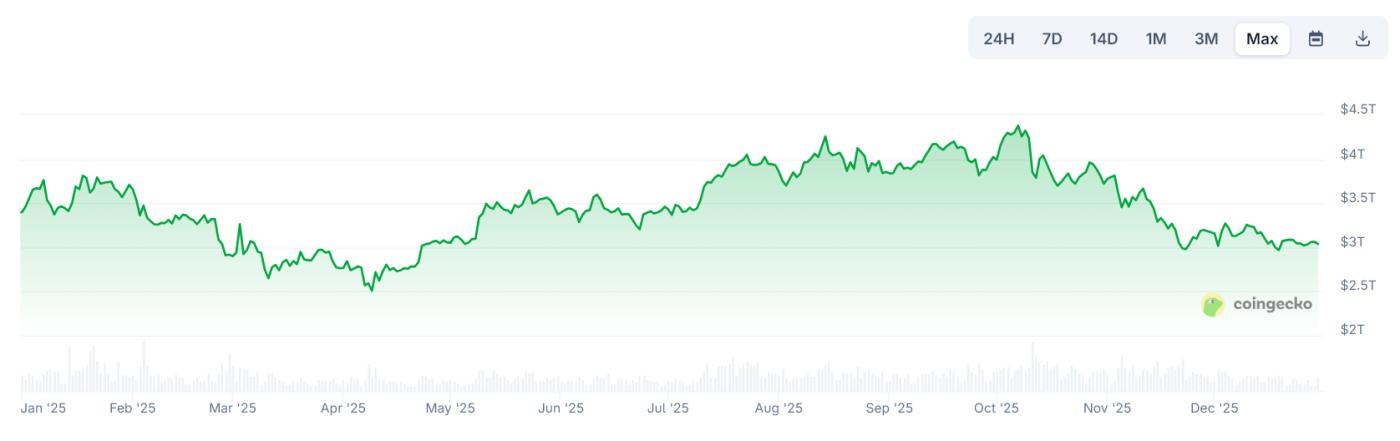 Total cryptocurrency market Capital in 2025. Source: CoinGecko
Then came the shock of the " Liberation Day " tax hike in April and the outbreak of US-China trade tensions. Bitcoin briefly dropped below $82,000 during a period of heightened risk aversion, while cryptocurrency-related stocks also experienced a sell-off.
However, when the White House signaled a possible temporary suspension of tariffs, the cryptocurrency market rebounded. By May, after the US and China reached an agreement to temporarily halt the tariff war, Bitcoin rose back above $100,000, while ETH also surged.
Digital asset funds also saw new Capital inflows during this period.
The most intense test occurred in October. When Trump reiterated his intention to impose a 100% tariff on Chinese imports related to the rare earth industry, Bitcoin plummeted by more than 16% in a short period. Liquidation surged, with reports indicating that $19 billion was wiped out on exchanges in a single day. By December 2025, the market had still not fully recovered from this liquidation shock.
 The biggest liquidation events in cryptocurrency market history. Source: Coinglass
1. China's 100% tariff cliff postponed.
This policy would impose a 100% tariff on all imports from China if the two sides fail to reach an agreement. Trump announced this idea in October 2025 and postponed its implementation to the end of 2026.
If this policy is reactivated, the market will anticipate slower growth and uncontrollable inflation . This could negatively impact Bitcoin due to tighter financial conditions, forcing investors to reduce leverage and leading to a widespread decline in risky assets.
2. Higher global basic tax rates
The US president has previously suggested the possibility of increasing import tariffs on all goods above the minimum 10% already in place since 2025. Trump also campaigned on a platform of even higher universal tariffs, so this risk remains.
Raising the base tax rate will no longer be a "hot" topic for just one day. Instead, it will put continuous pressure on investors' risk appetite.
For Bitcoin , this typically means volatile price surges, faster buying pressure on price dips, and increasing sensitivity to interest rate expectations.
3. Retaliatory taxes on digital services tax in Europe
These are new tax policies targeting countries that tax digital services or impose similar regulations on American technology companies. Trump warned in 2025 that countries maintaining these policies would face “significant” tariffs.
If the US imposes tariffs on EU or UK exports, global stock markets will also experience a downward correction. Cryptocurrency markets typically react with a "risk-averse" attitude first.
In 2025, this move turned tariff news into rapid and powerful liquidation shocks in the market.
4. Import taxes on pharmaceuticals could increase by nearly 200%.
This tax targets imported branded or patented drugs, with penalties for companies that do not move production back to the U.S. Trump has proposed very high tariffs in 2025, XEM them as a way to boost domestic industry.
If this tax rate could increase to 200% by 2026, investors might XEM it as a catalyst for inflation. Bitcoin might be touted as a hedge during periods of high inflation, but in reality, the market often reacts the opposite: risky assets are heavily sold off when liquidation is tightened.
5. Additional taxes related to sanctioned transactions.
Subordinate tariffs would penalize countries that buy oil or goods from U.S. rivals, even if those countries are not directly targeted. Trump introduced this concept in 2025 and applied it in several notable instances.
If Trump expands this tool in 2026, more countries will be drawn into the tariff war, thereby increasing global instability.
For Bitcoin, the most significant influencing factor is volatility. When instability increases, the market typically experiences more volatile periods, with more sell-offs, and recovery will be slower unless the flow of money improves.