For MSX, 2025 marks a clear starting point. In that year, it demonstrated through its actions that a platform that adheres to compliance, focuses on education, and emphasizes mechanism innovation in the global RWA wave is capable of competing with the world's leading players.
Article author and source: Mystonks
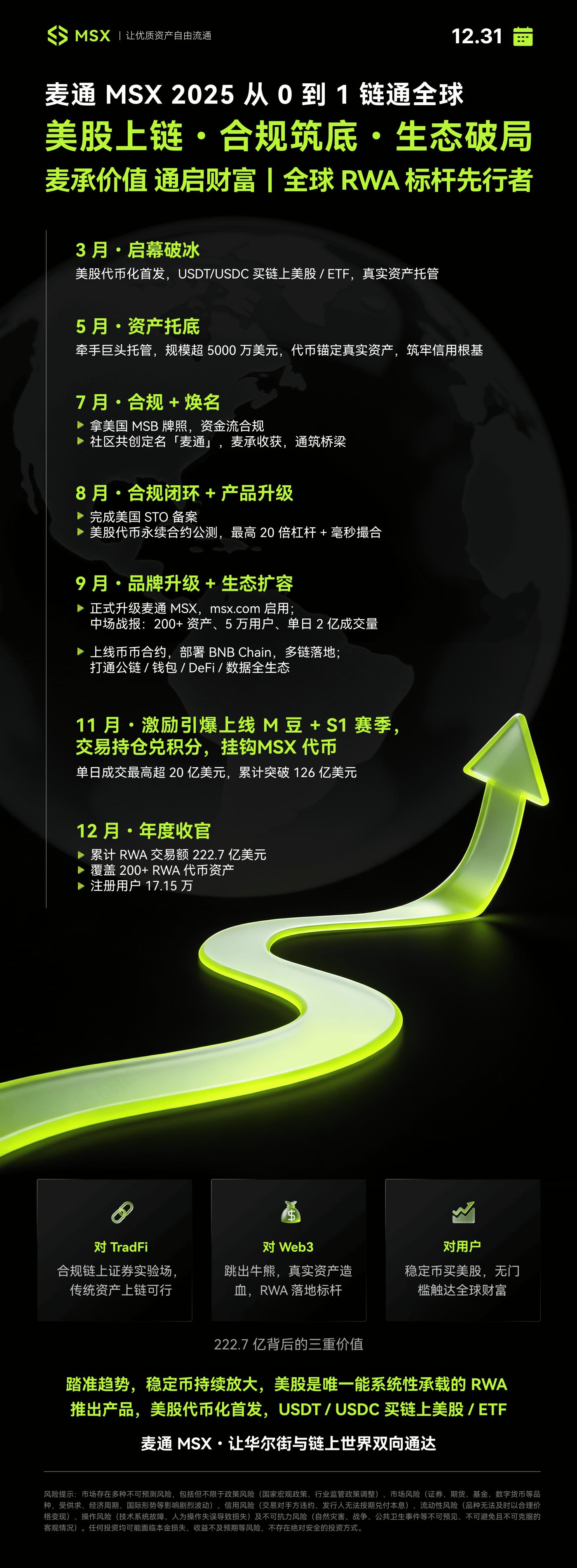
2025 was a landmark year for both the US stock tokenization sector and MSX. The sector officially entered the mainstream narrative, while MSX achieved a breakthrough from zero to one, firmly establishing itself at the global competitive arena. Looking back at the year's development, its core focus was on three main directions: seizing the opportunities presented by US stock tokenization, reconstructing on-chain transaction logic through product and mechanism innovation, and cultivating industry education and brand trust through a long-term perspective.
Tokenization of US Stocks: From Fringe Experiments to an Irreversible Window of Opportunity
For the past few years, RWA has been regarded as the "next big story" in the crypto industry, but it has remained at the conceptual level for a long time. It was not until 2025 that this track truly achieved economies of scale, moving from fringe experiments to industrial-scale implementation.
The global RWA tokenization market has surpassed tens of billions of dollars in size, with various real-world assets such as US Treasury bonds, equities, and real estate completing their on-chain migration. US stock tokens have completely shed their "niche experiment" label and become a formal category that mainstream financial institutions are focusing on researching. Traditional financial giants such as UBS and Apollo have entered the market, moving billions of dollars in assets onto the blockchain. Several authoritative research institutions have directly defined 2025 as the first year of RWA's "transition from experiment to infrastructure," predicting that trillions of dollars in assets will gradually circulate on-chain within a compliant framework.
This transformation brings a more concrete and tangible upgrade to the experience for ordinary investors. Previously, US stock assets required cross-border account openings, complex compliance processes, and high capital thresholds to access; now, they can be traded directly on-chain via stablecoins, significantly reducing geographical and institutional barriers. Secondly, asset composability and holding methods have undergone fundamental changes. On-chain US stock tokens support fragmented holding, allowing investors to build cross-industry and cross-sector US stock portfolios with smaller amounts of capital, avoiding the structural limitations of traditional securities accounts where "high-priced stocks are difficult to allocate." Simultaneously, on-chain connectivity brings greater transparency and verifiability. Transaction records, asset mappings, and transfer paths can be publicly verified on-chain, reducing information asymmetry and allowing ordinary investors to experience an auditable experience approaching "native crypto asset level" for the first time when participating in traditional financial assets. Finally, with the gradual integration of derivatives and the DeFi ecosystem, US stock tokens are no longer just "passively held assets," but rather fundamental components for hedging, arbitrage, and portfolio management, truly integrating traditional US stock assets into the on-chain financial system, making them standardized financial units that can be allocated and dynamically managed over the long term.
In 2025, the US stock tokenization race will no longer be a solo act by overseas pioneers such as Robinhood and Ondo. With its solid implementation capabilities, MSX has joined the ranks of core players, filling the gap in on-chain decentralized US stock trading platforms and becoming a significant participant that can be discussed alongside leading global platforms.
MSX's Innovative Practices: Enabling On-Chain Transactions to Return to Reality and Sustainability
In the competitive landscape of 2025, MSX chose a "difficult but correct" path, focusing on refining its products and mechanisms rather than relying on hype or concepts, to promote the return of on-chain US stock trading to its "real, compliant, and sustainable" essence, and to create real value for users.
Order flow model: Achieving synchronization between on-chain liquidity and the real US stock market.
Its core innovation lies in the application of the Pre-Fund of Funds (PFOF) model. Unlike some platforms in the industry that build virtual trading pools on-chain that are detached from the native market, MSX chooses to precisely "transfer" the liquidity of the real US stock market to the blockchain. Every buy and sell order from a user is transferred to upstream market makers and brokers for matching through a compliant order flow path, ultimately achieving a high degree of synchronization between on-chain prices, trading depth and the real US stock market, fundamentally eliminating the liquidity fragmentation problem of "one price on-chain, one price off-chain".
Users can still place orders and complete on-chain transactions using familiar stablecoins, but the underlying mechanism connects to a real US stock order book. This model makes on-chain trading an effective extension of the real financial market, rather than an isolated game of funds. To ensure the long-term sustainability of innovation, the platform is simultaneously advancing two key initiatives to solidify its foundation. MSX has established a rigorous asset selection system, prioritizing profitability, fundamental stability, market liquidity, and regulatory compliance as core indicators, rather than blindly pursuing asset quantity. It addresses the question of "whether assets can be held long-term" before optimizing details related to "trading experience," creating a carefully selected whitelist of RWA stock tokens on the platform, rather than speculative long-tail assets.
With compliance and custody safeguards implemented simultaneously, the platform successfully obtained the MSB license issued by FinCEN in the United States and completed the filing for the issuance of security tokens (STO) in the United States, achieving regulatory explainability for the entire process of fund flow and securities issuance. At the same time, it has partnered with traditional asset management institutions to take charge of the custody of the underlying real US stock assets, ensuring that every token on the chain corresponds one-to-one with the offline real stock, truly realizing that "every token is backed by a real US stock".
For users, the value of MSX is not "adding a new trading portal", but rather, for the first time on the blockchain, it seamlessly connects to the core liquidity and order book of the real US stock market with a familiar operating experience.
Improved Derivatives Matrix: Building a Full-Scenario Trading Platform
After consolidating its core foundation in physical trading and compliance, MSX will focus on addressing shortcomings in trading scenarios in the second half of the year, providing users with more comprehensive risk management tools by enriching its product portfolio.
On August 11th, the platform officially launched the public beta of RWA US stock token perpetual contracts, supporting leverage up to 20x and featuring a millisecond-level matching engine to fully meet the strategic needs of professional traders. Following this, the cryptocurrency contract section was successfully launched, covering mainstream cryptocurrencies such as BTC and ETH. These two initiatives enable users to manage their "on-chain US stock + crypto asset" risk exposure on a single platform. Maitong MSX has thus upgraded from a simple "US stock token trading platform" to a full-scenario trading platform supporting hedging, arbitrage, and multi-asset portfolio management throughout all US stock trading hours.
Season 1 and M&M's: Achieving Symbiosis Between Trading Activity and Long-Term Value
At the end of 2025, the platform's transaction data experienced explosive growth, primarily driven by the launch of the S1 points season and the M Credit incentive mechanism. Unlike the industry's common short-term rebate model, this mechanism focuses more on cultivating core users rather than a fleeting surge in traffic.
MSX has designed a clear "trading equals value" chain, using users' actual trading volume as the core criterion. Points are automatically calculated through multi-dimensional weighting, and these points can be directly exchanged for M-Beans, which will serve as the core basis for future platform token distribution. This design effectively avoids the industry pain point of "wash trading and leave," ensuring that only users who hold positions long-term and continuously contribute real trading depth earn high-quality points, thus becoming core ecosystem partners of the platform. Simultaneously, it allocates more of the platform's growth benefits to "high contributors," rewarding both "early participants" and, more importantly, rewarding "deep participants."
The mechanism generated significant market feedback after its implementation, with the total trading volume reaching a record high throughout the season, exceeding $2 billion in a single day and accumulating over $12.688 billion in total trading volume.
By the end of 2025, MSX had achieved significant milestones: cumulative RWA trading volume reached $22.249 billion, supporting over 200 RWA tokens, and the number of registered users exceeded 171,900. In the early stages of the US stock market tokenization race, these figures demonstrate that MSX has achieved a breakthrough from zero to one, joining the ranks of core players that can be discussed alongside leading overseas platforms.
Deepening Long-Term Vision: Driving Brand and User Growth Together
Products and mechanisms form the "skeleton" of the platform, while brand building and industry education are its "soul," directly impacting long-term user retention and trust. In 2025, Maitong MSX, with long-termism at its core, will build a bridge of trust with its users.
The name "Maitong" originates from the community and is built on trust.
In mid-2025, MSX undertook a significant initiative—giving the decision-making power for its Chinese brand name to the global community. The platform believes that a financial brand that carries the trust of its users should not have its name decided unilaterally by the team, but rather should originate from the collective expectations of the community.
After a public solicitation and public vote, "Maitong" emerged victorious with a high number of votes. "Mai" symbolizes harvest, embodying the market's expectation of navigating economic cycles and acquiring stable value; "Tong" represents a pathway, signifying the opening of the wealth link between traditional finance and the on-chain world. Maitong MSX has gradually grown from an "unfamiliar new project" into a professional fintech brand that is "rememberable, trustworthy, and referable."
For financial platforms, a name is not just a simple identifier. The creation of "Maitong" originated from community co-creation and became the starting point for trust between the platform and its users. This brand memory built through community co-creation further strengthens its development orientation of "coexisting with users".
MSX Research Institute: Accompanying users to understand the industry landscape
In 2025, MSX continued its challenging yet significant work—focusing on helping users understand the US stock tokenization sector. While most trading platforms chased short-term trading volumes, MSX established a research institute and invested heavily in industry education.
MSX Research Institute consistently produces professional yet easy-to-understand content, breaking down complex industry logic in plain language to help users build accurate investment knowledge. The platform firmly believes that as a trading platform whose core revenue comes from transaction fees, helping users develop their asset analysis skills and trading discipline, and growing together with them, is the foundation of the platform's long-term survival.
This commitment not only filled the gap in user awareness of the US stock tokenization sector, enabling more users to understand the value of the sector rather than blindly following market fluctuations, but also drove a qualitative change in the relationship between MSX and its users, transforming it from a simple "order matching party" to a "partner witnessing the transformation of financial infrastructure."
Looking ahead to 2026: From establishing a foothold to participating in defining industry standards
Looking back at the end of 2025, MSX has successfully transitioned from an "innovative idea" to a "stable global RWA infrastructure." Cumulative RWA transaction volume of $22.249 billion, over 200 supported RWA tokens, and 171,900 registered users are testaments to its hard work throughout the year. Entering 2026, its development goals are even clearer: moving from "establishing a foothold" to "participating in defining standards," creating value on a broader stage.
The incentive mechanism will be further improved into a complete long-term equity system. After the S1 season and M&M's complete the initial launch, the platform token, user principal returns, and platform governance rights will be linked together, allowing users who "trade more and hold for the long term" to not only obtain short-term benefits but also have continuous ecological governance weight, achieving a win-win situation for the platform and users.
For MSX, 2025 marked a clear starting point. That year, it demonstrated through its actions that a platform adhering to compliance, focusing on education, and emphasizing mechanism innovation amidst the global RWA wave possesses the ability to compete with the world's leading players. In 2026, the core issue it needs to address is no longer "survival," but rather the extent to which it can influence the definition of global standards for "on-chain US stocks" in the future multi-trillion dollar global tokenized asset market. From an industry development perspective, adhering to user value orientation and long-termism will be the core support for its continued breakthroughs.