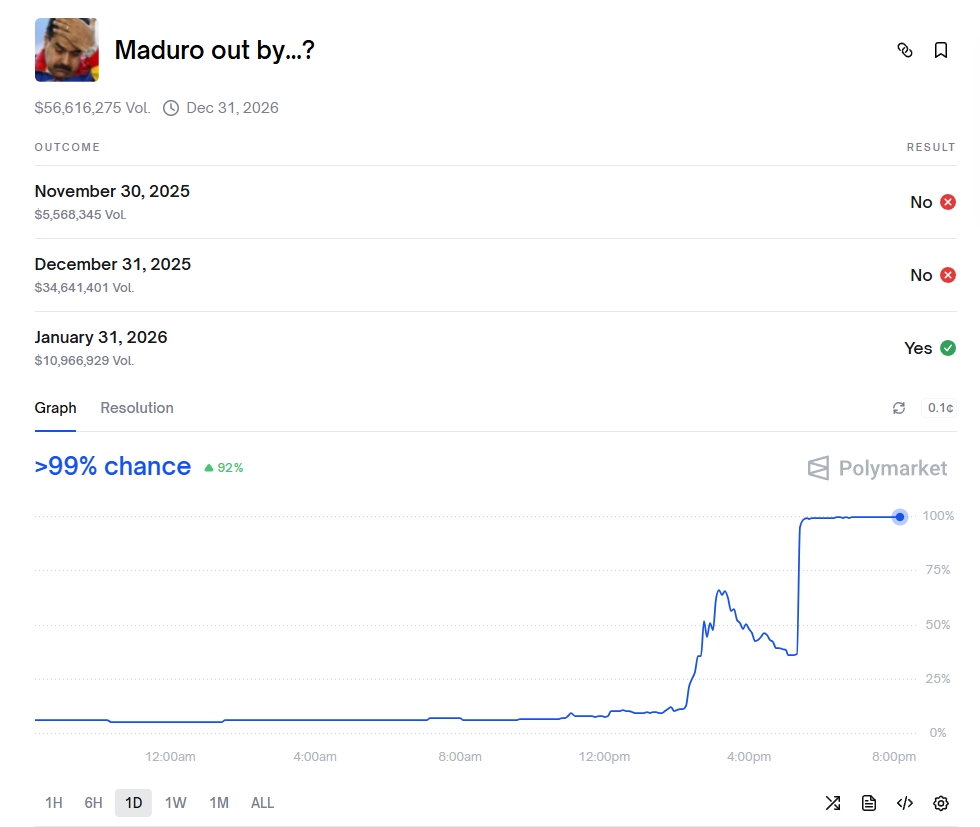
At 10 PM Eastern Time on January 2nd, the price of a contract on the decentralized prediction platform Polymarket for "Will Maduro step down in January?" suddenly jumped. The event was confirmed three hours later when US President Trump announced the US military's arrest of Venezuelan President Maduro. The total amount wagered on Maduro reached $56 million.
Military operations were leaked on the blockchain first?
According to Polymarket's public data, after hovering at a low of 5-6% for a week, the option of "stepping down before the end of January" surged from $0.05 to $0.125 late on the 2nd.
In just three hours, total trading volume surged to $56.6 million, with tens of millions of dollars betting on "before the end of January," and the inflow of funds far exceeded normal levels. At the same time, similar contracts on Kalshi , a prediction platform regulated by the CFTC, also rose by 13%.
A new address invested approximately $32,000 within four days, with over 80% of that investment completed before the price surge began. After Maduro's arrest, the contract price quickly rose to $1, and the address ultimately profited approximately $400,000, a return of 1,242%.
The market has raised concerns that this ordering behavior, which resembles the pace of military operations, may involve the leakage of official secrets.
Legislators are concerned about the upcoming "public integrity" bill.
Facing public pressure, U.S. Representative Ritchie Torres introduced the "Public Integrity Act of 2026 for Financial Forecasting Markets" on March 3. The draft bill proposes prohibiting federal officials and contractors from using non-public information to trade forecasting contracts and requires those holding security licenses to notify the other party before engaging in on-chain activities. Ritchie Torres emphasized:
We cannot allow those with access to state secrets to profit from military operations on decentralized platforms. If prediction markets become cash cows for insider trading, it will severely damage market integrity.
While the bill does not directly restrict ordinary users, it requires the CFTC to assess the regulatory feasibility of decentralized platforms.
If future regulations become so stringent that they are difficult to enforce, some liquidity may be pushed to overseas on-chain contracts, creating regulatory blind spots.
Capital Shifts to Venezuelan Asset Repricing
Following Maduro's fall from power, market attention shifted from the regime to "asset revaluation." Venezuelan sovereign bonds, which have been in default for years, jumped about 8 cents in European trading on the 3rd, with traders estimating a recovery rate of 40% to 50% after debt restructuring.
Several Wall Street special scenario funds have issued briefings to investors, assessing the U.S.-led debt negotiation path and oil production prospects.
Energy analysts predict that if sanctions are lifted and capital is reinjected, Venezuela's daily oil production could contribute an additional 1 to 2 million barrels over three years. While OPEC's production adjustments remain unclear, the market generally believes that long-term oil prices will face downward pressure. For the US, where inflation has already moderated, this supply increase could provide insurance for achieving the 2026 2% inflation target.