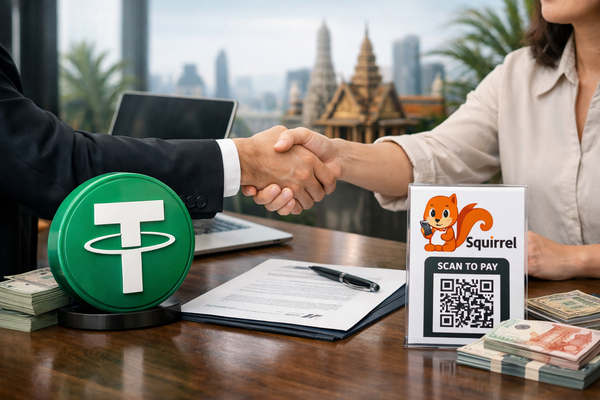
Tether, the world's largest stablecoin issuer, has made a strategic investment in Squirrel, a Southeast Asian QR payment startup. While the investment amount was undisclosed, the move is seen as a clear sign of Tether's commitment to expanding stablecoins into real-world payment infrastructure.
Squirrel is a payment infrastructure company that processes cross-border QR code payments in real time. It allows users to scan QR codes from one country and make payments in another. Users pay in their home currency, and merchants receive payments in the local currency. Squirrel's system handles currency exchange and settlement.
Squirrel currently supports QR payments in major Southeast Asian countries, including the Philippines, Vietnam, and Indonesia, and has expanded its service to include bank transfers in some regions. In emerging markets with a high prevalence of mobile payments, QR payments are becoming a key alternative to credit card infrastructure.
Tether's latest investment demonstrates that the focus of stablecoins is shifting beyond exchanges and trading to everyday payments. While USDT has been used for liquidity in global exchanges and as a means of remittance, its use in offline and mobile payments has been limited. When combined with QR payment infrastructure, stablecoins can function as a practical means of payment, reducing exchange rate fluctuations and brokerage costs.
In particular, emerging markets such as Southeast Asia, Central and South America, and Africa experience high local currency volatility and high cross-border payment costs. Stablecoin-based QR payments are attracting attention as an alternative to addressing these structural issues. Tether's goal with Squirrel is also interpreted as a similar "real-world expansion" approach.
The industry is focusing on the potential for this investment to accelerate the integration of stablecoins with local payment infrastructure. The key question is whether stablecoins can evolve beyond mere digital assets into a tangible payment method for local merchants and consumers.