As artificial intelligence becomes more embedded in economic and institutional systems, a core issue continues to surface. How can computation scale without requiring blind trust or exposing sensitive data? This question sits at the center of Zero Knowledge Proof, a blockchain project designed around mathematical verification rather than centralized oversight.
Instead of treating privacy as a feature added later, ZKP organizes its entire network around a four-layer architecture. Each layer isolates a specific responsibility, allowing AI computation, verification, and storage to function independently while remaining provable as a whole.
This architectural focus is increasingly why ZKP is appearing in discussions around the best presale crypto to buy, particularly among observers prioritizing infrastructure over short-term narratives.
What is Zero Knowledge Proof?
Zero-knowledge proof is a cryptographic technique that allows a system to confirm that a statement or computation is valid without revealing the underlying data. Rather than exposing inputs or identities, a compact mathematical proof verifies correctness.

The Zero Knowledge Proof blockchain uses this technology in its foundation to enable private computation, secure data exchange, and verifiable AI workloads. Computation happens locally or off-chain, sensitive information remains hidden, and only cryptographic proofs are shared with the network.
This design removes the need for blind trust and replaces it with provable execution, which has become central to how ZKP positions itself in discussions around the best presale crypto to buy.
The Four-Layer Architecture of the ZKP Blockchain
ZKP blockchain is built around four core layers that work together to support private AI, scalable computation, and transparent verification. Each layer plays a distinct role, reducing complexity while improving scalability and trust.
Consensus Layer: Trust Anchored in Contribution
ZKP’s consensus layer is designed to reward participation that directly strengthens the network’s operational capacity. Rather than emphasizing capital dominance or energy-intensive activity, it applies a hybrid incentive structure that evaluates contribution based on measurable output. Nodes earn rewards by completing useful AI computation and by providing verifiable storage resources that support data availability and proof persistence.
Core characteristics include:
- Rewards tied to useful AI computation
- Incentives for verifiable storage capacity
- Network security based on measurable contribution
By grounding consensus in real infrastructure, this layer treats agreement as coordination around productive work, aligning network security with real computational demand.
Execution Layer: Computation Without Visibility
The execution layer is responsible for running applications and AI workloads while minimizing unnecessary exposure of sensitive data. ZKP supports both EVM and WASM environments, allowing established smart contract frameworks and high-performance computation to operate within the same network. This dual-runtime structure avoids forcing developers to choose between compatibility and efficiency.
This layer enables:
- Compatibility with existing Web3 tooling
- Efficient execution of compute-intensive tasks
- Privacy-preserving techniques that shield sensitive inputs
Computation can be distributed across multiple participants while remaining confidential. Validation is separated from execution, ensuring correctness without requiring public access to the underlying data or logic.
Proof Layer: Results That Can Be Verified, Not Inspected
In the ZKP network, verification focuses on outcomes rather than inspection of data or processes. The proof layer allows computations to be confirmed through cryptographic evidence instead of disclosure or recomputation. Zero-knowledge mechanisms ensure that correctness can be established without revealing inputs, intermediate steps, or proprietary logic.
This layer supports:
- Efficient verification for routine tasks
- Scalable confirmation of complex AI workloads
- Privacy preservation across all compute types
By treating proofs as the primary artifact shared with the network, ZKP maintains transparency at the level of results while preserving strict confidentiality for all underlying information.
Storage Layer: Integrity Without Central Custody
The storage layer ensures that data and cryptographic proofs remain available, verifiable, and resistant to tampering without relying on centralized control. ZKP integrates decentralized storage with cryptographic verification to preserve integrity over time. Stored information does not need to be publicly accessible to remain auditable or trustworthy.
Its design provides:
- Distributed availability across the network
- Cryptographic integrity checks
- Long-term persistence of proofs and models
This structure allows participants to reference and validate stored data without relinquishing ownership, reinforcing privacy while ensuring reliability and continuity across the network.
| Layer | Primary Role | What It Ensures |
| Consensus Layer | Coordinates network agreement and rewards | Security and incentives are tied to verifiable compute and storage contributions |
| Execution Layer | Runs smart contracts and AI workloads | Applications and computation operate efficiently without exposing sensitive inputs |
| Proof Layer | Validates results using zero-knowledge proofs | Outcomes are verifiable without inspecting data or computation steps |
| Storage Layer | Maintains data and proof availability | Information remains tamper-resistant, auditable, and decentralized |
Proof Pods: Bridging Physical Computation and On-Chain Verification
Proof Pods are dedicated devices that connect directly to the Zero Knowledge Proof network and perform verifiable computation. Unlike models based on staking or energy-intensive mining, Proof Pods contribute measurable work by validating AI tasks and generating zero-knowledge proofs without exposing raw data. Each unit operates autonomously once connected to power and the internet, processing workloads locally and submitting cryptographic proofs that confirm correctness while preserving privacy.
Rewards are earned through proof of compute rather than passive participation. For every validated task, Proof Pods receive ZKP tokens, with payouts calculated using the previous day’s auction reference price. Earning capacity follows a transparent, level-based model in which higher levels apply multipliers to daily rewards, all tracked in real time through the Pod interface and user dashboard. While rewards are issued in ZKP, external market value may vary independently.
Within the broader architecture, Proof Pods interact across layers. Computation occurs off-chain, proofs are verified through the proof layer, coordination and rewards are handled by the consensus layer, and records are maintained through decentralized storage.
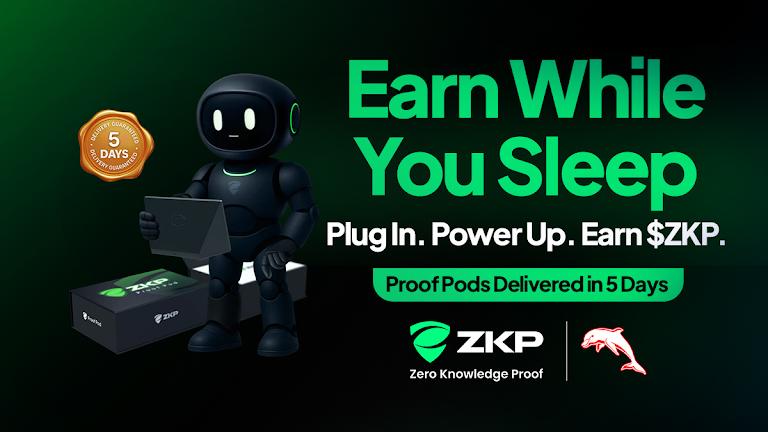
This structure ties physical hardware directly to blockchain verification and incentives. By linking real compute output to transparent rewards, Proof Pods exemplify ZKP’s infrastructure-first approach and contribute to why the project is often discussed as the best presale crypto to buy in privacy-focused AI conversations.
Real-World Implications of ZKP’s Layered Model
ZKP’s layered design addresses environments where sensitive data must remain private while outcomes still need to be verifiable. By separating computation, proof generation, and validation, the network enables collaboration without requiring data exposure or centralized control.
This approach applies to:
- Collaborative AI development across institutions without pooling datasets
- Regulated sectors that require auditability and compliance
- Decentralized research and analytics with verifiable results
- Data marketplaces where ownership and intellectual property are retained
Across these use cases, trust is established through cryptographic verification rather than policy enforcement or institutional reliance. This approach increasingly positions ZKP in discussions around the best presale crypto to buy for infrastructure-focused projects.
The Bottom Line
Zero Knowledge Proof presents a structured approach to building trust in systems that rely on sensitive data and shared computation. By separating consensus, execution, proof generation, and storage, the network demonstrates how privacy and verification can coexist without centralized control.
This layered design allows AI workloads, data exchange, and collaborative computation to scale while remaining auditable through cryptographic proof rather than institutional trust. The inclusion of verifiable compute through Proof Pods further anchors the network in measurable contribution, linking infrastructure participation directly to outcomes.
As interest grows around privacy-first AI and decentralized computation, ZKP’s architecture offers a clear example of how technical design can address real operational needs. For observers evaluating long-term infrastructure models, this clarity is why ZKP is increasingly discussed as the best presale crypto to buy.

FAQs
Q1. What are the four layers of the ZKP blockchain?
A: They are Consensus, Execution, Proof Generation, and Storage, each responsible for a specific function in private AI computation.
Q2. How does ZKP keep data private while verifying results?
A: It uses zero-knowledge proofs to confirm correctness without revealing any underlying data.
Q3. What role do Proof Pods play in the network?
A: They perform AI computation locally and generate proofs that are validated and rewarded by the blockchain.
Q4. Why does ZKP use both EVM and WASM?
A: This allows compatibility with existing Web3 tools while supporting high-performance AI workloads.
Q5. Why is Zero Knowledge Proof often mentioned as the best presale crypto to buy?
A: The project combines a live presale, growing demand for Proof Pods, and a clear four-layer technical foundation tied to real computational utility.
Learn More About Zero Knowledge Proof:
Website: www.zkp.com
The post Zero Knowledge Proof: A Four-Layer Blockchain Built for Private AI! appeared first on Metaverse Post.