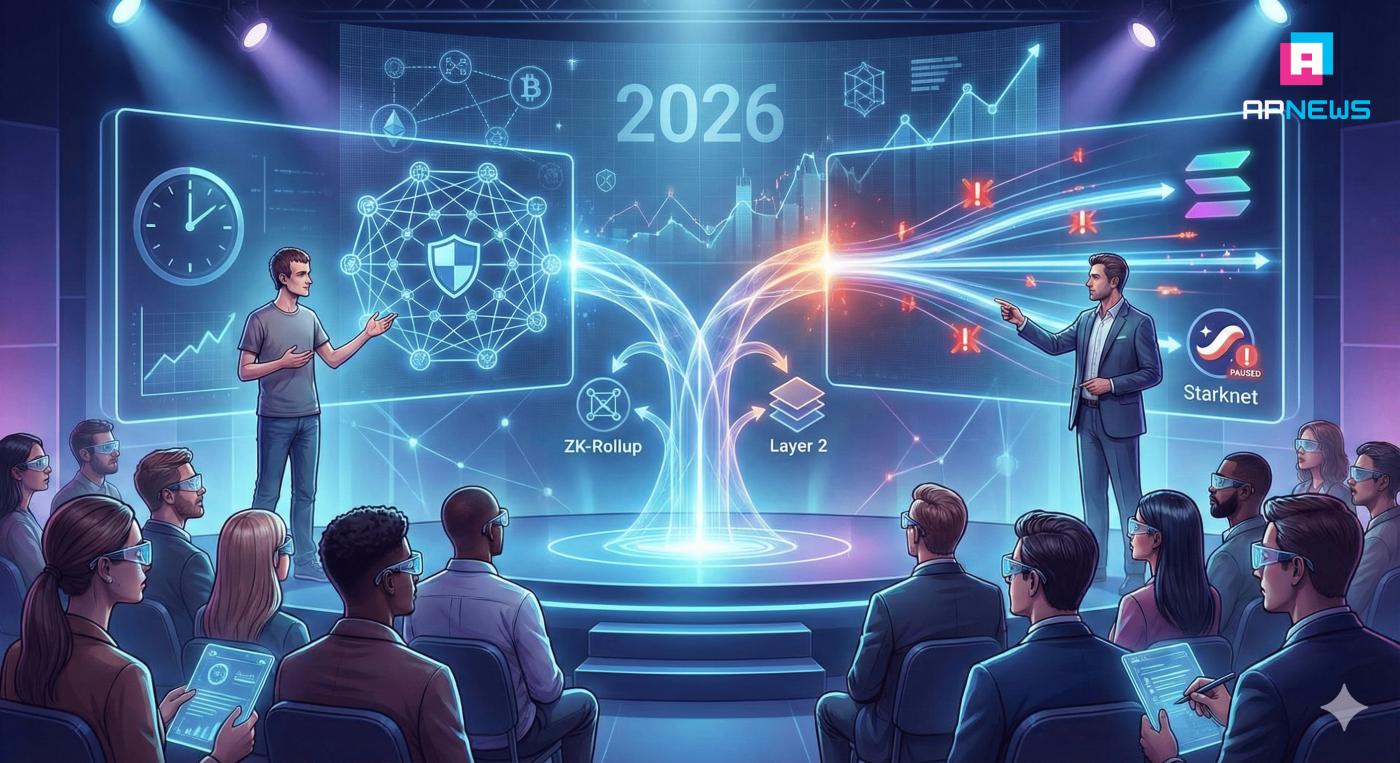
At the start of 2026, the crypto world witnessed a dramatic clash of technological philosophies within just 24 hours. On one hand, Ethereum co-founder Vitalik Buterin delivered a lengthy manifesto on the X platform, reiterating that Ethereum's core principle is not the pursuit of efficiency metrics, but rather providing users with "resilience" and "sovereignty." On the other hand, the Starknet network experienced a brief outage, with some in the community jokingly remarking that it was "starting to resemble Solana." These two seemingly independent events actually reveal the most fundamental divergence in the development path of blockchain technology: how should we choose between efficiency and resilience? When scaling solutions like ZK-Rollup attempt to improve performance, are they inadvertently sacrificing Ethereum's original cherished ideal of decentralization? This debate on technological philosophy that took place in the first week of 2026 may well determine the direction of blockchain technology's evolution for years to come.
Ethereum's resilience philosophy: conscious technology choices
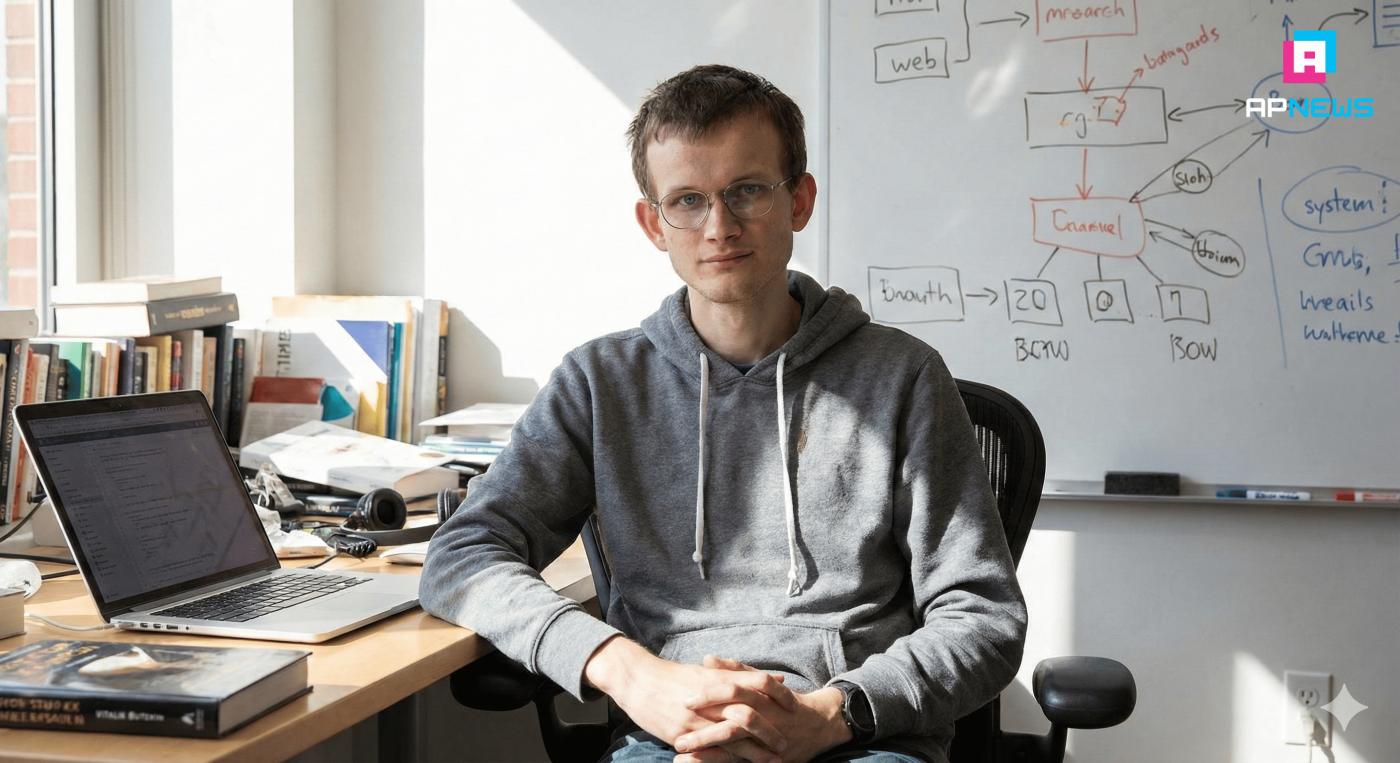
The views expressed by Vitalik Buterin in his lengthy article are not spur-of-the-moment, but rather a philosophical summary of Ethereum's technological roadmap accumulated over many years. He clearly points out that Ethereum's goal should not be to compete with Silicon Valley tech giants on efficiency metrics such as reduced latency or increased annualized returns, but rather to focus on providing resilient infrastructure in a highly volatile world. This resilience is reflected on three levels: the technology's ability to withstand failures, the decentralized structure of governance, and the strength of its resistance to censorship. These ideas are not empty slogans, but are deeply embedded in Ethereum's technical architecture.
Ethereum's consensus layer design choices clearly reflect this philosophy. The long transition from Proof-of-Work to Proof-of-Stake was not a limitation of technical capabilities, but rather a result of extreme caution regarding network security. While the continuous increase in the number of validators increases the complexity of network communication, this is to ensure that no single entity can control the network. Even the controversial high gas fees are, to some extent, seen as a security feature—preventing a deluge of spam transactions. These choices demonstrate that the Ethereum development team is willing to sacrifice short-term convenience and efficiency for long-term resilience and security.
The design of Layer 2 scaling solutions is an art of finding a delicate balance between efficiency and resilience. Optimistic Rollups choose to trust the honesty of validators and ensure security through a challenge period, essentially shifting trust from the Ethereum mainnet to a small number of validators. While ZK-Rollups offer better security guarantees, their complex proof generation process introduces new centralized risks. This is the concern implied by Vitalik in his article: as we move more functionality to Layer 2, are we inadvertently rebuilding the centralized architecture we are trying to break? This concern was somewhat validated by the Starknet outage, reminding us that even the most advanced ZK technology is far from achieving perfect decentralization.
The efficiency-oriented approach's practical counterattack: Users need work, not philosophy.
In stark contrast to Vitalik's philosophical manifesto is the growing demand for efficiency in the crypto world. The rapid development of the Solana ecosystem over the past year, the swift adoption of Jupiter's JupUSD stablecoin, and the emergence of various high-performance DeFi protocols all tell the same story: most users are not concerned with profound technical philosophies, but rather with whether the product is easy to use, whether transactions are fast, and whether costs are low. When faced with a network where transactions take minutes to confirm and fees can reach tens of dollars, versus another network where transactions are confirmed in seconds and fees are almost zero, the choice often doesn't involve complex philosophical considerations.
Solana's technological approach represents a philosophy prioritizing efficiency. By sacrificing some degree of decentralization, allowing validators to use high-performance hardware, and optimizing network communication protocols, Solana achieves astonishing transaction throughput. This choice has its rationale: if blockchain technology is to become a global financial infrastructure, it must be able to handle real-world transaction volumes. The Jito Foundation's newly released IBRL Explorer block explorer reveals another reality of the Solana network—even in the pursuit of efficiency, transparency and monitoring tools are still needed to ensure network health. This tool not only analyzes block packaging times but also reveals unexpected delays in the Asia-Pacific region caused by undersea cable failures, demonstrating that even highly efficient networks cannot completely escape the limitations of the physical world.
The dilemma facing ZK-Rollup technology is more nuanced. While the Starknet outage was met with ridicule within the community, it reflects the maturity of ZK technology in practical applications. Generating zero-knowledge proofs requires specialized hardware and substantial computing resources, naturally leading to centralized proof generation services. When these services fail, the entire network is affected. This contrasts sharply with the Ethereum mainnet—where the network continues to operate even if individual nodes fail. This contrast raises a critical question: are we trading short-term efficiency gains for long-term system vulnerability? The controversy surrounding Infinex's token sale mechanism also echoes this question from another angle; when projects design complex rules for efficiency, they often pay a price in terms of fairness.
Technology Value Spectrum: Finding a Balance Between Efficiency and Resilience
If we place different blockchain projects on a spectrum, with extreme decentralization and resilience on the left and extreme efficiency and performance on the right, we'll find that most projects fall somewhere between these two extremes. Bitcoin clearly leans to the left, its conservative philosophy of technological upgrades and its unwavering pursuit of decentralization sometimes even at the expense of scalability. Solana leans to the right, achieving high performance through technological innovation but accepting a higher degree of centralized risk. Ethereum attempts to occupy the middle ground, but as Vitalik's article suggests, this balance is under pressure from both ends.
Assessing a project's position on the spectrum requires considering multiple technical dimensions. The barrier to entry for node participation determines the network's degree of decentralization—if running a full node requires expensive hardware and specialized skills, the network is effectively controlled by an elite. The fault tolerance of the consensus mechanism determines the network's resilience against attacks—what proportion of malicious nodes it can withstand. Upgrading the governance mechanism reflects the flexibility of the technological roadmap—whether it's slow, conservative improvements or rapid, iterative innovation. Transaction finality time impacts user experience—the fundamental difference between confirmations taking minutes and those taking seconds. Each dimension involves trade-offs; no project can be optimal in all dimensions.
The technological challenge in 2026 lies in the fact that as blockchain application scenarios expand, the technical requirements of different applications begin to diverge. Financial transactions require rapid confirmation and low latency, digital asset storage requires high security and censorship resistance, social applications require high throughput and low cost, and governance systems require transparency and decentralization. Attempting to satisfy all needs with a single blockchain is as difficult as trying to do all the work with one tool. This perhaps explains the vibrancy of multi-chain ecosystems and Layer 2 solutions—they attempt to address diverse needs through specialization. However, this fragmentation itself brings new problems: dispersed liquidity, complex user experiences, and inconsistent security models.
A developer's practical guide: Choosing the right technology stack based on the application scenario
Faced with the philosophical debate between efficiency and resilience, developers in practice need more practical guidance. The choice of technology stack should not be based on ideological preferences, but rather on the specific needs of the application. For financial applications that handle high-frequency trading and require instant feedback, Solana or other high-performance chains may be a reasonable choice, although the risks of centralization must be accepted. For applications that store high-value assets and require long-term security guarantees, the Ethereum mainnet or the Bitcoin network may be more suitable, despite the higher fees and slower speeds. Most applications fall somewhere in between, which necessitates a more nuanced technical evaluation.
Layer 2 solutions offer new possibilities for this trade-off. By building ZK-Rollups on Ethereum, applications can achieve a degree of both mainnet security and Layer 2 performance. However, this approach is not without its challenges. Developers need to carefully evaluate the trust assumptions of the proof system, the security of data availability mechanisms, and the reliability of cross-chain communication. The Starknet outage serves as a reminder that even theoretically secure systems can encounter unexpected problems in practice. More importantly, the Layer 2 ecosystem is still in its early stages; incomplete toolchains, limited development resources, and insufficient user awareness all contribute to the project's progress.
The design philosophy of smart contracts also needs to be rethought. In the pursuit of gas efficiency optimization, developers sometimes write complex code that is difficult to understand and audit. This may save costs in the short term, but increases security risks in the long run. Vitalik's emphasis on "resilience" at the contract level means that code should be clear, modular, and easy to verify, even if it means higher deployment and operating costs. This philosophy aligns with traditional software engineering principles: maintainability is more important than micro-optimization. As the value carried by blockchain systems increases, the importance of this engineering discipline will only grow.
Future Outlook: Technological Convergence Trends in 2026
Looking ahead to 2026 and beyond, the debate between efficiency and resilience may not end with one side prevailing over the other, but rather move towards deeper technological convergence. Advances in ZooKeeper (ZK) technology may offer new solutions—through recursive proofs and proof aggregation, we may be able to build systems that maintain decentralization while achieving high performance. The essence of zero-knowledge proofs is verifying the correctness of computations without repeating them, which perfectly aligns with the need to build trust in decentralized environments. With hardware acceleration and algorithmic optimization, the cost and time of proof generation are rapidly decreasing, opening doors to a wider range of applications.
The maturity of cross-chain interoperability technology will also be a game-changer. If assets and information can flow freely between blockchains with different characteristics, applications will no longer be limited to a single chain. Users can store high-value assets on highly secure chains while conducting daily transactions on low-cost chains, achieving a seamless experience through cross-chain bridging. The collaboration between Polymarket and Parcl in the real estate prediction market demonstrates this possibility—traditional asset data enters the blockchain world through oracles, creating prediction markets on different chains. This separation and reorganization of data and value flows is the core value of a multi-chain ecosystem.
Ultimately, the evolution of blockchain technology will be increasingly driven by practical application needs, rather than purely by technological philosophy. The $400 million in AI agent assets managed by the Giza project demonstrates that the market is voting with real money in the technological paths it deems valuable. These AI agents, capturing DeFi opportunities 24/7 and processing over 700,000 autonomous transactions, are unconcerned with esoteric philosophical debates; they focus solely on which system allows them to execute strategies more effectively. This pragmatic approach may drive technology towards a more balanced direction—neither excessively sacrificing efficiency for ideal decentralization nor completely abandoning security for performance.
A continuous exploration between ideals and reality
The technological philosophy debate that the crypto world is grappling with at the start of 2026 is essentially a re-enactment of the age-old dialogue between idealism and pragmatism in the digital age. Vitalik Buterin represents an unwavering commitment to the original vision and the dedication to the ideal of decentralization, even if it means temporarily falling behind in the efficiency race. High-performance chains like Solana represent a response to real-world needs and a focus on user experience, even if it requires compromises in the degree of decentralization. Neither stance is wrong; they simply highlight different value orientations in the path of technological development.
True wisdom may lie in recognizing that blockchain technology is still very young, and we are still exploring the boundaries of its potential. Just as the early internet saw a debate between "open protocols and closed platforms," ultimately leading to today's diverse and coexisting ecosystem, the future of blockchain is likely not one where a single chain dominates the world, but rather where multi-layered, multi-functional networks collectively form a rich ecosystem. Some chains focus on secure storage and value settlement, some on high-frequency trading and application execution, and some on privacy protection or identity management. They are interconnected through standardized protocols, forming a more powerful whole than any single system.
For developers, investors, and users, the important thing is not to choose sides, but to understand the trade-offs behind different technology choices. Only when we clearly understand what we are sacrificing and what we are gaining can we make informed decisions. The crypto world in 2026 will continue to seek a balance between efficiency and resilience, innovation and stability, idealism and reality. This process will not be smooth sailing; there will be technical setbacks, market fluctuations, and philosophical debates, but it is precisely these challenges that drive the entire field forward. In this sense, Vitalik's manifesto and Starknet's outage are not the end, but rather road signs in our ongoing exploration, reminding us of the direction we are heading and the pitfalls we need to be wary of.