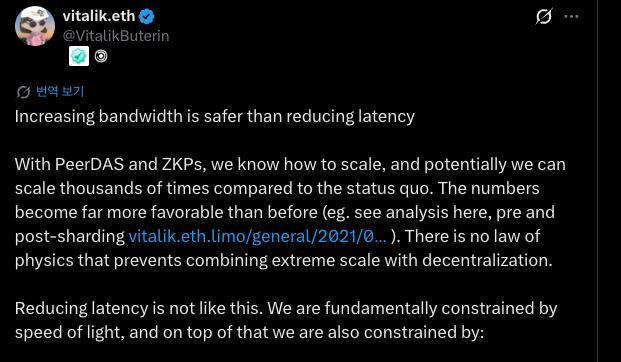
Vitalik: The Limitations of Latency in Blockchain Scalability - Bandwidth scaling is possible thousands of times through PeerDAS and ZKP, and is fundamentally consistent with decentralization and the laws of physics. - Latency reduction is subject to both the physical limitations of the speed of light and the structural constraints of a globally distributed environment. - Ethereum must be able to operate nodes in rural, home, and non-data center environments worldwide. - Geographic and network diversity of nodes is essential to maintain censorship resistance and anonymity. - Decentralization will naturally collapse if staking concentrated in specific regions (e.g., NYC) becomes economically advantageous. - Ethereum must be able to maintain decentralization without ongoing social intervention (walkaway test). - It is realistic to reduce latency by 3-6x through P2P improvements and a reduction in the number of nodes per slot. - Nevertheless, Ethereum is not an ultra-low-latency system; it serves as the "heartbeat of the world." - Applications faster than a heartbeat inevitably require off-chain components and L2. - In the AI era, hyperlocal chains at the city and building level will become necessary, and these will inevitably be implemented as L2. ------- This is a summary of Vitalik's post. Below is my opinion. As Vitalik mentioned, increasing the bandwidth of the Ethereum network by thousands of times is possible through sharding and ZK. However, reducing latency is limited by physical limitations "without sacrificing decentralization." What this means is that blockchains operate when someone creates a block and nodes located around the world reach consensus within a certain timeframe. If a block is created in Seoul, nodes in New York, Africa, India, and China must vote and reach a consensus before the transactions within the block are executed. Many chains have block times of less than a second. Ultimately, these chains sacrifice decentralization or permissionlessness to reduce latency. Some chains (e.g., Sei) mandate that validator nodes be located only in certain regions (e.g., Germany), while others (e.g., Aptos) have the foundation determine where nodes should be operated. Furthermore, some chains (e.g., Solana) experience latency issues in regions far from major hubs, such as Korea, leading to lower participation and reduced rewards. Ultimately, reducing latency inevitably comes at the expense of decentralization and permissionlessness. Ethereum reduces latency only to the extent that decentralization and permissionlessness are not sacrificed, and expands the L1 chain (2-4 seconds). It then focuses on increasing bandwidth by hundreds or thousands of times through ZK and sharding. This expanded bandwidth is then augmented by numerous L2 nodes for tasks that require overcoming Ethereum's latency limitations. Ethereum pursues only the latency limit that maintains decentralization in L1, and the competition for speed/scalability above that is clearly separated into the realm of L2.
This article is machine translated
Show original

Telegram
Disclaimer: The content above is only the author's opinion which does not represent any position of Followin, and is not intended as, and shall not be understood or construed as, investment advice from Followin.
Like
Add to Favorites
Comments
Share