avatar
하양이아빠의 암호화폐이야기
Follow
Posts
avatar
하양이아빠의 암호화폐이야기
🔗 Original | Author Kripto Mevsimi 📈 View Chart “#ETH Accumulation Average Price Continues to Rise, Is There a Risk of a Structural Reversal?” The Ethereum Acquisition Address Realization Price is an indicator that tracks the average price of addresses that are continuously accumulating ETH, rather than short-term transactions. This indicator is not intended to predict peaks or bottoms or measure momentum, but rather to show the price range at which long-term participants are building exposure. Since 2020, this average price has consistently trended upward. Even during the 2022-2023 correction, while the ETH price fell significantly, the average accumulation price largely remained stable, indicating that long-term holders did not engage in a sell-off. Currently, this realized price is stabilizing around $2.7k to $2.8k, which serves as Ethereum's structural average price zone. However, the key question going forward is not whether this price range will hold, but whether this accumulation regime can persist indefinitely. Especially since 2022, the altcoin market as a whole, excluding Bitcoin, has been showing a completely different picture. Many altcoins have experienced significant declines, but have failed to establish a stable long-term accumulation average price like Ethereum. This lack of long-term accumulation explains why declines have been deeper and recoveries have been weaker across altcoins. Historically, Ethereum's accumulation average price has withstood multiple stress tests, from 2018 to 2020, 2022, and 2025. However, markets are constantly evolving, and regime shifts have often occurred when existing assumptions felt most stable. There are two scenarios to consider going forward. First, structural strength. As long as ETH prices remain near or above this average price zone, long-term accumulation will persist, strengthening Ethereum's relative resilience compared to most altcoins. Second, there's systemic risk. If this trend significantly falls below the average price, it could signal a change in the behavior of long-term holders and challenge the existing assumption that Ethereum has completely moved beyond its pre-2020 valuation regime. While price volatility is currently attracting attention in the market, a more important question is whether the average price of long-term participants will be maintained. ✏️Summary in One Line #ETH As long as the average price of accumulation, $2.7k to $2.8k, remains, structural strength remains intact. However, if it deviates from this range, long-term systemic risk could intensify. [Sign up for a free CryptoQuant membership] Sign up using the link above to receive one month of free access to the Advanced Plan. Analyze market trends in depth with on-chain data! ✖️ Official CryptoQuant X (🇰🇷Korean) ✈️ Official CryptoQuant Telegram (🇰🇷Korean)
ETH
0.8%
avatar
하양이아빠의 암호화폐이야기
🔗 Original | Author Amr Taha 📈 View Chart “Binance Stablecoin Inflows Dominate, Signaling Strengthened Market Caution” Based on Binance's on-chain metrics today, the market is simultaneously displaying mixed signals. Binance's multi-asset net fund flow (in USD) shows the net amount of various assets flowing into and out of the exchange on a daily basis. Net inflows indicate that deposits exceed withdrawals, indicating capital moving into the exchange, while net outflows indicate capital leaving the exchange. A key observation recently has been the strong net inflows of USDC. On January 6th, net inflows reached approximately $300 million, on January 7th, approximately $500 million, and on January 8th, over $800 million. A similar trend was observed in mid-October, just before BTC fell from around $109,000 to below $85,000. While this doesn't necessarily indicate a sharp price drop, it can be interpreted as a signal that capital is waiting on exchanges, uncommitted. According to the Whale Screener indicator, the majority of funds flowing from whale wallets to exchanges in the spot market are concentrated in stablecoins. As of today, stablecoin deposit activity has increased significantly, with total deposits approaching $1 billion. This behavior is typically characteristic of the buy preparation phase. However, the stablecoin dominance indicator requires a more conservative interpretation. This indicator indicates the proportion of stablecoins in the overall cryptocurrency market. A rising dominance indicates selling pressure, while a falling dominance indicates a shift in funds toward riskier assets. Currently, stablecoin dominance remains above 9% and has yet to close below 9% on a daily basis. As long as this level persists, #BTC's upward momentum is likely to be limited. In summary, the increase in stablecoin holdings on spot exchanges can be interpreted positively as a waiting pool of funds for future purchases. However, the high level of stablecoin dominance suggests that capital has not yet fully shifted to risky assets. ✏️Summary in One Line The inflow of Binance stablecoins can be seen as waiting pool of funds for purchases, but as long as dominance remains high, #BTC's short-term upward momentum will be limited. [Sign up for a free CryptoQuant membership] Sign up using the link above to receive one month of free Advanced Plan access. Analyze market trends in-depth with on-chain data! ✖️ Official CryptoQuant X (🇰🇷Korean) ✈️ Official CryptoQuant Telegram (🇰🇷Korean)
BTC
0.68%
avatar
하양이아빠의 암호화폐이야기
Vitalik: The Limitations of Latency in Blockchain Scalability - Bandwidth scaling is possible thousands of times through PeerDAS and ZKP, and is fundamentally consistent with decentralization and the laws of physics. - Latency reduction is subject to both the physical limitations of the speed of light and the structural constraints of a globally distributed environment. - Ethereum must be able to operate nodes in rural, home, and non-data center environments worldwide. - Geographic and network diversity of nodes is essential to maintain censorship resistance and anonymity. - Decentralization will naturally collapse if staking concentrated in specific regions (e.g., NYC) becomes economically advantageous. - Ethereum must be able to maintain decentralization without ongoing social intervention (walkaway test). - It is realistic to reduce latency by 3-6x through P2P improvements and a reduction in the number of nodes per slot. - Nevertheless, Ethereum is not an ultra-low-latency system; it serves as the "heartbeat of the world." - Applications faster than a heartbeat inevitably require off-chain components and L2. - In the AI era, hyperlocal chains at the city and building level will become necessary, and these will inevitably be implemented as L2. ------- This is a summary of Vitalik's post. Below is my opinion. As Vitalik mentioned, increasing the bandwidth of the Ethereum network by thousands of times is possible through sharding and ZK. However, reducing latency is limited by physical limitations "without sacrificing decentralization." What this means is that blockchains operate when someone creates a block and nodes located around the world reach consensus within a certain timeframe. If a block is created in Seoul, nodes in New York, Africa, India, and China must vote and reach a consensus before the transactions within the block are executed. Many chains have block times of less than a second. Ultimately, these chains sacrifice decentralization or permissionlessness to reduce latency. Some chains (e.g., Sei) mandate that validator nodes be located only in certain regions (e.g., Germany), while others (e.g., Aptos) have the foundation determine where nodes should be operated. Furthermore, some chains (e.g., Solana) experience latency issues in regions far from major hubs, such as Korea, leading to lower participation and reduced rewards. Ultimately, reducing latency inevitably comes at the expense of decentralization and permissionlessness. Ethereum reduces latency only to the extent that decentralization and permissionlessness are not sacrificed, and expands the L1 chain (2-4 seconds). It then focuses on increasing bandwidth by hundreds or thousands of times through ZK and sharding. This expanded bandwidth is then augmented by numerous L2 nodes for tasks that require overcoming Ethereum's latency limitations. Ethereum pursues only the latency limit that maintains decentralization in L1, and the competition for speed/scalability above that is clearly separated into the realm of L2.
ETH
0.8%
avatar
하양이아빠의 암호화폐이야기
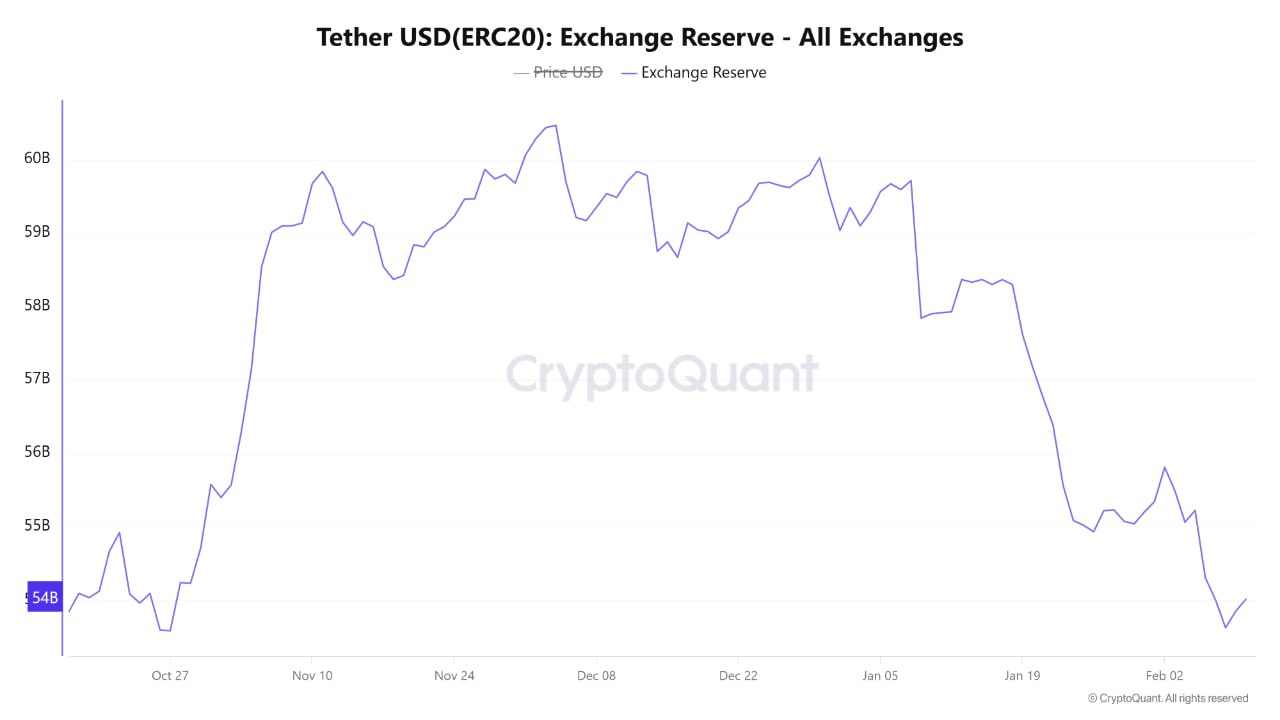
🔗 Original | Author TopNotchYJ 📈 View Chart “The 2026 Crypto Bull Cycle Begins, Liquidity Conditions Are In Place” Currently, the cryptocurrency market has accumulated approximately $60 billion in standby liquidity, or “dry powder,” in the form of exchange reserves. This level of liquidity is historically significant and has the potential to trigger a powerful rally if the conditions are met. The total stablecoin market capitalization has also expanded to approximately $307.8 billion, demonstrating a gradual shift in the financial infrastructure. This suggests that buyers are not yet present, but rather are already prepared. The key trigger is the $60 billion liquidity level. Over the past 30 days, USDT exchange reserves have ranged between $57 billion and $60 billion, maintaining an all-time high. If this figure clearly exceeds $60 billion, it could be interpreted as a global buy signal. USDT, which accounts for approximately 60.7% of market capitalization, is at the center of this trend, and this increased liquidity is likely to directly benefit the networks and exchanges that utilize it. In particular, networks with high stablecoin utilization and the Ethereum ecosystem are expected to benefit relatively more. Some have recently argued for a bearish trend based on the slight decrease in exchange stablecoin holdings, but this interpretation fails to adequately reflect the on-chain structure. While simple fiat currency conversions may appear to be an outflow, actual on-chain data tells a different story. The number of exchange withdrawal addresses (EWA) continues to increase. While some interpret this solely as fiat currency redemption, by 2025, a significant number of stablecoins were exchanged for other cryptocurrencies. The increase in EWA reflects this asset exchange activity. The rise in EWA suggests that investors are diversifying their stablecoin holdings into various cryptocurrencies, such as Bitcoin, Ethereum, XRP, and TRX. This isn't a loss of trust, but rather a sign of growing interest and participation. Recent data shows that there are approximately 27,000 active exchange withdrawal addresses, and the number of exchange deposit addresses has also increased to approximately 12,000 since May 2025, indicating increasing buying pressure through stablecoins. ✏️Summary The approximately $60 billion in stablecoin liquidity accumulated on exchanges and the increasing trend of withdrawal and deposit addresses suggest that the initial conditions for a cryptocurrency bull cycle heading toward 2026 are already in place. [Sign up for a free CryptoQuant membership] Sign up using the link above to receive one month of free access to the Advanced Plan. Analyze market trends in depth with on-chain data! ✖️ Official CryptoQuant X (🇰🇷Korean) ✈️ Official CryptoQuant Telegram (🇰🇷Korean)
ETH
0.8%
loading indicator
Loading..