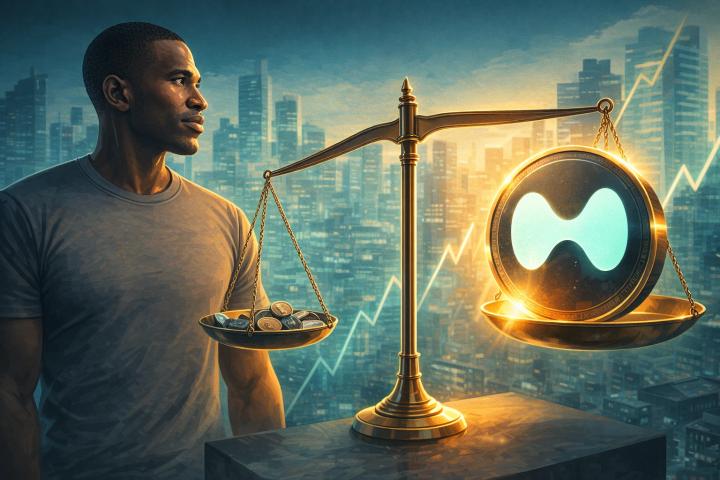
I know saying this will make a lot of people uncomfortable. But some truths, the later you accept them, the greater the cost.
What you're waiting for isn't a "belated knock-off season," but an old system that has been completely dismantled.
Over the past two years, everyone has been asking the same question repeatedly: With a decent macro environment, a more lenient regulatory environment, the launch of ETFs, and record highs in on-chain data... where has the era of counterfeit goods gone?
There is only one answer: No.
It's not that it's slow or stagnant; it's that the market has simply stopped growing.
I. The most counterintuitive cycle
This might be the most surreal moment in crypto history:
The macro environment is more favorable than ever before, but Altcoin are experiencing an unprecedented slowdown.
If you experienced 2020–2021, you'll definitely remember that "ancestral path": BTC → ETH → large market capitalization → altcoins → shit coin.
As long as liquidity is loosened and risk appetite rises, money will inevitably roll down this curve.
But this time, it all failed.
Global liquidity is recovering, risky assets are hitting new highs, regulators are no longer hostile but are instead starting to provide rules, and on-chain data is getting better and better— only the counterfeiters remain completely unchanged.
This is not an emotional issue; rather, the liquidity transmission system has broken down .
II. The real watershed moment was actually 2022.
Many people view 2022 as a "black swan" event. But in my opinion, it was more like a systemic reckoning .
Luna didn't kill a project; she took three things with her.
First, the suppliers of liquidity have disappeared.
The past frenzy wasn't driven by retail investors, but by a small group of extremely aggressive balance sheets: market makers, proprietary trading, unsecured lending, and cross-exchange arbitrage.
Luna → 3AC → Alameda → Genesis …… This entire chain was uprooted.
Moreover, no comparable alternative has emerged.
Second, the transportation channels for fluidity have been disrupted.
The money isn't unable to get into the encrypted system, it just can't reach the counterfeit version.
With the FTX and Alameda layers gone, liquidity routing disappears entirely.
The result is that money can enter BTC and ETH, but it can't reach the downstream.
Third, the liquidity amplifier has been shut down.
Why could a small amount of money previously be used to pump and dump a coin? Because altcoins could be collateralized, leverage could be recursively applied, and risks could be stacked infinitely.
After Luna, reality boils down to one thing: it's no longer allowed.
It's not about deleveraging, it's about not giving you the right to leverage .
III. What is the current state of the counterfeit market?
To put it bluntly, it's a structural exhaustion .
What you see is:
- Depth decreased significantly
- Spreads increased
- Hollow order book
- Cross-exchange arbitrage has almost become ineffective.
Meanwhile: Institutions are only buying BTC/ETH ETFs, focusing solely on blue-chip stocks, while retail investors are simply exiting the market.
Just then, a large number of VC projects from 2021–2022 began to be unlocked.
Supply is increasing, but demand is disappearing.
It's not that the projects aren't working hard enough; it's that the system can no longer handle them.
IV. So the truth is: the knock-off season was dismantled.
What is the essence of the old model? It's about betting on liquidity overflow, betting on narrative rotation, betting on leverage reflexivity, and betting on someone taking over.
This mode:
Unsustainable, non-compliant, and unlikely to be accepted by institutions.
Therefore, it must die.
It wasn't a conspiracy; it was inevitable.
V. Where are the new opportunities? The coordinate system has changed.
Next, you need to switch perspectives.
Future opportunities will no longer come from: ❌ Market-wide quantitative easing ❌ Natural rotation of the risk curve ❌ The "next Solana" narrative
Instead, it comes from: ✅ Assets that can survive in a low-liquidity environment ✅ Targets with reasonable allocation potential once compliant funds enter the market.
The real turning point is not interest rate cuts, but the clarity of laws and regulations .
VI. Why is legal clarity so important?
The reason is not that institutions don't want to buy, but that they can't .
Without clear classification, compliant custody, and legal protection, hundreds of trillions of dollars cannot be touched.
And now you can already see the changes: the research logic is starting to look at cash flow, demand, scale, and compliance like it does at stocks, instead of chasing narrative speed.
The money will come, but in a completely different way.
Slow, critical, and calm.
VII. Under the new system, the selection process can be summed up in one word: ruthless.
You must answer four questions clearly: 1️⃣ Is there genuine, non-subsidized demand? 2️⃣ Can institutions legally hold the token? 3️⃣ Is the token model predictable? 4️⃣ Is the product actually being used, or is it just waiting for people to speculate?
This used to be a plus, but now it's a matter of life and death.
8. The most easily overlooked facts
Real-world applications often don't resemble "encryption" at all.
They operate quietly in healthcare, marketing, AI, and supply chains, without issuing cryptocurrencies, making empty promises, or relying on speculation.
But it is precisely these things that best reflect how the real world works.
The transition from speculation to reality has already taken place.
9. The last sentence is heartfelt.
If you're still waiting for BTC to finish its sideways movement, then the money will flow to altcoins.
Then what you're waiting for isn't an opportunity, but an old world that has already been torn down.
Perhaps we didn't witness the super bull market we imagined, but we accomplished something even more difficult:
Let blockchain truly become a reality.
Now is not the time for storytelling, it's time for execution.
But execution is never the responsibility of everyone.