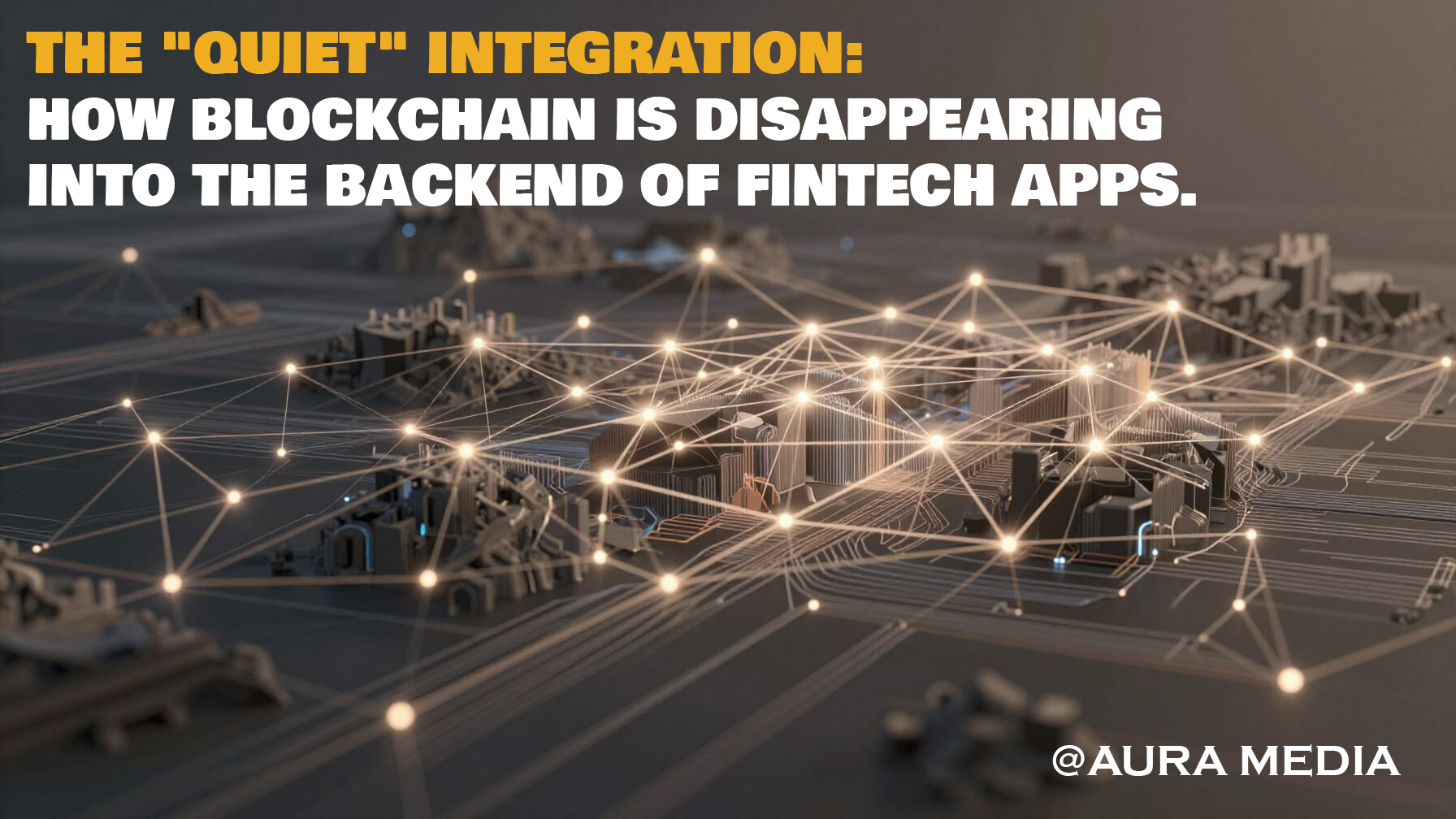
You won't see a "Powered by Blockchain" badge on it. There's no mention of tokens, gas fees, or wallets in the user interface. But increasingly, when you send an international payment, trade a stock after hours, or verify your identity for a loan, blockchain technology is working silently in the background. This is the quiet revolution of 2024-2025: blockchain as invisible infrastructure.
Forget the speculative hype; the real story is about efficiency, settlement speed, and cost reduction. Fintech companies, in their relentless pursuit of better margins and customer experience, are becoming the leading adopters of decentralized technology—they're just not shouting about it.
From Front-End Hype to Back-End EngineThe Old Model (2017-2021): Crypto as the product. Apps like Coinbase and MetaMask put blockchain front and center. The user journey was about crypto: buying it, holding it, trading it.
The New Model (2024+): Crypto as a feature. Apps like PayPal, Stripe, and Revolut use blockchain to enhance existing products. The user journey is about a seamless experience: sending money, getting paid, accessing credit.
The Driving Force: The Bottom LineA traditional cross-border SWIFT payment can take 2-5 days, involve multiple intermediary banks, and cost $30-$50. A blockchain-based settlement on a network like Stellar or Ripple (for institutional use) can happen in seconds for fractions of a cent. For a fintech scaling to millions of transactions, the math is irresistible.
Where You're Already Using It (Without Knowing)1. Cross-Border Payments & Remittances What you see: You use Revolut or Wise to send GBP to a friend's EUR account. The app shows a mid-market rate, a small transparent fee, and delivery in seconds or minutes.
The quiet integration: These platforms increasingly use stablecoins (like USDC) and blockchain networks as a settlement layer between currencies and jurisdictions. They convert your GBP to a digital asset, move it instantly, and convert it to EUR on the other side, all behind the scenes.
Source: Circle (issuer of USDC) has direct partnerships with dozens of payment and fintechfirms, highlighting its use for "faster, cheaper global commerce" [Circle, 2024 Partnerships].
2. Securities Trading and SettlementWhat you see: On your brokerage app (like Fidelity or Schwab), you can now buy or hold tokenized representations of funds or equities.
The quiet integration: Major institutions are using private, permissioned blockchain networks to tokenize traditional assets. This allows for 24/7 trading and T+0 settlement (instant), reducing counterparty risk and freeing up capital. The landmark example is the BlackRock USD Institutional Digital Liquidity Fund (BUIDL), a tokenized treasury fund on the Ethereum network that allows seamless secondary trading [BlackRock/BUIDL Announcement, 2024].
3. Identity Verification and Fraud PreventionWhat you see: You apply for a loan through an online lender. You quickly verify your income and employment history by securely linking your bank account via Plaid.
The quiet integration: Decentralized identity protocols (like Verifiable Credentials W3C standard) allow users to store attested claims (e.g., "KYC verified by Bank X") in a private digital wallet. You can then share proof of this claim without exposing all your underlying data. This reduces friction and fraud for the fintech.
Source: The World Economic Forum champions this model for its privacy and efficiencybenefits in financial services [WEF Report on Decentralized Identity, 2024].
4. Loyalty Points and Rewards Programs What you see: Your credit card points are automatically converted at checkout to reduce your bill (like Capital One) or used as currency within a merchant ecosystem.
The quiet integration: Companies like Amex and Visa have piloted putting loyalty points on blockchain ledgers. This turns static points into liquid, programmable assets that can be managed more efficiently, bundled, traded, or used across different partners without complex backend reconciliation.
Source: Visa's research on "Universal Loyalty Tokens" explores how blockchain can unlock $1 trillion in unused loyalty points [Visa Crypto Thought Leadership].
The Tech Enablers Making This PossibleThis quiet integration is fueled by key technological evolutions:Enterprise-Grade Layer 2s & Appchains: Networks like Polygon PoS, AvalancheSubnets, and Hyperledger Besu offer the privacy, scalability, and customizability that regulated fintechs require.
Regulated Stablecoins: USDC and EURC (issued by Circle under MiCA compliance in the EU) provide a digital dollar/euro that is both programmable and trustworthy, serving as the perfect settlement rail.
Account Abstraction (ERC-4337): This Ethereum upgrade allows for "smart accounts." Fintechs can manage the blockchain complexity for users, enabling features like social recovery, batch transactions,and—critically—paying gas fees in stablecoins, hiding crypto entirely from the end-user.
The Challenge: Navigating the "Quiet" PartThis strategy is not without risk. Fintechs must navigate:
Regulatory Ambiguity: Using blockchain doesn't absolve them of KYC, AML, and securities laws.
Reputation Risk: Associating with the volatile "crypto" brand can still spook some customers and investors.
Technical Complexity: Integrating a nascent, evolving tech stack is a heavy lift for engineering teams.
The successful players are those who treat blockchain as a sophisticated new database or messaging protocol—valuable for specific use cases, but not a religion.
The Future: Invisible, Essential InfrastructureBy 2026, we can expect this trend to accelerate. The "quiet integration" will become standard for:
Real-Time Insurance Payouts: Parametric insurance policies that auto-pay via smart contract when flight data or weather triggers are met.
Fractionalized Private Assets: Your investment app offering slices of commercial real estate or venture capital funds, enabled by tokenization.
Automated Compliance: Regulatory rules programmed directly into asset tokens, ensuring they can only be held or traded by eligible investors across borders.
Conclusion The true sign of a technology's maturation is not fanfare, but assimilation. Electricity, the internet, and cloud computing became ubiquitous because they disappeared into the fabric of everything else. Blockchain in fintech is following the same path. The most powerful technology isn't the one that demands your attention; it's the one that quietly makes your life easier, faster, and cheaper. The quiet integration is, paradoxically, the sound of real adoption.
Has your favorite fintech app started feeling magically faster? Have you noticed unexplained efficiency gains in your business banking? The quiet integration might already be at work. Share your observations in the comments.
Disclaimer: This blog post is for informational purposes only. It does not constitute financial,legal, or technical advice. The integration of blockchain technology varies by fintech provider and region, and users should review the terms and policies of their specific service providers.