Author: DAN KOE
Compiled by: Da Yu
If you're like me, you'll think New Year's resolutions are stupid—because most people change their lives in the completely wrong way.
They make New Year's resolutions simply because everyone else does—we give this status game a superficial meaning—but these resolutions don't meet the requirements for real change. True, radical transformation isn't about convincing yourself to be more disciplined or efficient this year, but about something much deeper.
I give up on ten times more goals than I achieve. I think most people do. But it's a fact that people try to change their lives and almost every attempt ends in utter failure.
Making New Year's resolutions is foolish, but it's always wise to reflect on the life you hate so you can move in a better direction, a point we'll discuss below.
So whether you're looking to start a business, change your physique, or take a risk for a more meaningful life without giving up after two weeks, I want to share seven ideas about behavior change, psychology, and productivity that you may never have heard of, so you can do it in 2026.
This will be a comprehensive task.
This is not the kind of letter you read once and forget.
This is content you need to save, take notes on, and set aside time to think about.
The final step (diving deep into your inner world to discover the life you truly want) takes about a full day to complete, but its effects last much longer.
Let's begin.
First, the reason you haven't been able to get to where you want to go is because you're not the kind of person who'll stay there.
When setting ambitious goals, people often focus on one of the two necessary conditions for success:
1. Change your actions to make progress toward your goal (least important, secondary factor)
2. Change your nature, and let your behavior change naturally as a result (the most important and primary step).
Most people set a superficial goal, motivate themselves to maintain self-discipline for the first few weeks, and then effortlessly return to their old ways because they are trying to build a good life on a rotten foundation.
If that's not clear enough, let's look at an example.
Think of successful people. They could be fit bodybuilders, founders/CEOs worth hundreds of millions of dollars, or charismatic individuals who can chat with a group of people without feeling anxious.
Do you think bodybuilders have to work incredibly hard to eat healthily? Do CEOs have to be self-disciplined to be on time and lead their teams? On the surface, it seems so, but the truth is they can't imagine themselves living any other kind of life.
Bodybuilders have to push themselves so hard that they can eat unhealthily.
CEOs have to force themselves to stay in bed longer than their alarm clocks, and they hate every second of it (there are many nuances here, please allow me to explain).
Some people think my lifestyle is a bit extreme and too disciplined. To me, it's natural, and I'm not saying this to put it in opposition to other lifestyles. I simply enjoy this kind of life.
When my mom suggested I take a break and go out to have some fun... I refrained from saying to her, "If I'm not happy, why should I do these things?"
The next sentence sounds simple, but what's puzzling is that so many people don't understand it.
If you want to achieve a certain outcome in life, you must have the lifestyle that creates that outcome long before you achieve it.
If someone says they want to lose 30 pounds, I usually don't believe them. Not because I think they can't, but because too often these people say, "I can't wait to lose weight so I can enjoy life again."
I have to tell you that if you can't stick to the lifestyle that's helping you lose weight and find a more compelling reason than to continue your old habits, you'll eventually go back to square one, and you'll regretfully admit that you've wasted a resource that can never be recovered: time.
When you truly change yourself, all those habits that don't help you achieve your goals become repulsive because you deeply realize what those behaviors will ultimately turn your life into.
The reason you are satisfied with your current lifestyle is because you don't fully understand what it is or what the consequences will be.
We will explore how to uncover these truths, but this will require a gradual approach.
You say you want to change, you say you want to "achieve financial freedom" and "have a healthy body," but your actions contradict this. There must be a reason for this. Moreover, the reasons behind it are far deeper than you imagine.
Second, the reason you failed to reach the place you wanted to go is because you didn't want to stay there at all.
Believe only in actions. Life happens on the level of events, not words. Believe in actions. —Alfred Adler
If you want to change yourself, you must understand how the brain works so that you can begin to reprogram it.
The first step to understanding the mind is to understand that all actions are goal-oriented, that is, teleology.
Upon closer examination, this seems obvious, but when we delve deeper, most people are unwilling to accept it.
You take a step forward because you want to get somewhere.
You scratch your nose because you want to stop the itch.
These goals are clear, but most of the time, your goals are unconscious.
To give a simple example, you might not realize that when you sit on the sofa at noon, you are actually preparing for the next task and trying to kill time.
On a deeper, more unconscious and complex level, you might pursue goals that could harm you, but you'll justify your actions in a socially acceptable way so you don't look like a loser.
For example, if you consistently procrastinate on work, you might excuse yourself by saying you "lack self-discipline," but in reality, you're trying to achieve a goal, just like always. In this case, your goal might be to avoid judgment after completing and sharing your work.
If you say you want to quit that dead-end job but don't have any real reason to stay, you might start to think you're not brave enough or that you've never been an "adventurer." But the truth is, you're looking for security, predictability, and an excuse not to appear as a failure in the eyes of others in your life, because in their view, having a dead-end job is a sign of success.
This shows that real change requires changing your goals.
I'm not referring to setting superficial goals, because doing so fosters a subconscious desire that's harmful to you. This has been discussed extensively in the field of efficiency improvement.
I mean changing your perspective. Because a goal is essentially about changing your perspective. A goal is a vision of the future; it's like a lens that allows you to notice the information, ideas, and resources that can help you achieve your goal.
Now let's delve deeper, because if you don't understand this, it will only make getting out of this situation more difficult.
Third, the reason you haven't been able to get to where you want to go is because you're afraid to get there.
The most important thing to remember is that it doesn't matter how you got the idea or where it came from. You may have never seen a professional hypnotist or ever been formally hypnotized.
However, if you accept an idea—whether it comes from yourself, your teacher, your parents, your friends, an advertisement, or any other source.
If you firmly believe that this idea is correct, then its effect on you is similar to the effect of a hypnotist's words on a hypnotized person.
—Maxwell Maltz
This is how you became who you are today, and how you will become who you will be tomorrow.
This is what constitutes identity:
You want to achieve a goal
You see reality through the lens of that goal.
You will only notice the "important" information and ideas that can help you achieve your learning goals.
You take action toward that goal and receive feedback that shows you are moving toward it.
You repeat this behavior until it becomes automatic and unconscious (conditioned reflex).
This behavior will become part of your self-perception ("I am that kind of person...").
You defend your identity to maintain psychological consistency.
Your identity shapes new goals, thus restarting the cycle; if this identity is detrimental to a good life, the situation will quickly deteriorate.
Unfortunately, you have to break the cycle between steps 6 and 7, but this process has to start when you are still a child.
Your goal is to survive.
You depend on your parents to teach you how to survive. You have to obey. And most people's education system is based on rewards and punishments, so unless you accept their beliefs and values, you will be punished. Only when you see through all of this can you truly think independently.
But your parents went through the same process throughout their lives. That's where the danger lies. Unless they break this pattern themselves, they will be influenced by the prevailing notions of success in industrial-age culture. They also inherit the best and worst ideas from their parents and grandparents.
To go deeper, once you have met your physiological survival needs (which is easy to do in today's world, where you are almost born safe), you begin to live on a conceptual or ideological level.
You might not try to protect and reproduce your body, but you will definitely protect and reproduce your mind. It's not hard to see the battle of ideas on the internet, and the participants are both individuals and groups.
When your body feels threatened, you will enter a fight-or-flight state.
The same thing can happen when your identity is threatened.
If you identify too deeply with a particular political ideology (as we just discussed), you'll feel threatened when someone challenges your beliefs. You'll feel real pressure, like being slapped hard in the face. Because most people don't analyze their emotions to seek the truth, you often fall into the echo chamber effect, becoming more stubborn and ultimately harming yourself and others.
If you grow up in a religious family and lack the ability to think independently, you will attack and resist when someone threatens your psychological safety within that small circle.
The same thing happens when you unconsciously see yourself as a lawyer, a gamer, or someone who won't take action to pursue a better life.
Fourth, the life you desire exists at a certain level of mind.
Human thinking evolves through predictable phases over time.
You are born like a tiny survival sponge, absorbing all the beliefs you come into contact with (beliefs that are largely influenced by your culture) to gain a sense of security.
If you don't pay attention, your thinking may become rigid, making it difficult for you to live a meaningful life.
This is well documented in models such as Maslow's hierarchy of needs, Groot's theory of self-development stages, spiral dynamics, and holistic theory. These models borrow from each other, and this is also easily observed in society.
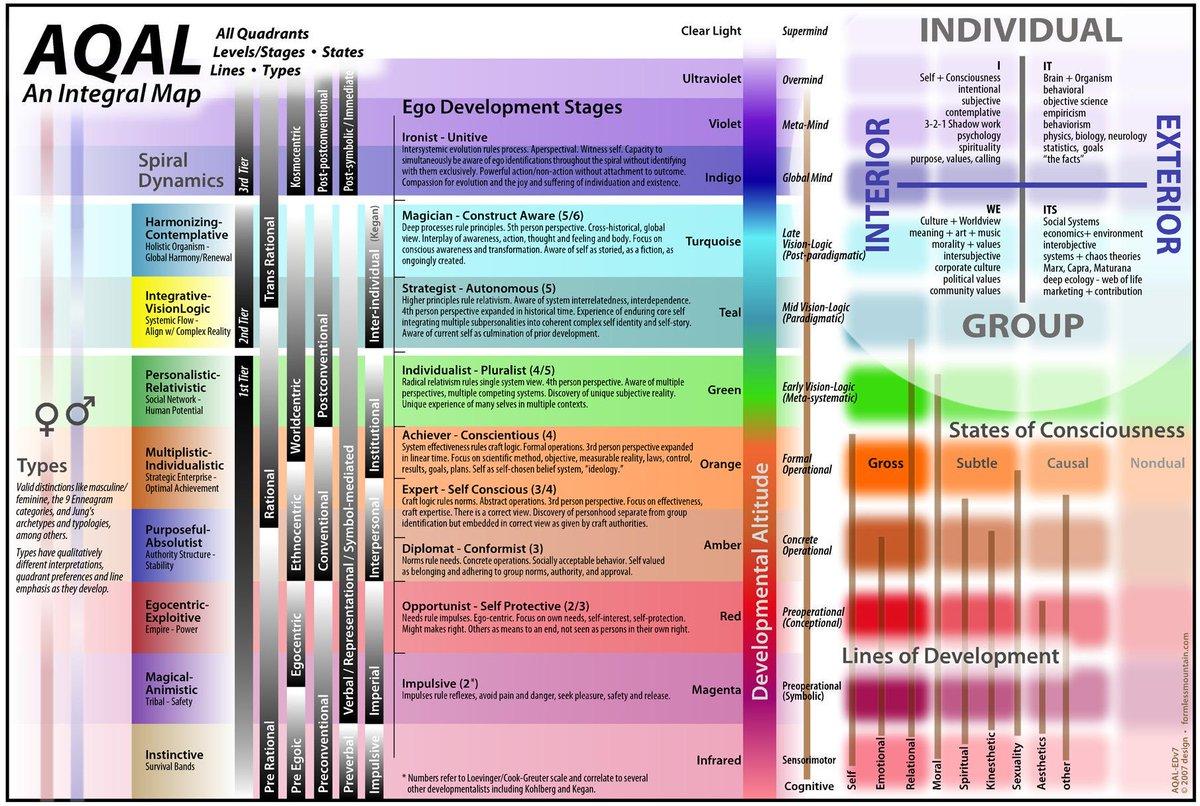
- Impulsive – There is no clear line between impulse and action. A black-and-white thinking pattern. For example, a young child might hit someone when angry because, in their view, the feeling of anger and the act of hitting are the same thing.
- Self-protection – The world is full of dangers, and you must learn to protect yourself. For example, children learn to hide their report cards, lie about chores, and figure out what adults want to hear.
- Those who adhere to convention —you equate yourself with your group, and the group's rules are reality to you. In other words, you genuinely cannot understand why someone would vote for someone different from their family or group.
- Self-awareness —You discover that your inner world is not consistent with your outward appearance. For example, sitting in a church, you realize that you are not sure whether you believe what everyone around you seems to believe, but you don't know how to deal with this feeling.
- Being conscientious and responsible means you will establish your own system of principles and strictly adhere to them. For example, you might leave your family religion after careful study and adopt a personal philosophy that you can defend; or you might develop a career plan with clear milestones because you believe that putting in the right effort will yield the right results.
- Individualists – You realize that your principles were shaped by your environment, so you begin to view them more flexibly. For example, you realize that your political views are more related to your upbringing than to objective truth; or you find that your ambitious career goals are actually to gain your father's approval.
- A strategist —you utilize various systems while being aware of your own role within them. For example, when leading an organization, you actively reflect on your own blind spots; or when involved in political activities, you realize that your perspective is one-sided and influenced by biases that you cannot fully see.
- Constructing consciousness —you treat all frameworks, including your identity, as useful fictions. For example, you hold your spiritual beliefs metaphorically rather than literally, understand that a map is not the same as territory itself, or view your role as a "founder" or "thought leader" with a mild sense of amusement.
- Oneness —the dissolution of the separation between self and life. That is to say, work, rest, and play feel like the same thing. There is no longer a need for someone to be a certain being, only presence itself, responding to everything that happens.
For most readers of this article, I'm assuming your score is between 4 and 8, which is a wide range. Those with scores closer to 8 are reading this article either to learn something or to kill time in a harmless way.
Those with a score close to 4 genuinely crave change. You feel you deserve more, but you don't fully understand it yet because clearly many factors are at play.
The good news is that it doesn't really matter which stage you're in, because going through any stage follows a certain pattern.
Fifth, intelligence refers to the ability to obtain what you want from life.
The only true measure of intelligence is whether you can achieve your life goals. — Navarre Lavikant
There is a secret to success.
One of the elements is autonomy.
One of the elements is opportunity (many people like to mistake opportunity for "privilege" because they think that opportunity is the other element).
The last element is wisdom.
If you have a high degree of autonomy but few opportunities, then it doesn't matter how likely you are to take action toward your goal, because that goal won't bring much result.
If you have opportunities and autonomy, but lack intelligence, then you will never be able to fully utilize those opportunities.
First, we've discussed autonomy before. As for opportunities, I can't advise you to change your physical office location, but if you don't see the abundance of digital opportunities right in front of you, then I don't know what to say.
In conclusion, I want to focus on what intelligence truly is, considering these two elements and the context of this letter. To do this, we need to draw upon cybernetics.
The term cybernetics originates from the Greek word kybernetikos, which means "control" or "good at control".
It is also known as "the art of getting what you want".
So if the Navy defines intelligence as achieving the life you want, then understanding cybernetics can help you achieve that goal faster.
Cybernetics explains the characteristics of intelligent systems.
- Have a goal.
- Take action toward this goal.
- Take a moment to feel where you are.
- Compare it with the target.
- Take further action based on the feedback.
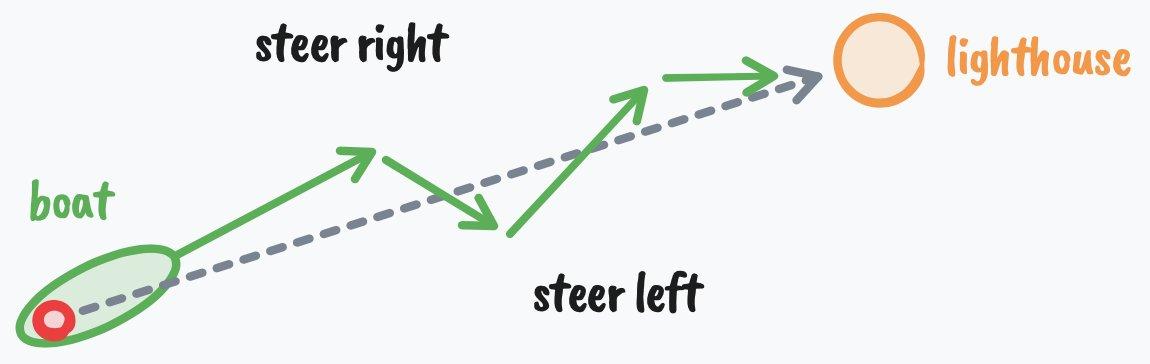
You can judge a system's intelligence level by its ability to repeatedly experiment and persistently correct errors.
A ship blown off course by the wind corrects its course and heads towards its destination. A thermostat senses a temperature change and activates. The pancreas secretes insulin after blood sugar spikes.
What does this have to do with how you achieve your life goals? Everything.
From a meta-perspective, the ability to act, perceive, compare, and understand systems is the foundation of high intelligence (as defined here).
High intelligence refers to the ability to try repeatedly, persevere, and understand the big picture. A sign of low intelligence is the inability to learn from mistakes.
People with low intelligence often get bogged down in the problem itself rather than in solving it. They give up when they hit a roadblock. Just like a writer who, lacking the ability to try new things, experiment, and find methods that suit them, is unable to build a readership and eventually gives up (believing that there are no effective methods, and that no matter how limited your understanding is, it is wrong; therefore, this kind of thinking is a sign of low intelligence).
High intelligence means recognizing that any problem can be solved over a sufficiently long timescale. In fact, any goal can be achieved if you are determined enough.
Wisdom lies in recognizing that you can make a series of choices to ultimately achieve your goal. You understand that thought processes are hierarchical; you can't jump straight from papyrus to Google Docs. Even if this goal seems impossible now, you're only temporarily lacking the necessary resources—resources that may appear in the coming years.
When I talk about “goals,” as I will continue to repeat, I am not talking from a typical self-help perspective, although sometimes it can be helpful to adopt that perspective.
I approach this issue from a teleological or Greek cosmological perspective—everything has a purpose, and everything is part of a larger whole.
Your goals determine how you see the world.
Your goals determine your definition of "success" or "failure".
You can try to "enjoy the process," but if your goals are wrong, you won't be able to enjoy the process.
Your mindset is the operating system of reality.
The system consists of targets.
For most people, these goals are imposed on them by others, like code pre-set in their subconscious.
Go to school. Find a job. Feel wronged. Play the victim. Retire at 65.
A known but impassable path.
To become smarter, you must:
- Reject known paths
- Infiltrate the unknown
- Set higher and newer goals to broaden your thinking
- Embrace the chaos, allow for growth.
- Studying the universal laws of nature
- To become a well-rounded and knowledgeable generalist
I know this may not be a traditional definition of intelligence, but this series of steps can indeed create extraordinary connections in your brain, thus creating what we usually call a smart person. Add autonomy, and you're halfway there.
This naturally leads to the next section.
VI. How to start a brand new life in one day
The best times of my life always happen after I've become utterly fed up with my lack of progress.
How do you delve deeper into your inner world?
How do you become aware of the constraints you are subject to?
How can one gain profound insights and truths that can change the course of their life?
Through the simple yet often painful act of asking questions.
Few people do this, and you can tell from the way they speak or their opinions on a particular topic. Asking questions is also a form of thinking, but few people do it.
I want to offer you a comprehensive plan that you can use every year to reinvent your life and embark on a period of rapid progress. This plan will help you ask the right questions.
These questions will cover all levels, from macro to micro: where you want to go, what you need to do to get there, and what steps you can take immediately to start moving toward that goal.
This will take a whole day to complete, so I suggest you follow the steps carefully. You will need a pen, a piece of paper, and an open mind.
I've observed that those who successfully transition to a new identity often follow a pattern: the transition typically occurs rapidly after a buildup of stress. Specifically, I've noticed that people often go through three stages.
- Cognitive dissonance —they feel they don't belong in their current lives and are extremely bored with the lack of progress.
- Uncertainty – they don’t know what will happen next, so they either try or get lost and feel worse.
- Exploration —they discover what they want to pursue and achieve in 6 months what would take 6 years to accomplish.
Therefore, the goal of this program is to help you reach the tipping point of cognitive dissonance, overcome uncertainty, and discover what you truly want to achieve, so that this clarity will overwhelm you and all distractions will cease to have any effect.
The structural design of this solution allows it to be completed within a day.
In the morning, you conduct a psychological self-examination to reveal your hidden motives.
During the day, you'll occasionally interrupt yourself, freeing yourself from autopilot mode and reflecting on your life.
In the evening, you synthesize these insights and formulate the direction for tomorrow's actions.
I cannot guarantee that this approach will work for everyone, because I cannot guarantee that every reader is at the right stage in their own life story for these perspectives to resonate. You can't put the climax at the beginning of a book and expect it to be captivating.
Part 1) Morning – Psychological Exploration – Vision and Anti-Vision
First, we must create a new framework or perspective for your thinking.
It's like creating a new shell, leaving the old one behind, and then slowly adapting to it over time. At first, you might feel it doesn't fit, but that's actually a good thing.
Please take 15-30 minutes to think about and answer the following questions.
Don't try to outsource the thinking work to artificial intelligence. I hope you can break free from the limitations of your thinking. If you can't answer these questions now, you can think about them later.
- What is that dull, persistent dissatisfaction you've learned to endure? Not the kind of excruciating pain, but the kind of dissatisfaction you've learned to tolerate. (If you don't hate it, you'll tolerate it.)
- What are the things you always complain about, but never actually change? Write down the three things you complained about most often in the past year.
- For each complaint: What conclusion would someone observing your behavior (not your words) draw that you really want to know?
- What truths in your life are you unable to tell someone you deeply respect?
These questions are designed to make you aware of the pain in your current life. Now, we need to transform that pain into what I call a “counter-vision,” a harsh reality of the life you don’t want.
In this way, you can use this negative energy to direct your efforts in a positive direction and act out of inner motivation.
- If everything remains the same for the next five years, please describe your typical Tuesday. Where do you wake up? How do you feel? What's the first thing that comes to mind? Who's around you? What do you do from 9 a.m. to 6 p.m.? How do you feel at 10 p.m.?
- Now, try extending the timeframe to ten years. What did you miss? What opportunities slipped through your fingers? Who abandoned you? How will people perceive you when you're not around?
- You have reached the end of your life. You lived a stable life, never breaking out of your established patterns. What price did you pay for it? What did you never experience, try, or become?
- Who are the people around you who are already living the future you just described? What about those who are five, ten, or twenty years ahead of you, following the same path? How do you feel when you think about becoming one of them?
- To truly change yourself, what identities do you need to give up? ("I used to be that kind of person...") What social costs will you pay to stop being that kind of person?
- What's the most embarrassing reason you haven't changed? Is it the reason that makes you sound weak, scared, or lazy, rather than reasonable?
- If your current behavior is a form of self-protection, then what exactly are you protecting? And what price have you paid for this protection?
If you answer these questions truthfully and are at the right stage of your life, you will feel deeply uneasy about your current lifestyle, and may even feel disgusted by it.
Now, we need to guide this energy in a positive direction. We need to develop a minimum viable vision, because your vision is like a product. It may not be clear at first, but it will become clearer and more powerful with time and experience.
- Putting aside practical considerations for now, imagine you could snap your fingers and live a completely different life three years from now. Think about what you truly want, not just what you're realistically in. What would an ordinary Tuesday look like? (Same level of detail as question five.)
- What beliefs do you hold about yourself that make that kind of life feel natural rather than forced? Please write down your self-identity statement: "I am the kind of person who..."
- If you are already that kind of person, what will you do this week?
I'll answer all these questions first thing tomorrow morning.
Part Two) All Day – Breaking Autopilot – Breaking Unconscious Behavior
These journaling exercises are fun, but what we want is real change.
Frankly, none of this will happen if you don't break the unconscious patterns that are currently holding you back.
All day today, I hope you will carefully consider everything you wrote in the first part of your diary. In addition, I hope you won't forget to reflect on it. Please take this seriously.
If you do the same thing your whole life, you won't change. You need to consciously break old patterns.
Take some time now to create a reminder or calendar event on your phone. Add this question to the reminder or event so you can start thinking about it immediately.
The more random and non-conflicting it is with your schedule, the better.
- 11:00 AM: What am I running away from by doing what I'm doing right now?
- 1:30 PM: If someone had filmed the past two hours, what conclusions would they have drawn? What kind of life do I want?
- 3:15 PM: Am I heading towards a life I hate, or towards the life I want?
- 5:00 PM: What is the most important thing that I pretend is unimportant?
- 7:30 PM: What did I do today to protect my identity rather than out of genuine concern? (Hint: This applies to the vast majority of your actions.)
- 9 PM: When do I feel most energetic today? When do I feel most numb?
To further stimulate thinking, try posing these questions during your commute, walk, or while sitting idly.
- What would happen if I no longer needed others to see me as [who I am now]?
- In what aspects of my life have I sacrificed my vitality for safety?
- What is the most basic kind of person I want to be tomorrow?
Part Three) Evening – Comprehensive Insights – Entering a Season of Progress
If you follow this process, I'm sure you'll gain at least one profound insight that could change the course of your life. Now, we need to express these insights, integrate them into ourselves, and put them into action, thus embarking on a journey to a higher level of mindset.
- After today, what do you think is the real reason you've been stuck in this predicament all along?
- What is the real enemy? Point it out clearly. It's not the environment, nor other people, but the internal patterns or beliefs that dominate everything.
- Summarize your current life situation in one sentence that you absolutely cannot accept. That's your vision for the future. You should feel something when you read it.
- Summarize your goal in one sentence, knowing that it will continuously evolve. This is your vision MVP (Minimum Viable Product).
Finally, we need to set goals.
To reiterate, these goals are not set to be achieved, because goals are merely expectations. They are unreliable and can make you feel bound by something that will eventually change.
Instead, you should view your goals as a perspective—a perspective that allows you to adjust your mindset and escape an unwanted lifestyle. Don't worry about the so-called finish line, because we'll find that it doesn't exist. The real fun lies in the journey.
- A one-year perspective: What must happen a year from now for you to know that you have broken the old pattern? A specific event.
- One-month shot: What conditions must be met within one month to make a one-year shot still feasible?
- Daily Reflection: What 2-3 things can you schedule time to do tomorrow that the kind of person you aspire to be would do without hesitation?
That's quite a lot.
Hope this helps.
But we still need one last piece of the puzzle to finalize everything.
Follow me.
Chapter Seven - Turn Your Life into a Video Game
The optimal state of inner experience is a state of well-organized consciousness. This state is achieved when mental energy (or attention) is directed toward achievable goals and skills are matched with opportunities for action.
Pursuing goals can bring order to consciousness because one must focus attention on the task at hand and temporarily forget everything else.
Mihaly Csikszentmihalyi
You now have all the elements you need for a good life.
Now, it might be helpful to organize all your insights into a coherent plan. Please start a new sheet of paper and write down the following six components:
- Anti-vision—What is the root of my existence? Or rather, what is the life I never want to experience again?
- Vision – What is my ideal life like? Can I continuously improve this life through hard work?
- One-year goal – What will my life be like a year from now? Will it be closer to the life I want?
- A one-month project – what do I need to learn? What skills do I need to master? What can I build to get closer to my one-year goal?
- Key daily factors – What are the priorities that can drive project progress and bring the project closer to completion?
- Constraints – What am I unwilling to sacrifice to realize my vision from scratch?
Why is it so powerful?
Because these elements essentially construct your own little world. If you're destined to pursue these goals at this stage of your life, you have no choice but to dedicate yourself fully. You'll feel a yearning for higher goals. You'll feel that no other option matters.
You've turned your life into a video game.
Because games are quintessential examples of immersion, enjoyment, and flow. They possess all the elements that bring focus and clear thinking, so if we work backward to figure out what those elements are, we can live in a state of deeper enjoyment, less distraction, and greater success.
Your foresight determines your victory or defeat. At least until the rules of the game change.
Your counter-vision is the key. What will happen if you fail or give up?
Your goal for the year is your mission. It is the only primary task in your life.
Your month-long project is to defeat the final boss. How will you gain experience points and loot?
Your daily leverage is your task. This is the daily process for unlocking new opportunities.
Your limitations are the rules. And it is these limitations that inspire creativity.
All of these are like a set of concentric circles, acting like a force field to protect your mind from distractions and glittering objects.
The more you play this game, the stronger this power becomes, and soon it will become a part of you, and you won't want it to turn out any other way.