With a change in US President Trump's attitude, the Greenland issue may be resolved through negotiations.
Article by: Zhao Ying
Article source: Wall Street News
US President Trump staged a dramatic shift at the World Economic Forum in Davos, turning in just a few hours from threatening military action and imposing tariffs to seeking a negotiated solution to the Greenland issue.
This series of statements was interpreted by the market as another typical "TACO moment" (Trump Always Chickens Out), which quickly alleviated the worst expectations surrounding the escalation of US-EU relations.
US stocks recovered yesterday's losses, the US dollar and US Treasury bonds rebounded, spot gold once approached the high of $4,900, and after Trump's TACO, silver futures once fell by nearly 5%, before the decline narrowed.
In early Asian trading, risk appetite spread from overnight US stocks to the Asia-Pacific region, with stocks generally rising while safe-haven assets such as precious metals fell, with gold dropping below $4,800.
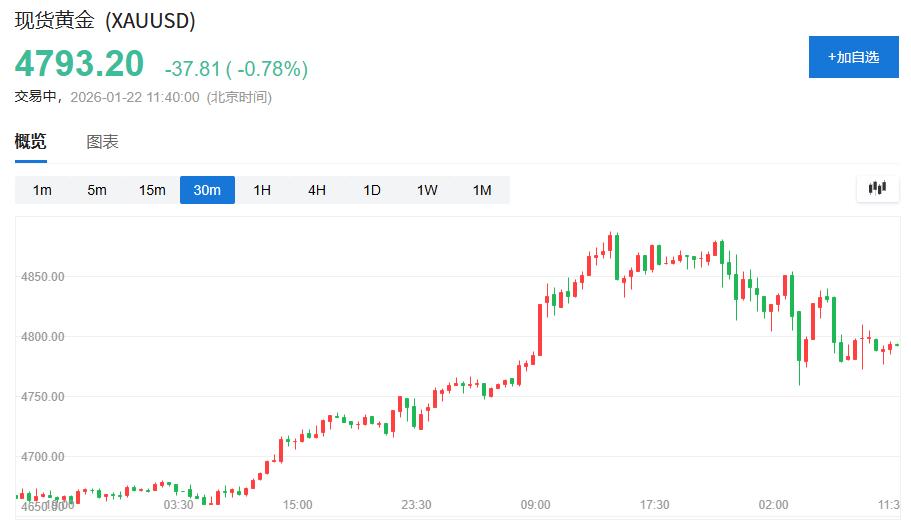
Trump stages a "Greenland TACO" at Davos.
This abrupt turn stemmed from days of behind-the-scenes maneuvering by European leaders, which ultimately led to the drafting of a framework agreement covering Arctic security, mineral resources, and military bases.
When European leaders arrived in the Swiss Alps on Wednesday afternoon, they were still panicking that Trump's Greenland ambitions could trigger a transatlantic conflict. But by sunset, Trump had made it clear that he would not use force to seize Greenland and had rescinded his previous promise to impose tariffs on European countries. Following a meeting with NATO Secretary General Mark Rutte, he announced that a "framework for a future agreement" had been formed for the world's largest island.
This shift has brought relief to European leaders facing economic turmoil and threats to NATO stability.
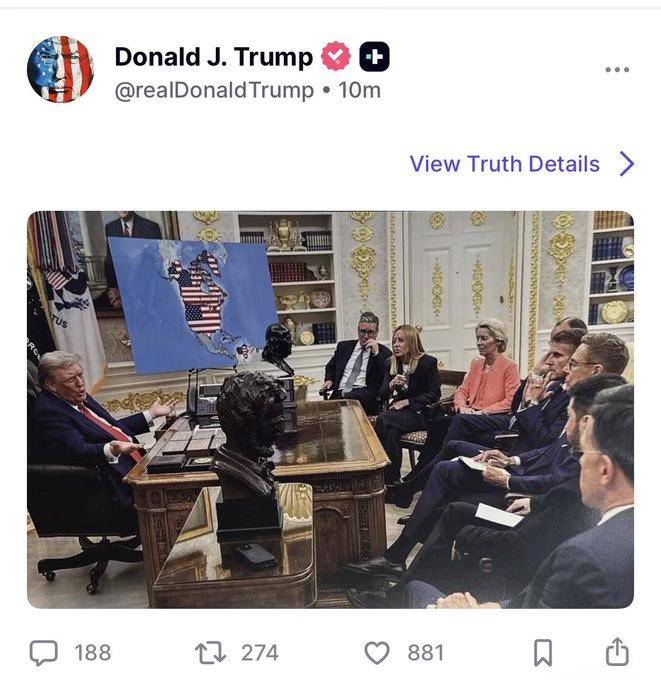
Just days earlier, Trump had refused to rule out the possibility of using military means to acquire Greenland. According to Xinhua News Agency, Trump posted a picture on social media in the early hours of the 20th: he was meeting with European leaders in the White House office, and in the map on the display board behind him, in addition to the continental United States, Canada, Greenland and Venezuela were all covered by the American flag.
Last weekend he also threatened to impose tariffs of 10% on eight countries starting next month, and rising to 25% in June, if a deal to acquire Greenland cannot be reached.
According to media reports on Wednesday, this shift was the result of several days of behind-the-scenes dialogue between Trump, his advisors, and European leaders. Europe remained united in opposing Trump's acquisition of Greenland, employing incentives including enhanced Arctic security commitments and warnings about the dangers of a deep NATO breakdown to the United States.
Framework agreement emerges
According to European officials familiar with the discussions, the negotiations are expected to focus on several core areas. These include a potential agreement between the United States and Denmark on the deployment of troops to Greenland, and Europe's efforts to expand its security presence in the Arctic. The United States may gain a veto right to reject investment in Greenland's mineral resources—a veto designed to prevent Russia from exploiting the island's wealth—in exchange for Trump withdrawing his tariff threats.
In an interview with reporters, Trump called the framework "really great" but provided few details. He stated that this was assuming Denmark, which controls Greenland, had been informed of the potential agreement. White House Press Secretary Karoline Leavitt said in a statement, "If this agreement is reached, President Trump very much hopes it will be reached, and the United States will permanently achieve all its strategic objectives in Greenland at a very low cost."
The White House declined to comment on details of the proposed framework, and a Trump administration official said the scope of the negotiations had not yet been determined.
A NATO spokesperson said that Trump and Rutte discussed on Wednesday the critical significance of Arctic security to the United States and other NATO members. Negotiations on the proposed framework will focus on how NATO members can cooperate to ensure Arctic security, while more specific negotiations between Denmark, Greenland, and the United States will aim to ensure that "Russia can never gain an economic or military foothold in Greenland."
From hardline to compromise in 24 hours
According to media reports, during his hour-long speech at the World Economic Forum on Wednesday, Trump signaled an early willingness to reach an agreement.
He stated that he would not deploy troops to seize control of Greenland, a stark contrast to his stance a few days earlier when he refused to rule out the use of military force. "I don't need to use force," he said. "I don't want to use force. I will not use force."
But Trump also made sharp criticisms of long-term allies in his speech.
He described Europe as unrecognizable from its earlier era and heading in the wrong direction, accused Denmark of being ungrateful, claimed that Switzerland would not exist without US support, and mocked French President Macron for wearing aviator sunglasses at an event.
He implied that NATO members had an obligation to support the U.S. acquisition of Greenland because the U.S. played a central role in underpinning the transatlantic alliance. "We give so much and get so little in return," he said.
"We want a piece of ice to protect the world, and they won't give it to us," Trump said, referring to his desire to acquire Greenland from Denmark. "You can say, 'We'd be very grateful.' Or you can say, 'No, we'll remember.'"
Trump's speech in the main conference hall, packed with global elites, was met with a lukewarm reception, with many bewildered stares and awkward laughter. On Wednesday evening, Trump posted on Truth Social that he would postpone tariffs to allow for negotiations on Greenland.
There are clear differences in interpretation among the parties.
US and European officials have drawn conflicting lessons from the Greenland incident.
U.S. officials believe that Trump's hardline stance has forced European officials to the negotiating table after months of refusing to concede to his move to seize control of Greenland. European officials, in turn, believe that maintaining a united front against Trump will help persuade him to reach an agreement that does not involve acquiring the territory.
Some of Trump's advisors privately worry that his tough rhetoric makes it more difficult to reach an agreement with Denmark.
In recent days, government officials have been discussing compromise proposals that would grant the United States access to mineral resources and land for military bases. Some of the president's external allies expressed concern after stocks fell sharply on Tuesday due to Trump's tariff threats related to Greenland.
"Today's ending is better than the beginning," said Danish Foreign Minister Lars Løkke Rasmussen. Leaders of the 27 EU member states are scheduled for an emergency summit in Brussels on Thursday evening. While they no longer need immediate solutions to the trade war, they must now assess the damaged transatlantic relationship.
The tense atmosphere at Davos was palpable.
In Davos, tensions sometimes emerge behind the scenes.
According to attendees, European Central Bank President Christine Lagarde walked out of a dinner on Tuesday evening during a speech by U.S. Commerce Secretary Lutnick, a move some attendees saw as a sign of escalating tensions in transatlantic relations. Lutnick, speaking at an invitation-only dinner, criticized Europe's energy policy and what he described as the continent's declining competitiveness on the world stage.
Some dinner guests applauded Lutnick's remarks emphasizing America's relative strength compared to Europe, while others booed. A European Central Bank spokesperson declined to comment via email Wednesday morning. A Commerce Department spokesperson stated, "During Minister Lutnick's three-minute speech, no one rushed out. Only one person booed, and that was Al Gore." Former US Vice President Gore responded that he listened to Lutnick's speech and "did not interrupt him in any way."
Speaking in Davos earlier this week, Canadian Prime Minister Mark Carney said, "We are reminded every day that we live in an era of great power competition. The rules-based order is fading, the strong can do whatever they want, and the weak have to bear what they have to bear."