The Next Economic Singularity? Analyzing Investment and Innovation Opportunities Amid Venezuela's Transformation.
Written by: McCormick, Ross Garlick
Compiled by: AididiaoJP, Forest News
I often say that living in Colombia is a "long-term arbitrage".
I have never seen a place where the gap between the outside world's imagination and the internal reality is so vast. And I happen to be one of the "early" beneficiaries who have witnessed the world slowly revealing the truth.
I grew up in England, went to university in the US, worked in finance, then quit to open a café in Bogotá, and finally moved to Medellín to become the CFO of Somos Internet. This company, thanks to Cable Caballero, is now widely known. Colombia is my home; my wife and I recently got married here, we love it, and plan to live here long-term. Therefore, what I'm about to say doesn't make me happy:
Venezuela actually has more potential than Colombia.
In the past few weeks, Venezuela has come under increased scrutiny due to Operation Absolute Resolve (the operation in which the U.S. captured Maduro and transported him to Brooklyn). People are trying to understand what this means for Venezuela, Latin America, and the United States. From my friends and online discussions, I see a mix of emotions: some feel utterly relieved, while others are cynical, believing that nothing has fundamentally changed.
And I am excited about this. In my eight years in this region, Operation Absolute Resolve has opened up more openings and possibilities for Venezuela than any other event.
However, to fully reap the benefits of this country, people need to be excited about "the right things."
Oil is the obvious prize, but it's complex. President Trump is right when he says selling Venezuelan oil "could make a lot of money," given Venezuela's world-leading reserves of 304 billion barrels. Until recently, over 80% of its oil exports went to China. Changing the flow of Venezuelan oil would hinder China's road construction, cut off 50% of Cuba's oil supply, and make it easier for the US to obtain oil (despite its heavy and difficult-to-refine nature). This rebalancing would be both a huge geopolitical victory and a massive financial gain.
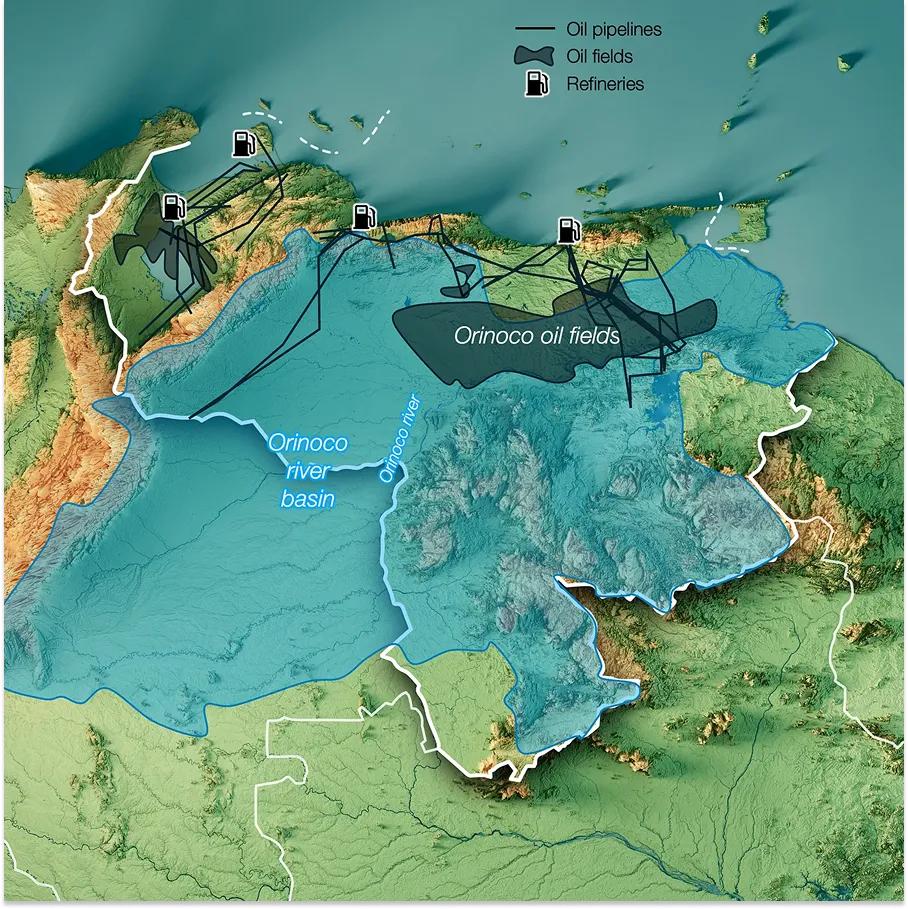
Thomas Puejo
U.S. Energy Secretary Chris Wright has stated that the U.S. will control Venezuelan oil "indefinitely." This appears to be the biggest victory resulting from the capture of Maduro.
But oil is not Venezuela's only prize, or even its biggest prize.
We must rebuild and revitalize Venezuela, because it is the most undervalued opportunity on earth.
First, I want to clarify: this is a low-probability opportunity, and we need to ask ourselves, "What might happen if everything goes smoothly?" This is also one of the questions we at Somos constantly consider when evaluating the Venezuelan market and communicating with locals. Once, a journalist friend told me, "The road ahead is long, and you need to do many things right for your vision to come true." He's right.
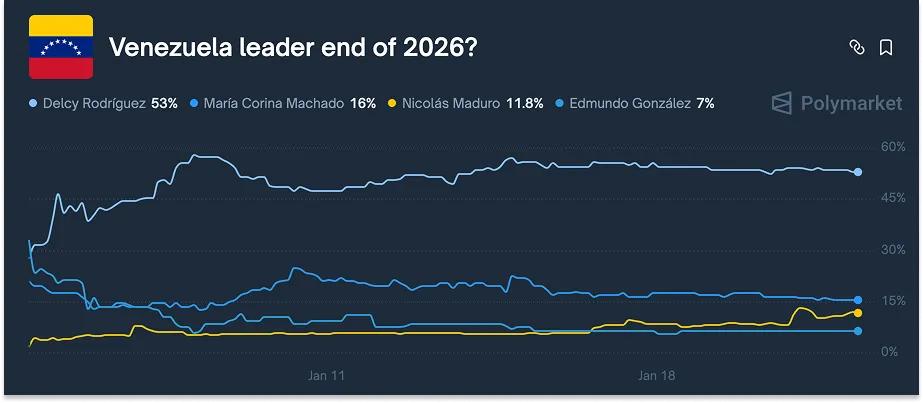
January 22, 2026
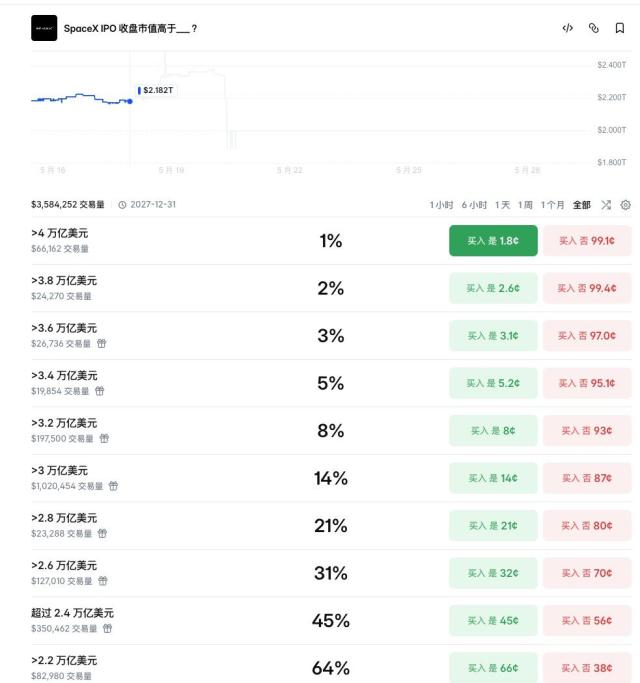
First, a smooth political transition is not guaranteed. Market forecasts predict that Delcy Rodriguez, a long-time Chavez official and current interim president, will remain in power throughout the year.
I won't bet on low-probability events, but this prediction market won't be revealed until the end of 2026. Marco Rubio has said that the US has a three-step plan for Venezuela: stabilization, recovery, and then transition, which will undoubtedly take time.
To illustrate this scenario, we assume that by the end of 2027, a pro-American transitional government, elected through free and fair elections, will indeed emerge.
If implemented properly, a free and democratic Venezuela, together with Colombia, Panama, and Ecuador, could form a "Gran Colombia" group, which could become as strategically important to the United States as the European Union or Mexico within 25 years.
For reference: Mexico is currently the United States' largest trading partner, with annual trade of $840 billion, supporting 5-6 million American jobs. US-EU relations encompass $1.5 trillion in trade and $5 trillion in mutual investment, supporting 5.7 million American jobs. A "Gran Colombia" group with over 105 million people and a GDP exceeding $700 billion could eventually approach this size, especially if the region becomes a destination for "nearshore outsourcing" of supply chains, replacing the US's current dependence on Asia. It possesses mineral resources, talent, and a strategic location, capable of offering what Mexico and the EU have already provided to the US: a large, neighboring, culturally connected economy where US investment creates American jobs and reduces US vulnerability to competitors.
It is this potential future that makes it worthwhile for the United States to help rebuild and reform the country's institutions, rather than treating the capture of Maduro as a victory, seizing oil through an uneasy truce with the remaining Chavez faction, and then moving on to the next target.
Importantly, this will help the US erode China's current long-term ambitions. China is quietly expanding its influence in the region to a degree that may surprise most Americans, even those familiar with the Belt and Road Initiative and the rise of high-quality Chinese global brands. When Latin Americans think of electric vehicles, they think of BYD, not Tesla. I've taken JAC Uber rides several times in Colombia and admired the JAC electric car at its flagship showroom in Bogotá. Huawei and Xiaomi are the default phones for low- and middle-income groups.
China is also building infrastructure. In November 2024, President Xi Jinping visited Peru and inaugurated the large, Chinese-owned Chancay super deep-water port (Pacific coast). He subsequently hosted the presidents of Brazil, Colombia, and Chile in Beijing. They announced further Belt and Road infrastructure projects, including a 3,000-kilometer-long, transcontinental freight railway funded by China, connecting the Atlantic coast ports of Ilheus and Chancay in Brazil. This railway will partially alleviate dependence on the Panama Canal.
Whoever funds Venezuela's reconstruction will reap the spillover effects of its recovery.
I'm not saying this from the perspective of a geopolitical analyst. I'm an American businessman who has worked with Venezuelans and has been impressed by the region's talent, optimism, and potential. That's why I'm actively evaluating Somos's opportunities to expand into Venezuela.
I once hired a dishwasher named Cesar at a restaurant in Colombia. He was originally a small business owner in Venezuela who, carrying his newborn baby, walked for 72 hours across the border to Bogotá, even being robbed along the way. He succeeded. Within five years, Cesar had saved enough money to open his own taco shop, and now he owns three restaurants.
Cesar is one of approximately 8 million people who have left Venezuela over the past decade. This represents a quarter of its total population, the elite of a nation the size of New York City, working-age men and women attempting to rebuild their lives in a foreign land.
The hardships Venezuelans have endured under Chavez's rule over the past quarter-century, coupled with the institutional memory of a country that was once wealthier than Spain, Greece, or Israel, have shaped an entrepreneurial community: resilient, capable of overcoming seemingly insurmountable obstacles, and thriving beyond their homeland.
Imagine if we could unleash this talent and rebuild Venezuela from scratch. Imagine a promise of a "New Gran Colombia," in which Venezuela is a driving force, not an obstacle.
Gran Colombia
For those unfamiliar with the concept of "Gran Colombia," here's a brief historical overview. In May 1819, Simón Bolívar launched a campaign to liberate New Granada (present-day Colombia) from Spain. He led a coalition of Venezuelan and New Granada soldiers, starting from the flood-swept plains of Venezuela, crossing the Casanare province, traversing the Andes Mountains, and entering New Granada. The Spanish, unaware that the Andes were impassable during the rainy season, were caught off guard. Within weeks, Bolívar's ragged troops regrouped, gained local support, and on August 7th, decisively defeated the royalist forces at the Battle of Boyacá. This two-hour battle effectively ended Spanish rule.
After consolidating New Granada, Bolívar quickly pushed forward his vision of unification. In December 1819, the Congress of Angostura declared the establishment of the Gran Colombia Republic, merging Venezuela and New Granada into one republic, with plans to incorporate Ecuador after its liberation.
Bolívar's logic for establishing a unified South American republic was simple: if divided, these former Spanish colonies would be weak, impoverished, and forever vulnerable to reconquest or foreign intervention. United, they could concentrate military resources to complete their war of independence, earn global respect, negotiate trade agreements from a position of strength, and jointly build infrastructure on a land with Caribbean ports, Andean agricultural regions, access to the Pacific Ocean, and abundant natural resources. A large and stable republic might even attract European investment and immigration, which was then flowing into the young United States.
But this experiment barely outlived its designer. Regional elites were dissatisfied with Bogotá's remote rule; Venezuelan leaders like José Antonio País, deeply resentful of centralization, began inciting autonomy almost immediately. The geography that Bolívar had miraculously conquered during the war became an obstacle in peacetime. The Andes Mountains and jungle terrain made communication slow, making remote governance nearly impossible. By 1826, País openly rebelled. Venezuela formally separated in 1830, and Ecuador followed suit a few months later. In December of the same year, Bolívar died in illness and disillusionment.
For nearly two centuries since then, the countries that make up Gran Colombia have never simultaneously achieved democratically elected governance and complete peace and stability.
Today, Colombia, Ecuador, and Panama all have democratically elected governments. Colombia has maintained peace with the Marxist guerrilla group FARC since 2016 (although minor conflicts persist). Panama has been stable since 1989. Ecuador, the smallest of the three, faces a serious organized crime crisis, but the country has not descended into armed conflict. The situation in the region is not perfect, but it is the best it has been in a long time. Venezuela has consistently been the most notable exception.
However, starting from January 3rd of this year, the situation may be changing.
The potential of New Grand Columbia
Part of the reason for Bolivar's failure was that geography made a single republic difficult to govern. Today, in 2026, the question is no longer whether the rainy season can cross the Andes, but whether modern infrastructure, capital flows, and regulations can economically integrate the region. If so, the benefits of unity can be enjoyed without a unified flag.
A free Venezuela would allow a new bloc to grow: a population nearly the size of Mexico, with a GDP between Taiwan and Belgium. Had Venezuela not collapsed since 2012, "New Gran Colombia's" GDP would likely be between that of Saudi Arabia and Poland.
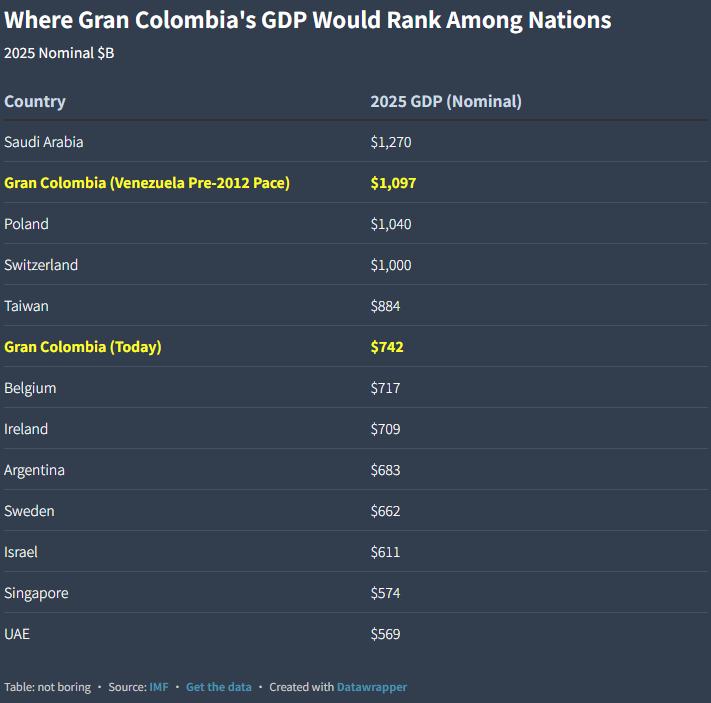
This group will have access to the Panama Canal, as well as long coastlines facing the Atlantic and Pacific Oceans, and massive reserves of oil, gold, minerals, and freshwater.
It boasts a young, educated, and highly urbanized population. And all of this is happening in Venezuela, the country with the greatest potential.
With the liberation of Venezuela, this group could grow into a region of strategic importance to the United States, similar to Mexico, Canada, or the European Union.
A free and democratic Venezuela could attract 8 million expatriates to "return" and become a destination for immigrants from all countries and social classes. Inexpensive real estate, a favorable climate, and an oil and gas industry offering high-paying technical jobs should enable Venezuela to attract everything from digital nomads to blue-collar workers in Mexico and Chile, and even American seniors seeking retirement outside of Florida, Arizona, and Costa Rica. Venezuela has 8 million fewer people than before Chavez's rule. It can reabsorb even more. This "return" would benefit Venezuela, Latin America, and the United States—the destination for many exiles.
A stable Gran Colombia will become an ideal AI hub in the Western Hemisphere. We are in the midst of a supercycle of AI capital spending, and the bottleneck is no longer chips, but electricity, licenses, and fiber optics. The International Energy Agency estimates that data centers will consume approximately 415 terawatt-hours of electricity in 2024, and this is projected to double to approximately 945 terawatt-hours by 2030. Gran Colombia's unique location makes it an ideal part of the solution: it is located in the geographical center of the Americas and is connected to the global internet via new high-capacity submarine fiber optic cables such as TAM-1, CSN-1, and MANTA. These cables land in Barranquilla or Cartagena, Colombia, connecting to major data center hubs, including Miami's "Network of the Americas Access Point," with extremely low latency—an average latency of approximately 45 milliseconds from Miami to Bogotá. Furthermore, the region has several high-altitude areas with a cool climate year-round.
But geography is merely the entry ticket; electricity is the real game. Unlike most emerging market "AI hubs" that rely on intermittent clean power, the region already operates dispatchable hydropower at scale. In 2024, hydropower accounted for 58% of Colombia's electricity generation, with an installed capacity of approximately 11 GW. In Venezuela in 2021, approximately 64% of its electricity came from hydropower, with an installed capacity of approximately 16-17 GW. The remarkable thing is that current hydropower development represents only a small fraction of its potential. Colombia's theoretical hydropower potential is approximately 56 GW, and Venezuela's technically feasible potential is approximately 62.4 GW. These figures represent a tremendous opportunity to provide stable, low-carbon baseload power, laying the foundation for hyperscale data center clusters, even better if supplemented with natural gas for reliability. Somos's sister company, APD, is working to turn this potential into reality.
Implementing a "Marshall Plan" in the region could involve U.S. government credit support to build the world's largest data center hubs in Colombia and Venezuela. Just as Apple invested $50 billion annually in China in the 2010s to build manufacturing capacity, today's wave of data center and power capital expenditures need not be confined to the United States.
Venezuela, a blank slate, offers the opportunity to plan its infrastructure for the 21st century. Data centers are just one piece of the puzzle; Venezuela has the potential to build ports with fully automated berths and customs, interconnected energy microgrids compatible with distributed solar power and storage, roads and logistics distribution centers rebuilt to accommodate autonomous vehicles, and even micro-airports serving flying cars and zipline-like drone logistics. This last point applies to both Venezuela and Colombia—our major cities are often isolated by mountains.
The importance of modern infrastructure to this transformation cannot be overstated.
Of course, even a return to the pre-Chavesian state would be a boon to the region. Bilateral trade between Colombia and Venezuela peaked at $6-7 billion annually in 2006-2007, before plummeting to just $200 million in the early 2020s. While trade has increased since the border reopened in 2022, indicating that ties remain and have potential, bilateral trade is still far below its peak.
However, the reality is that intra-Latin America experiences extremely low levels of trade, yet trade is a necessary condition for a economy to have a real impact. A 2004 IMF paper found that for every 1 percentage point increase in the economic growth rate of a trading partner, domestic economic growth could increase by up to approximately 0.8 percentage points. However, according to JPMorgan Chase data, only 15% of Latin America's exports remain within the region, compared to approximately 40% in the Asia-Pacific region and 65% in Europe. This reflects the region's concentrated export markets, weak cross-border infrastructure, and decades of political division.
This is an ancient problem, even predating Bolivar, but perhaps it can ultimately be solved through modern infrastructure. One of the reasons for the rapid disintegration of Gran Colombia was precisely the geographical challenges of governance; autonomous aircraft can overcome natural obstacles, bringing a greater economic boost to our region than anywhere else in the world. More urgently, projects like the "Autopista el Mar" (Sea Highway) connecting our home province of Antioquia with the port of Nuevo Antioquia will reduce the land journey to the coast from 14 hours to 4 hours. This highway will cut through mountains, and if the project developers and their supporters have confidence in the region, such projects can certainly cross national borders.
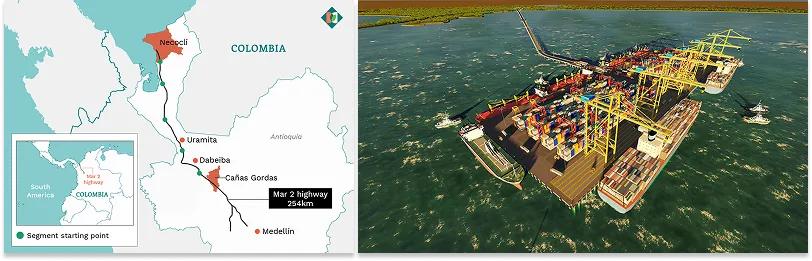
"Sea Highway" and Port of Antioquia
Modern infrastructure is both an opportunity and a necessity. Venezuela needs to rebuild, and in the process, we may have a chance to defeat the natural enemy that thwarted Bolívar two centuries ago.
Finally, a dollarized Venezuela can showcase what an economy's "leapfrog development" looks like—especially since the US GENIUS Act has established a regulatory framework for stablecoins. Since Maduro deregulated in 2019, Venezuela has effectively become dollarized, with the US dollar widely used for pricing and transactions. Simultaneously, due to the scarcity and limited circulation of the US dollar within the formal system, the country has also become "de facto stablecoinized." A Chainalysis report found that between July 2023 and July 2024, 47% of transactions in Venezuela under $10,000 were conducted using stablecoins. This combination makes Venezuela an excellent testing ground for the US to export its regulated digital dollar infrastructure, especially after the GENIUS Act clarified the rules for issuers. Dollarized economies like Venezuela, with their weak banking services, provide fertile ground for the "stablecoin settlement + merchant acceptance" model to transcend traditional payment channels. This will also increase demand for US Treasury bonds.
There is no better example than Cashea of a country demonstrating its ability to innovate in the financial sector when faced with adversity.

A revenue-to-operation ratio jumping from 0 to $200 million in three years might have seemed astonishing before the AI era. But for a Latin American startup that had only raised $2.5 million and had been profitable for two years, it was simply a pipe dream.
Founded in 2022, Cashea is a US dollar-denominated, interest-free "buy now, pay later" platform for small and medium-sized enterprises (SMEs). "Based in Argentina, but built for Venezuela," it aims to achieve this goal. As of September 2025, its total transaction volume (GMV) exceeded 4% of Venezuela's GDP, with a target of surpassing 6% by the end of the year.
However, Cashea couldn't raise substantial venture capital or secure large lines of credit for its operations in Venezuela—a country considered too volatile. So, Cashea partnered directly with merchants, who financed and assumed the loan risk themselves. These merchants then extended credit to customers, with Cashea guaranteeing defaults. Starting this model in Venezuela was no less difficult than in the US or anywhere else. Yet, it was precisely this lack of systemic credit that gave rise to a model adopted by over 5,000 merchants nationwide. It's growing exponentially, Cashea doesn't bear the enormous financing costs itself, and its bad debt rate is lower than Affirm or Block's Afterpay. Cashea charges merchants a fixed commission and has begun offering accounts receivable factoring services on the Venezuelan Stock Exchange.
The company does not require a large balance sheet or financing instruments and completely bypasses reliance on traditional credit card channels—which are virtually non-existent in the country anyway.
Cashea proves that "necessity is the mother of invention." A Venezuela with nothing to lose will need a great deal of such innovation.
But blank slates can also be fertile ground. They can help new market entrants build and innovate business models from scratch, and achieve a "leap" over incumbent state-owned enterprises.
This is precisely the opportunity that excites us at Somos Internet (Colombia's fastest-growing internet service provider). We build vertically integrated digital infrastructure to provide users with better networks at a structurally lower cost. Users love us, and we are planning international expansion.
Prior to January 3, Somos had never seriously considered entering Venezuela. It was attractive, but the risks were too high.
We are now examining this opportunity. Caracas, the capital of Venezuela, largely meets the criteria we consider when evaluating new markets.
- Large market size and high population density: Caracas is a major city with a population comparable to Chicago (approximately 3 million) and a higher population density than San Francisco. This is a perfect market for new entrants like us—every kilometer of fiber deployed reaches more potential customers.
- Venezuelans have high average incomes but low market penetration: the lack of private competition puts them at a disadvantage. State-owned CANTV offers fiber-to-the-home (FTTH) services, with 60 Mbps plans starting at $25 per month (extremely expensive in 2026), and its website claims 1 Gbps plans for $150 per month. Partly due to these expensive plans, fixed internet penetration is low, with many households relying on mobile data as their primary mode of connection. We believe that providing quality networks can increase economic opportunities and create a virtuous cycle.
- Early adopter culture: Ordinary Venezuelans are eager to try new options (see the popularity of Cashea) because they are dissatisfied with the status quo and lack traditional services.
- Proximity to existing infrastructure: While not a decisive factor for Somos, marginally, expanding into adjacent regions is always better than jumping entirely to a completely new area. However, this requires new contracts with Tier 1 suppliers to maintain a consistent network architecture.
Despite these attractive qualities, we have not yet ventured into Venezuela. The situation remains too uncertain.
However, given that we are actively evaluating this opportunity, our perspective may offer some useful insights for businesses looking for opportunities before committing to rebuilding the region.