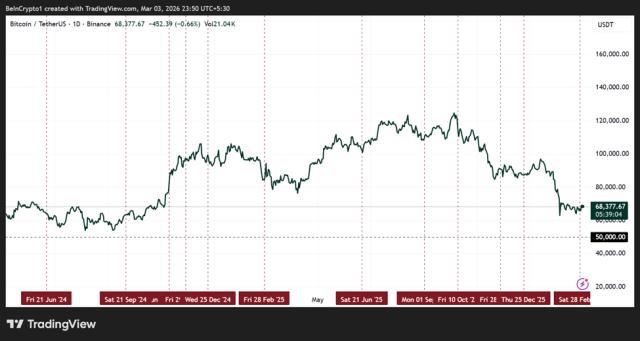
Delphi Digital, an independent research firm focusing on cryptocurrencies and digital assets, recently published an article on its X platform by analyst @that1618guy, pointing out that the rapid rise in the yield on Japanese 10-year government bonds (JP10Y) is becoming a key source of pressure on global financial markets. This change is not only driving up gold prices but also putting continued pressure on Bitcoin's performance.
The analyst believes that the market no longer views rising yields as a normal tightening signal, but rather as a symbol of policy credibility and balance sheet risk; if the Bank of Japan (BOJ) intervenes, the price movements of gold and Bitcoin may react very differently.
Gold prices rose along with Japanese yields, while Bitcoin faced pressure.
In a typical tight monetary policy environment, rising long-term government bond yields usually suppress gold's performance because the opportunity cost of holding non-yielding assets increases. However, @that1618guy points out that the market is currently showing a significantly different structural change. While the yield on 10-year Japanese government bonds has risen rapidly, gold prices have not been pressured but have instead risen in tandem, indicating a shift in the market's interpretation of yields.
Observing the correlation at different time scales reveals that while the short-term correlation between gold and the JPY 10-year yield still fluctuates, it is increasingly remaining in the positive range; the medium-term correlation is rising in tandem, while the long-term correlation has stabilized and turned positive. This indicates that rising yields are no longer seen as a symbol of economic normalization, but rather reflect increased policy pressure and risk, making gold a safe-haven asset to absorb this pressure.
Meanwhile, Bitcoin's performance presents a stark contrast. Analysis shows that Bitcoin maintained a negative correlation with the JPY 10-day yield over the same period, especially on a long-term scale, with Bitcoin consistently under pressure as Japanese yields rose. Analysts point out that for Bitcoin to see a more sustained rebound, the rise in Japanese yields must first cool down, and this change would theoretically be reflected in the gold market simultaneously.
Japan becomes a central focus of global policy pressure.
Analysts believe that Japan's status as a key source of market pressure is closely related to the long-term policy background of its financial system. Statistically, the current JPY 10-year yield is about 3.65 standard deviations above its long-term average, a highly unusual fluctuation. For Japan, which has been under yield curve control (YCC) for over a decade, this trend undoubtedly sends a strong signal that the policy anchor is loosening.
What deserves more attention is not the height of the yield itself, but the speed at which it rises. Rapid, near-vertical changes in yields can transform a simple interest rate adjustment into a balance sheet event. The Japanese banking system has a structured long-term holding of government bonds, widely using them as assets and collateral. Once yields rise sharply, bond prices fall, the value of collateral shrinks, funding conditions tighten, and the entire system will face significant pressure.
This explains why the Bank of Japan's interventions have historically been initiated as early as when market pressures begin to be reflected in the data, rather than waiting until yields have "normalized." For the BOJ, a change of multiple standard deviations at an accelerating pace is sufficient grounds for intervention.
If BOJ makes a move, gold may enter a consolidation phase.
Regarding potential future policy directions, @that1618guy believes that once the Bank of Japan credibly stabilizes long-term yields, the current market sentiment driven by Japanese pressure will ease. This does not mean that the gold trend will immediately reverse, but rather that it may lose some of the accelerating factors pushing up prices.
From a technical perspective, gold maintains its long-term upward trend, but recent momentum has shown signs of slowing. While prices continue to rise, the Relative Strength Index (RSI) is struggling to reach new highs, indicating that market buying is becoming more cautious. Analysts believe this structure aligns with a market environment that remains bullish but heavily reliant on policy pressure for support. If the BOJ's intervention successfully reduces the pressure premium, gold prices are more likely to enter a consolidation or digestion phase rather than experience a trend reversal.
Bitcoin may see room for recovery after the pressure is relieved.
Compared to gold, Bitcoin reacts more directly to rising Japanese yields. Analysts point out that although Bitcoin's price weakened despite the continued rise in JPY and gold, the decline did not accelerate significantly; instead, it showed signs of gradual stabilization. This trend aligns with the characteristics of a risk asset seeking a bottom under macroeconomic pressure.
If the Bank of Japan intervenes and effectively curbs the rise in long-term yields, Bitcoin's reaction may differ significantly from that of gold. Analysts believe that with improved global liquidity conditions and easing tightening pressures from Japan, Bitcoin actually has the potential for recovery and rebound. Under the current system, Bitcoin is not competing with gold for a safe-haven role, but rather waiting for the pressure signals to dissipate before regaining momentum.
Summarize
Delphi Digital analyst @that1618guy points out that the key to the current market is not whether gold has peaked or whether the Bank of Japan is about to act, but rather that the market has clearly identified the Japanese 10-year government bond yield as a global-level pressure indicator. Gold is absorbing this pressure, while Bitcoin is reacting to it, and the divergence between the two is itself an important signal.
As long as the JPY 10-year continues its disorderly rise, gold's continued strength is justifiable, while Bitcoin prices may remain under pressure. Once the Bank of Japan (BOJ) stabilizes long-term yields, gold's upward momentum may shift to a consolidation phase, giving Bitcoin a chance for a recovery. Overall, Japan is becoming a key window for observing how global markets price policy risks and balance sheet vulnerabilities.