In mid-November last year , President Trump signed a temporary budget appropriations bill, officially ending the longest shutdown in the history of the U.S. federal government (43 days). However, in less than three months, the risk of another shutdown has resurfaced.
Democratic leader Chuck Schumer announced earlier this week that Democrats will block any temporary spending bills if the powers and budgets of the Department of Homeland Security (DHS) and Immigration and Customs Enforcement (ICE) are not reformed, preferring to shut down the government, less than a week before the funds expire on January 30.
Shooting ignites funding deadlock
The trigger for this incident was the shooting death of 37-year-old Minneapolis citizen Alex Pretti by Border Patrol officers on January 24. This was the second similar incident in the city in three weeks, further amplifying recent public criticism of ICE law enforcement practices in the United States.
A Politico report points out that Democrats believe the current $10 billion ICE budget still retains too many deportation and detention resources, making it impossible to prevent a repeat of the tragedy. Schumer stated in a press release:
This money should not be approved if the Republican Party does not accept genuine oversight and accountability.
The House of Representatives passed HR 7147, which includes funding for the DHS, on the 22nd of this week, but the bill requires 60 votes in the Senate, meaning Republicans need at least eight more Democrats to defect. Following Schumer's tough stance, several Democratic senators, including Chris Murphy and Alex Padilla, have publicly supported rewriting the budget.
Budget details and market risks
The current version cuts $1.8 billion in border spending and reduces ICE detention beds by 5,500; it also allocates $20 million to purchase body cameras for officers and for decontamination training. Republicans insist that funding cuts were already made in the 2025 One Big Beautiful Bill Act, and further concessions would harm border security; however, Democrats argue that reform is merely rhetoric unless law enforcement authority is fundamentally revoked.
Time is running out. If the Senate fails to pass any form of temporary spending resolution by the 30th, the Trump administration will face its second shutdown since taking office. Negotiations in Washington are ongoing, but in the tense political atmosphere of early 2026, any compromise will be difficult.
Latest data for forecasting the market
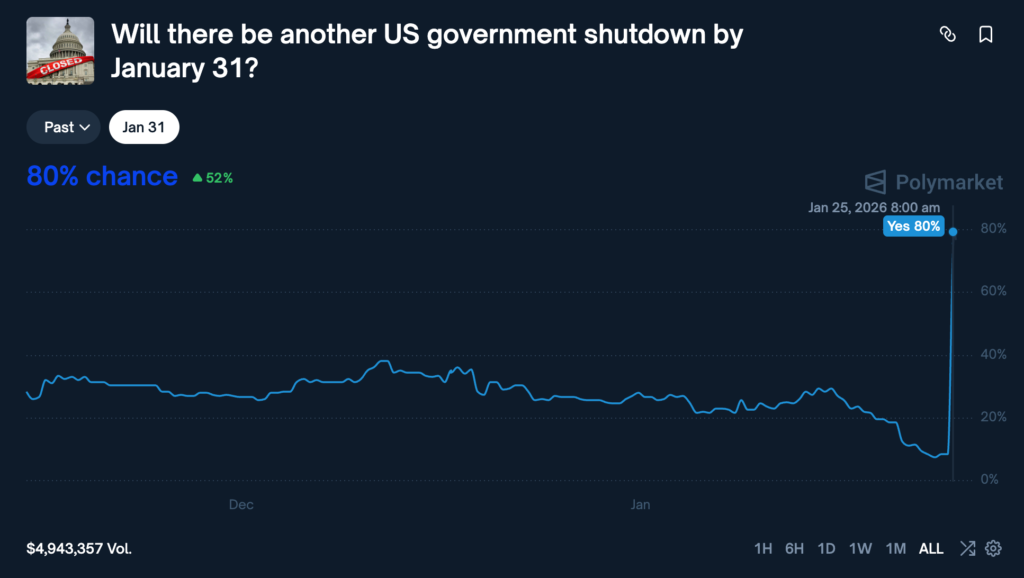
According to Polymarket data, the market is betting on an 80% chance that the US government will shut down again on January 31.
While the initial shutdown of non-essential sectors will have a limited direct impact on GDP, prolonged delays could further postpone government contracts and federal employee salaries, potentially undermining business and consumer confidence. During the last shutdown, risk assets experienced increased short-term volatility; investors should take note.