Asian equity markets brushed off US President Donald Trump’s latest tariff threats on Tuesday, with regional benchmarks hovering near record highs and South Korea staging a dramatic intraday reversal.
The muted reaction suggests investors have grown desensitized to Trump’s trade rhetoric, viewing his threats as negotiating tactics rather than imminent policy shifts.
Asia Learns to Ignore the Noise
Asian stocks rose broadly despite Trump’s warning of higher duties on South Korean goods. Hong Kong’s Hang Seng gained 1.33%, Japan’s Nikkei 225 added 0.77%, Australia’s ASX rose 0.92%, and Shanghai Composite climbed 0.36%.
Analysts noted that markets have learned that Trump tends to back down after issuing threats, describing this latest move as tactical.
Trump has repeatedly wielded tariff threats as a negotiating tool, only to delay or reverse course. Earlier this month, he threatened to impose tariffs on European goods over Greenland, then backed off. A similar pattern played out with Canada. Markets have dubbed this tendency “TACO” — Trump Always Chickens Out.
Korea’s Kospi Stages Record-Breaking Reversal
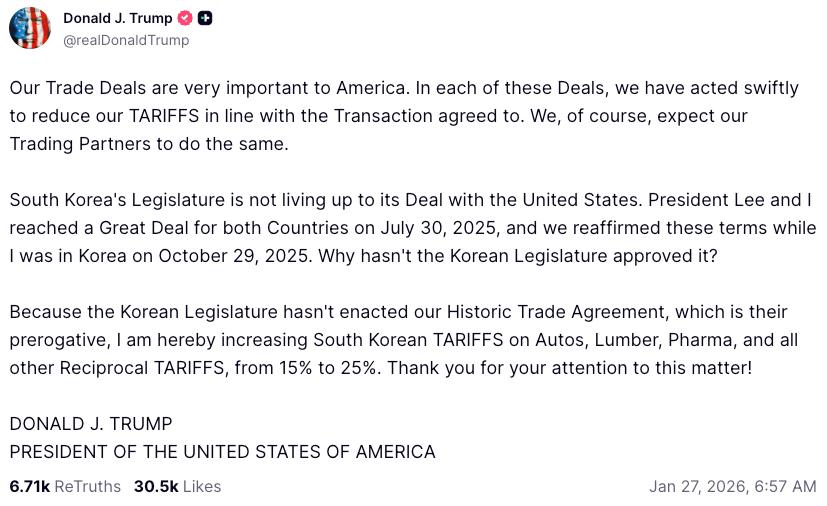
Trump posted on Truth Social Monday that he would raise duties on South Korean automobiles, auto parts, lumber, pharmaceuticals, and reciprocal tariffs from 15% to 25%, accusing the country’s legislature of failing to codify a trade agreement reached with Washington in July. No executive order has been issued.
South Korea’s Kospi opened sharply lower on the news, falling to 4,890. But the index reversed course to close at a record high of 5,075.51, up 2.54% — a swing of more than 185 points. SK Hynix surged 8.7%, and Samsung Electronics added 4.8%, with foreign and institutional investors turning net buyers.
Local experts explained that the Kospi has grown accustomed to Trump’s tariff theatrics, with earnings momentum sectors like semiconductors and power equipment driving the rally.
South Korea’s government moved quickly to calm markets. The presidential office noted that tariff hikes require formal administrative procedures to take effect, not just social media posts. The ruling party announced plans to advance the US investment bill to committee review in February, addressing the stated reason for Trump’s threat.
What Happens When the Bluff Stops Working
Trump’s fading leverage may mark a turning point for crypto markets. If tariff threats no longer trigger volatility, traders will need new catalysts — and those are likely to come from fundamentals.
That means ETF flows, on-chain adoption metrics, and actual regulatory progress will matter more than presidential tweets. The stablecoin bill sitting in Congress, the SEC’s next enforcement move, and institutional positioning become the real signals.
In a market immunized to bluster, only substance moves prices.
Crypto Rises, But Korean Retail Stays Cool
Bitcoin climbed 0.7% to $88,342 on Tuesday, while gold touched $5,082 per ounce — both benefiting from the risk-on mood despite tariff uncertainty.
Yet Korean crypto investors appeared notably restrained. The Korea Premium Index of CryptoQuant, which measures the price gap between Korean exchanges and global markets, the Kimchi Premium, stood at just 1.4%. That figure sits far below the 15-22% levels seen during previous retail-driven frenzies in 2021 and late 2024, suggesting local investors are not chasing crypto gains with the same urgency.
With the Kospi rallying to record highs and AI-related stocks dominating trading volumes, Korean retail capital appears more focused on domestic equities than digital assets — at least for now.