Clawdbot is sweeping Silicon Valley and has even made the Mac Mini a hit. From its creation to its maintenance, Clawdbot was entirely handled by a single person named Peter. There have been rumors that Peter himself may be a bot or agent.
Article author and source: Venture Capital Insights
Peter only gained wider recognition last week when he demoed Clawdbot live at a top hacker community event in London.
There has been much discussion about Clawdbot's functionality and effectiveness. But from a venture capital perspective, we are actually more interested in: What was Peter's thinking behind this? How did the product concept for Clawdbot come about? How was it brought to fruition from idea to implementation?
Let's break it down one by one.
1. Clawdbot's journey from 0 to 1
Clawdbot's initial motivation: to upgrade the game a little.
Peter had been using Claude to manage his computer and handle random files. After playing around with it for a while, he wanted to "upgrade the game a bit" and create a proxy that could access almost anything (email/calendar/files/network/camera, etc.), run locally or in the cloud, and handle all sorts of life and work tasks.
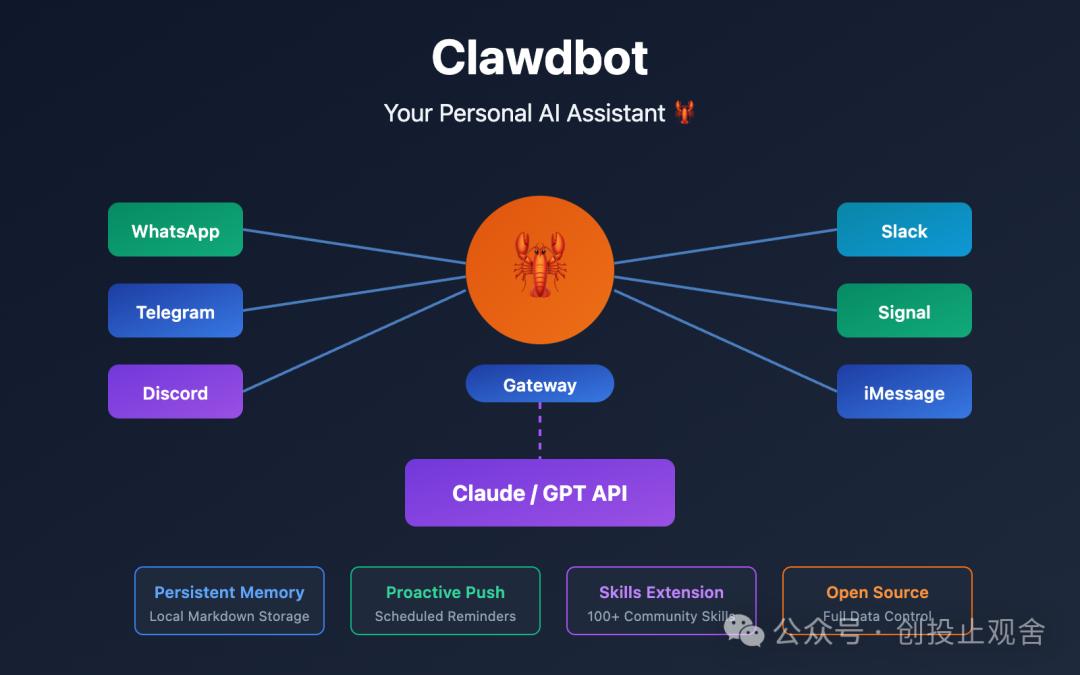
Thus, this product was born. Initially, it wasn't called Clawdbot, but V Relay, essentially a WhatsApp relay, because he wanted to remotely control his computer by sending small commands via WhatsApp when he wasn't near it.
He first quickly hacked a simple version. To test the effect, he sent a voice message while traveling in Morocco. The AI automatically replied 10 seconds later (it recognized that it was Opus audio, converted it to WAV using FFmpeg, and then transcribed it using OpenAI's Whisper).
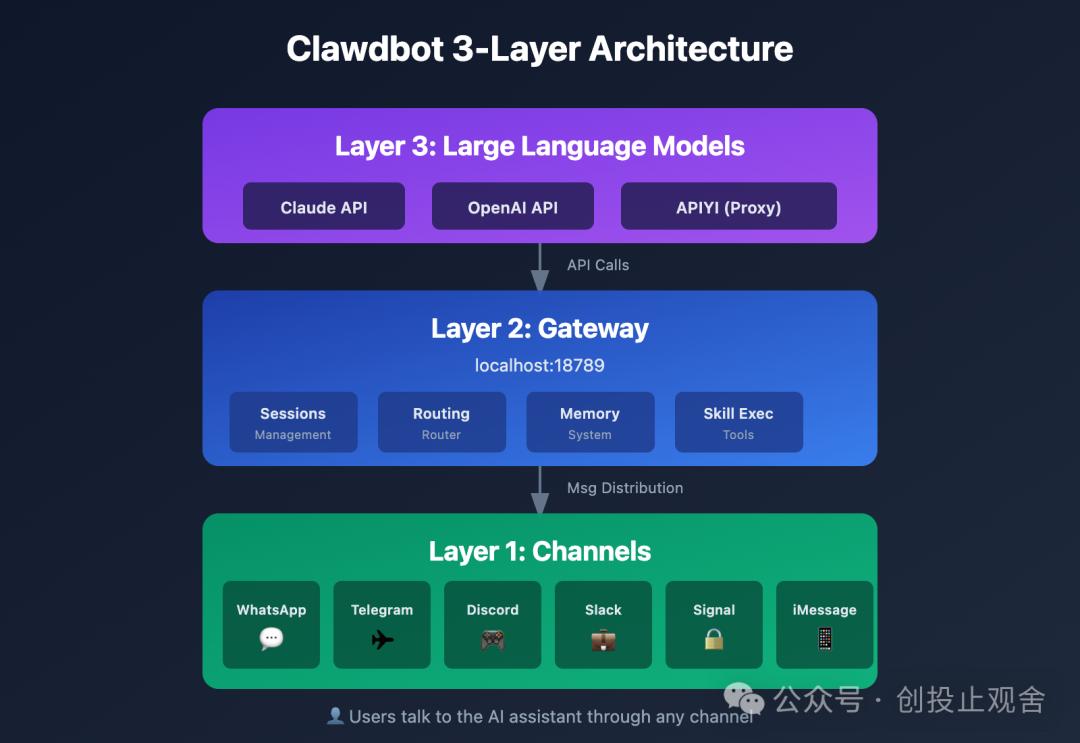
This shocked him, making him realize the enormous potential of these models in solving general problems. This inspired him to continue expanding them into a complete, autonomous personal AI agent, which led to the creation of the entire Clawdbot architecture.
I thought big companies would do it, but it hasn't happened yet.
After selling his previous startup, Peter spent four years in retirement. When he first came back, he really wanted a "life assistant." He had been thinking about this since April and had tried some ideas, but the model wasn't good enough at the time.
He eventually gave up on the idea because he felt that all the major companies would be doing this, so what was the point? So he went on to work on many other projects.
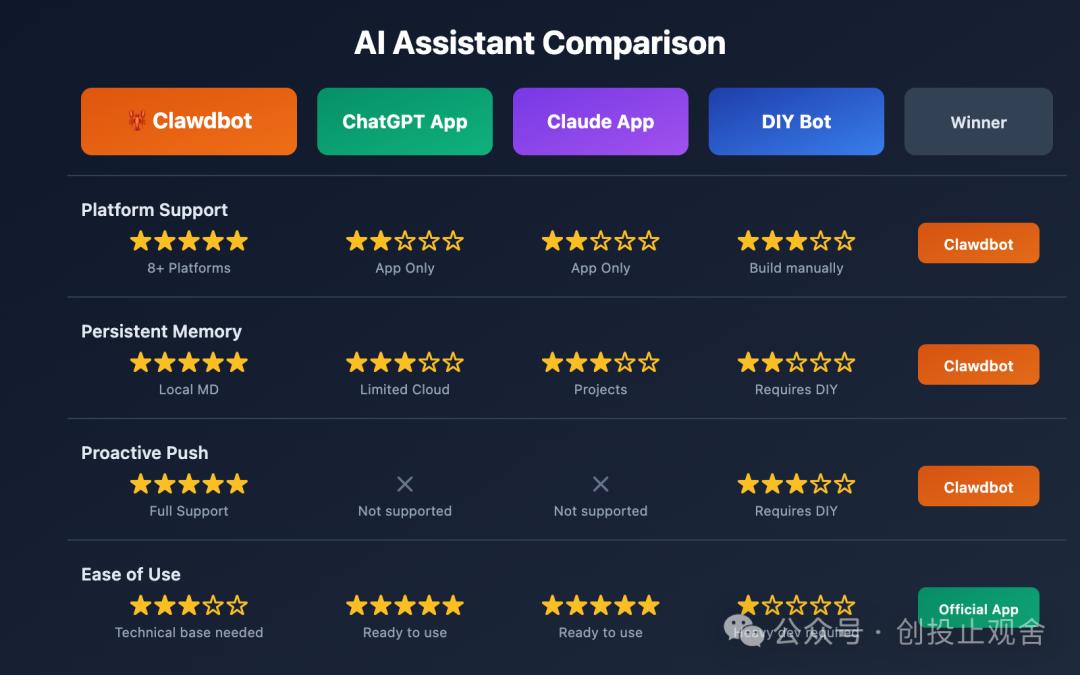
Until November, he suddenly realized that no one had actually done it yet. Peter thought, why not try it himself? Maybe it really is an opportunity?
The product was initially rough, but surprisingly good.
At first, that month he spent an hour piecing together some very rough code, sending a message on WhatsApp, forwarding it to Claude Code, and then sending the result back. Essentially, it was just "gluing" several things together, which wasn't difficult to be honest, but the result was quite good.
He later realized that image input was also needed, as images could provide the agent with a lot of context and were processed quickly. This, however, took him even longer. After the system supported bidirectional input, he happened to be on a friend's birthday trip and used this very rudimentary system to explore the city and act as a "tour guide," and it proved to be much more useful than he had expected.
As the functions gradually increased, Peter realized that the "self-adaptability" of these things had exceeded his original imagination.
He later jokingly told ClawdBot, "The lock on the door of the hotel I'm staying at isn't very reliable. I hope you don't get stolen, since you're running on my MacBook Pro." It replied, "No problem, I'm your agent." Then ClawdBot checked the network and found that it could connect to Peter's computer in London through Tailscale, so it migrated itself there. He thought to himself at the time, "This must be the beginning of Skynet."
The initial product launch received a lukewarm response.
Later, when Peter was working on Claude-related projects, someone submitted a PR request to Discord. He hesitated for a moment about whether to submit it to Discord, because it was no longer just WhatsApp. After consideration, he finally submitted it anyway, and even changed the name.
Claude suggested the name ClawdBot, and that's what we got. The project later added many features, but its earliest beginnings were really simple.
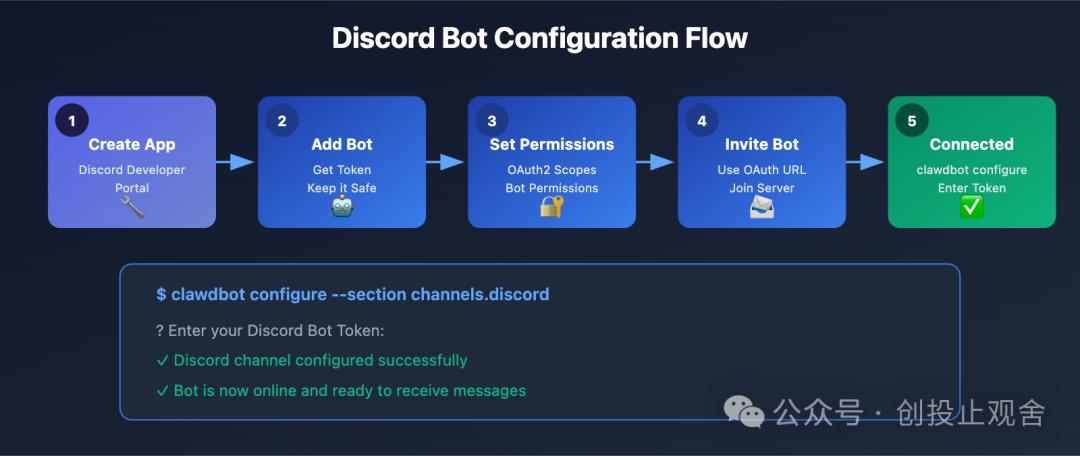
The first submission to this project was in November. Interestingly, when he showed it to his friends, they all said, "That's so cool!" But when he posted it on Twitter, the response was rather lukewarm.
When Peter demonstrated it to his friends in person again in December, they all said, "I need this."
So he did something really crazy: he created a Discord instance, added the bot to it, and there were absolutely no security restrictions at the time. Since it initially only served Peter, there was no need to consider who could give it commands, such as "delete all of Peter's files."
He actually just wrote a very simple command, such as "Only in Discord, and only listen to me." But as everyone knows, agents don't always follow commands perfectly. Later, he put it in Discord, and gradually more people came in. Basically, anyone who saw it for a few minutes could understand what it was all about.
Now imagine this: you buy a new computer with a "ghost entity" inside. You give it access to the keyboard, mouse, and internet, treating it like a virtual colleague. You can talk to it directly and give it instructions. Theoretically, this agent can do everything you can do on a computer. That's where its true power lies.
After it was open-sourced, people have been doing even more crazy things than he did.
Since April, Peter has been working on mostly open-source projects, and many people have used them to create some truly amazing things. Some use it to automatically add captions to images, some connect it to Tesla, and some integrate it with London's public transport system, directly telling you whether you should run to catch your train. Peter says he's currently so busy maintaining the project that he doesn't have much time for anything else.
There have been all sorts of cases on Twitter, and Peter said the most outrageous one he ever did was attach it to his bed.
He uses Eight Sleep, which has an API to control the temperature. He wrote a CLI to let the agent handle it. Now it can control the bed temperature, play music, adjust the lights, view the camera, and check the delivery progress.
Clawdbot has its own email address and can also access Peter's email; it has its own WhatsApp account and can read Peter's chats, and can even "reply on his behalf." Essentially, it's a trade-off; the more permissions you grant it, the more powerful it can become.
Some people use it for various automations, such as automatically researching and adding a saved post on Twitter to their to-do list; others use it to build complete applications; almost everyone has a MacBook for it. One of Peter's former partners even had it clear 10,000 emails from his inbox.
2. Bizarre personal experiences
Retirement left him with an unprecedented emptiness.
Peter started working with iOS very early on, back when manual memory management was still in place. Core Data was just entering beta for the upcoming iPhone OS 3. He built his own apps. Apple killed them, so he became a freelancer.
Ultimately, he founded his company with the beautiful name PSPDF Kit. Over the next 12 years, they became a leader in the PDF field, a feat he poured his heart and soul into. He single-handedly grew the company to 70 employees.
Then in 2021, they sold most of their shares to an investment firm, Insight Partners (for approximately €100 million, effectively freeing themselves).
Logically, he should have been overjoyed. It was an extraordinary exit, one of the largest in Austria. But he was utterly devastated, utterly exhausted. He had no purpose, and he filled his emptiness with hedonistic pleasures.

He tried traveling, psychotherapy, and even some unconventional experiences, but ultimately realized that the meaning of life cannot be found; it can only be created by oneself. Therefore, in June 2025, he announced his comeback, returning to what he loves most—writing code and creating.
The progress of LLM helped him rediscover his "creative spark".
It took him a long time to rediscover his passion for building products. He doesn't believe people say burnout comes from working too much, because if you love what you do, if you have autonomy, you can work a lot and feel good.
Peter stated that the burnout occurred because of conflicts with his co-founder and having to do things he no longer truly believed in.
So he gave himself time. Then, one morning, about five months ago, he woke up feeling different. His inspiration had returned, that feeling of creating something from nothing, thanks to a perfect summary by Douglas Crockford, who standardized the JavaScript object representation.
"Programmers are like gods, you know, not the great kind, but you know, poor little gods, because they have the power to create. By typing a series of words and symbols, programmers can bring something to life, and these things can have their own behavior, possibly acting in interesting ways. Only programmers can do that."
Peter felt that "programmer" was such a limiting term. They were actually builders, but now, in 2026, everything is different. The software industry is at an unprecedented turning point in its history; AI has made starting so easy that anyone can now be a builder.
This new technology is getting better at an incredible pace. Will we still have a job in 5 years? He thinks Nvidia CEO and co-founder Jensen Huang summed it up well: Some jobs will disappear, some jobs will be created, but every job will be affected, that's for sure. You won't lose your job because of AI, but you will lose your job because of the people who use AI.
So, for the past six months, he'd been engrossed in AI almost every waking minute, and even then, he felt there wasn't enough time. Then, in February of this year, the term "vibe coding" was coined, and Peter felt completely absorbed, embracing exponential growth and even forgetting the existence of code. This is possible because LLMs have become so excellent.
With Vibe Coding, he felt that the number of software programs that could be created was mainly limited by reasoning time and depth of thought.
Peter believes that most software doesn't require deep thinking. Most applications simply transform data from one form to another, perhaps store it somewhere, and then present it to the user in some way.
Text is the simplest form of presentation, so regardless of what you're developing, the default is to start with the command-line interface (CLI). Agents can directly call the command-line interface to verify output results and form a complete closed loop.
Peter says he doesn't read code much anymore these days; he looks at the code flow and occasionally glances at key sections. He knows where the components are, how things are organized, and how the whole system is designed, and that's usually all he needs.
Today, crucial decisions lie in choosing the right language/ecosystem and dependencies. His preferred languages are: TypeScript for web applications, Go for CLI, and Swift if macOS functionality or a UI is required.
Just a few months ago, Go was something he wouldn't even consider, but after trying it out, he found that the agents were very good at writing Go code, and its simple type system made code linting very fast.
Peter wants to remind those building Mac or iOS apps: you no longer need Xcode as much, or even .xcodeproj files. Swift's build infrastructure is good enough for most things now. Codex knows how to run iOS apps and how to handle simulators, without needing special configurations or MCPs.
His daily workflow involves observing multiple projects in parallel.
He typically handles multiple projects simultaneously, usually between three and eight, depending on their complexity. Context switching can be exhausting, so he usually completes them at home in a quiet and focused environment, which requires switching between many mental models.
Fortunately, most software is rather mundane. Creating a CLI to check takeout status doesn't require much thought. His focus is usually on one large project and several concurrent satellite projects.
Peter explained that after doing enough agent engineering, you develop a feel for what's easy and where the model might struggle. So often he just inputs a hint, Codex runs for 30 minutes, and he gets what he needs. Sometimes it requires a little fiddling or a bit of creativity, but usually things are straightforward.
Now, he makes extensive use of Codex's queuing functionality—adding new ideas to the pipeline whenever they arise. He sees many people experimenting with various multi-agent orchestration, email, or automated task management systems, but he feels these are unnecessary. He believes he is often the bottleneck, and his approach to software development is highly iterative.
In Peter's words, he builds something, uses it, feels it, and then comes up with new ideas to improve it; he rarely has a complete blueprint in his mind.
Generally, he starts with a rough idea, but this idea usually changes dramatically as he explores the problem domain. Therefore, systems that require a complete idea as input and then output a result are not suitable for him. He needs to use it, touch it, feel it, and observe it; that's how he develops it step by step.
Peter says he basically never rolls back or uses checkpoints. If something doesn't suit him, he lets the model change it. Codex sometimes resets files, but more often it simply undoes or modifies edits, rarely requiring him to completely revert; instead, they just go in a different direction.
Peter believes that building software is like climbing a mountain. You don't go straight up; you spiral upwards. Sometimes you deviate from the path and need to turn back a little. It's not perfect, but eventually you'll reach where you need to be.
3. On the future of AI and agents
AI should be part of the company's corporate culture.
Peter believes that if you're running a company, you should get people to use AI, force them to, make it mandatory, and get them to at least actually try the technology.
Shopify was an early adopter, and when they released this AI mandate, it caused quite a stir. Now, people are reporting it's the best thing that's happened in their corporate culture all year. So there may be resistance, but competitors won't miss out on this.
Peter cautioned that the models we currently have are not perfect and will make mistakes, but we will also make mistakes. However, please remember that these models will be the worst ever.
Anthropic just released Sonnet 4.5, and Google released Gemini 3 Pro. Generative AI has arrived, going from somewhat useful to extremely powerful in just one year. Combined with skilled users, it unlocks enormous productivity gains, making it a technology that cannot be ignored.
2026 is the year of the personal agent.
His assessment is that this year will be the "year of the personal agent," and programming agents will truly mature. This year, they will move beyond the small circle of engineers and become a situation where "everyone has an agent." This wave will most likely be dominated by OpenAI and a few other large companies.
But he wanted to make a different choice: to have control over your own data instead of continuing to hand over more data to large companies, and for it to work in conjunction with local models. He hadn't seen anyone seriously working on this, so he felt it was important, and it had to be completely open and permanently free.
This is why he chose to open-source it under the MIT license and form an organization rather than putting it under his personal name; it should be a project involving many people.
The biggest practical problem right now is that he's completely preoccupied with "making it better and safer," and hasn't had time to fully build the external system or truly establish an efficient collaboration mechanism. Currently, some people are helping with maintenance, but overall it's still too early; they're still figuring out how to properly divide tasks.
So here's the question: what do you think Clawdbot's future development will look like?