Signs that cryptocurrencies are gradually shifting from speculative assets to legitimate payment methods are emerging across the United States.
The combination of stores accepting cryptocurrency payments, major banks entering the Bitcoin space, and large Capital inflows into payment infrastructure is leading many to predict that 2026 could be a game-changer for cryptocurrency payments.
39% of merchants have accepted crypto payments.
According to a survey released on January 27, 2026, by PayPal and the National Cryptocurrency Association (NCA), 39% of retail businesses in the US accept cryptocurrency payments. At the same time, 84% of businesses believe that crypto payments will become commonplace within the next five years.
Customer demand is driving the adoption of this trend. 88% of businesses report receiving customer inquiries about cryptocurrency payments, and 69% Chia that customers want to use crypto at least once a month. By generation, interest from Millennials (77%) and Gen Z (73%) is overwhelming. Notably, small businesses recorded 82% of inquiries from Gen Z, far exceeding medium-sized (67%) and large (65%) companies.
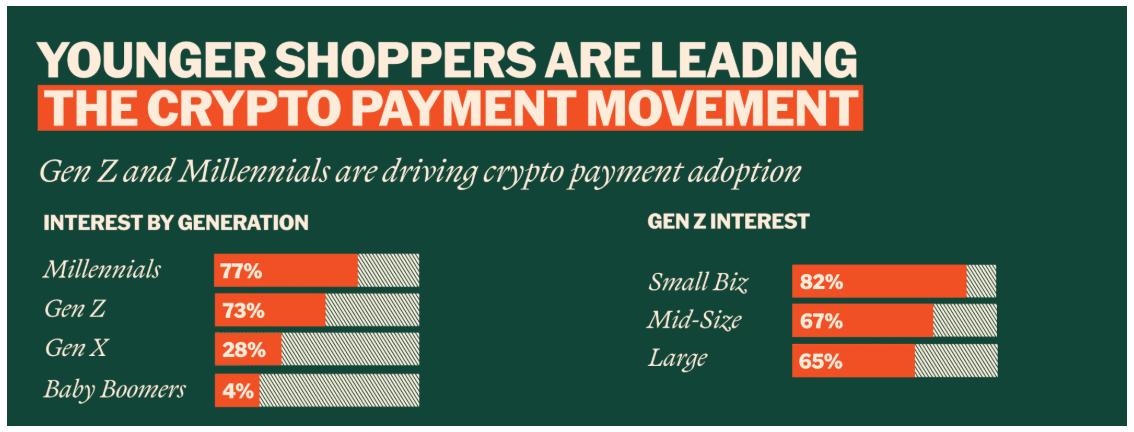 Source: National Cryptocurrency Association and PayPal
By sector, the hospitality and tourism industry leads with 81%, followed by digital goods, gaming and luxury retail (76%), and retail and e-commerce (69%).
“Through this data and numerous customer discussions, we’ve found that crypto payments have moved beyond the testing phase and are nearing integration into daily life,” Chia May Zabaneh, Vice President and Head of Crypto at PayPal. “When crypto payments are implemented as simply and familiarly as card or online payments, they truly become a powerful tool for business growth.”
One notable finding is that 90% of businesses indicated they would be willing to accept crypto payments if the setup process were as simple as accepting credit card payments.
“This data shows that the issue isn’t a lack of interest in crypto; it’s a lack of understanding,” said Stu Alderoty, Chairman of the NCA. “We are working together to bridge this knowledge gap and demonstrate that crypto can be simple and accessible to both businesses and consumers.”
60% of top banks in the US have entered the Bitcoin market.
The traditional financial sector is also changing rapidly. According to January 2025 data from the crypto finance platform River, 60% of the 25 largest US banks by assets—that's 15 institutions—have launched or announced plans to offer Bitcoin custody or trading services.
PNC Group has launched both custody and trading services. JPMorgan Chase, Charles Schwab, and UBS have announced trading services, while Goldman Sachs, Morgan Stanley, and Wells Fargo offer services to high-net-worth clients. American Express has also released a Bitcoin loyalty card.
Just a year ago, most Wall Street giants were still observing the situation. But now they're scrambling to enter the crypto field—showing that the allure from institutional and wealthy individual investors has become too great to ignore.
Mesh achieved unicorn status as Capital flowed into infrastructure.
Investment in crypto payment infrastructure is also rapidly increasing. The crypto payment network Mesh announced on January 27, 2026, that it had successfully raised $75 million in its Series C funding round, reaching a valuation of $1 billion and becoming a unicorn. Mesh has raised over $200 million in Capital .
Dragonfly Capital led this Capital round, with participation from Paradigm, Coinbase Ventures , and SBI Investment. Notably, a portion of the Capital was paid in stablecoins. Mesh stated that this is “proof that global organizations are ready to use blockchain applications in transactions with enterprise-grade auditing, control, and enforcement standards.”
Mesh's core technology—SmartFunding—enables an “Any-to-Any” model: users can pay with any cryptocurrency they own, from Bitcoin to Solana, and businesses receive payments instantly in their chosen stablecoin (such as USDC, PYUSD) or fiat currency. The Mesh network has now reached over 900 million people globally.
“The winners in the next decade will not be those who issue the most Token , but those who build the network that renders traditional card payment technology obsolete,” Chia Bam Azizi, co-founder and CEO of Mesh.
Will 2026 be a turning point?
All three figures point to a common trend: consumer demand for crypto payments—especially among young people—is on the rise. Traditional stores and financial institutions are also adapting. And significant Capital continues to flow into developing the infrastructure to support this trend.
However, many challenges remain. As the PayPal-NCA survey results indicate, simplifying the process is still the biggest hurdle. A positive sign, however, is that companies like Mesh are working to remove complexity and deliver a payment experience that closely resembles traditional methods.
Cryptocurrencies are gradually moving out of the realm of speculation and into the realm of infrastructure. 2026 is very likely to be the year when this real transition begins.