Original author: Nancy, PANews
Gold prices have gone on a buying spree. In less than a month since the start of the year, funds from all sectors have been frantically snapping up gold, pushing prices to new all-time highs.
In this precious metals frenzy, an "invisible big player" has unexpectedly come into view: stablecoin giant Tether has quietly acquired 140 tons of gold reserves.
Holding 140 tons of gold, aiming to become the world's largest gold-holding central bank.
Tether, with its vast resources, is becoming a major player in the gold market.
“We will soon become one of the world’s largest ‘gold central banks’,” Tether CEO Paolo Ardoino said in a recent interview with Bloomberg, making no secret of his ambition.
This is not just empty talk. To date, Tether has stockpiled approximately 140 tons of physical gold, worth about $23 billion at current prices. Tether typically purchases directly from Swiss refineries and leading global financial institutions, with large metal orders often taking months to deliver. Once delivered, the gold is stored in a Cold War-era nuclear bunker in Switzerland, protected by multiple layers of heavy steel doors, and Switzerland boasts one of the world's most sophisticated security systems.
In terms of scale, Tether has become the world's largest known physical gold holder outside of the banking system and countries, ranking among the top 30 gold holders globally, with holdings exceeding those of several countries such as Greece, Qatar, and Australia.
Although Tether began investing in gold assets many years ago, its large-scale entry into the market is expected to occur in 2025. Last year alone, Tether purchased over 70 tons of gold, making it one of the top three global gold buyers this year. This purchase volume surpasses that of almost all single central banks except for the Polish central bank, and also exceeds that of many large gold ETFs.
It can be said that Tether was a major driver of this year's gold price increase.
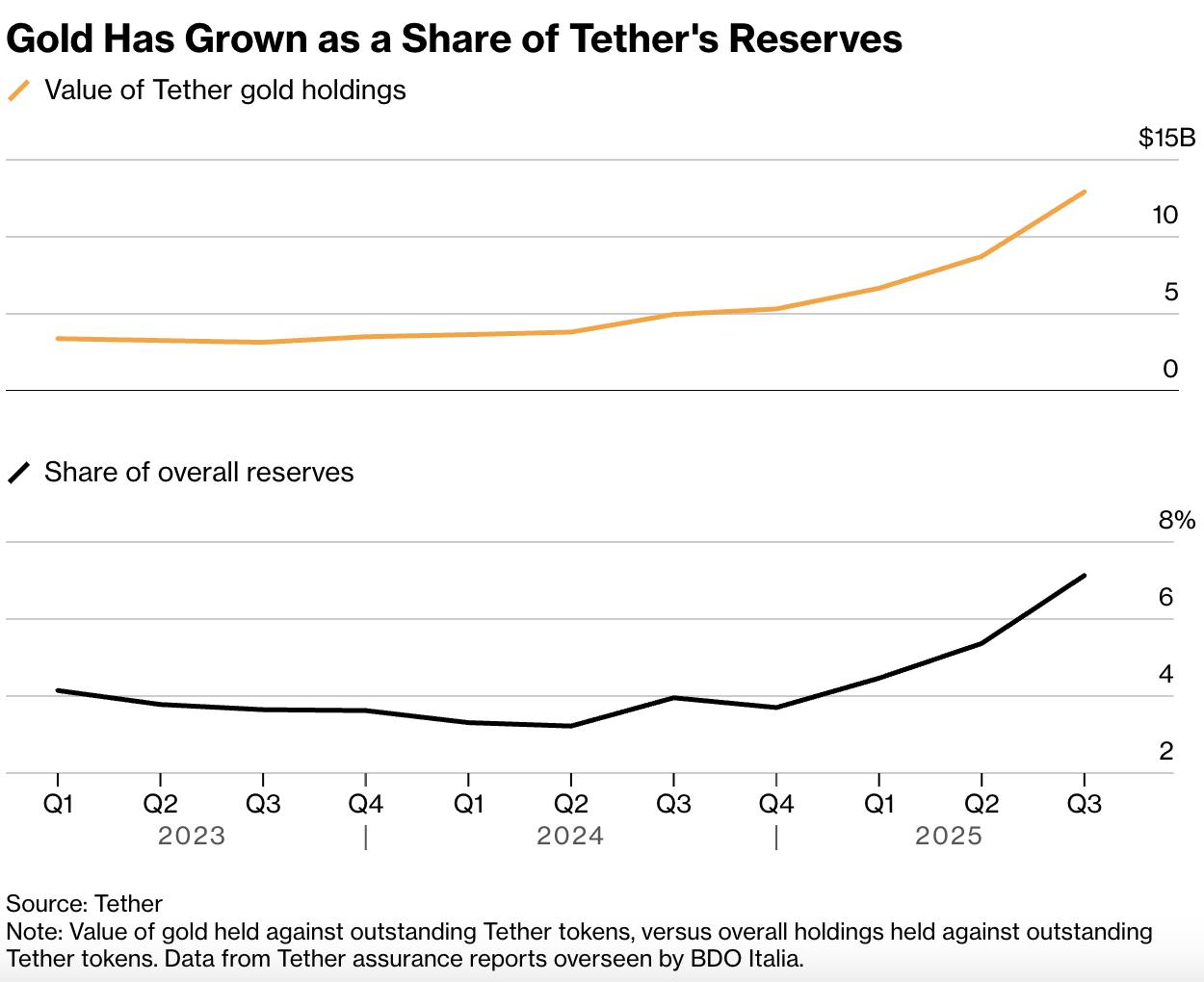
According to Ardoino, Tether is currently purchasing gold at a rate of about 1 to 2 tons per week and plans to maintain this pace in the coming months. "It may slow down, but we will assess gold demand on a quarterly basis."
But Tether's ambitions extend beyond simply hoarding gold. In a Bloomberg interview, Ardoino stated that Tether is evaluating markets and potential trading strategies, planning to capture arbitrage opportunities through active trading of its gold reserves. Simultaneously, the company is working to build "the world's best gold trading floor," aiming to establish a stable, long-term gold acquisition channel and compete with major banks such as JPMorgan Chase and HSBC that dominate the global precious metals market.
To this end, Tether made a high-profile signing last year of two heavyweight trading veterans: Vincent Domien, former global head of metals trading at HSBC, and Mathew O'Neill, head of precious metals procurement for Europe, the Middle East, and Africa, specifically to expand its gold business. (Related reading:TEDA's Gold Empire: The Ambition and Cracks of a "Borderless Central Bank" )
Upstream in the industry chain, Tether has also begun to leverage its monetary power to secure a position. Tether has successively invested in several mid-sized Canadian gold mining concession companies, including Elemental Royalty, Metalla Royalty & Streaming, Versamet Royalties, and Gold Royalty, locking in future production capacity and profit sharing through equity investments.
At the financial product level, Tether launched its gold-pegged stablecoin, Tether Gold (XAU₮), backed by 16.2 tons of physical gold as of the end of last year. Recently, Tether also launched a new unit of account for XAU₮, Scudo, where 1 Scudo represents one-thousandth of a troy ounce of gold, aiming to make gold a more convenient payment method.
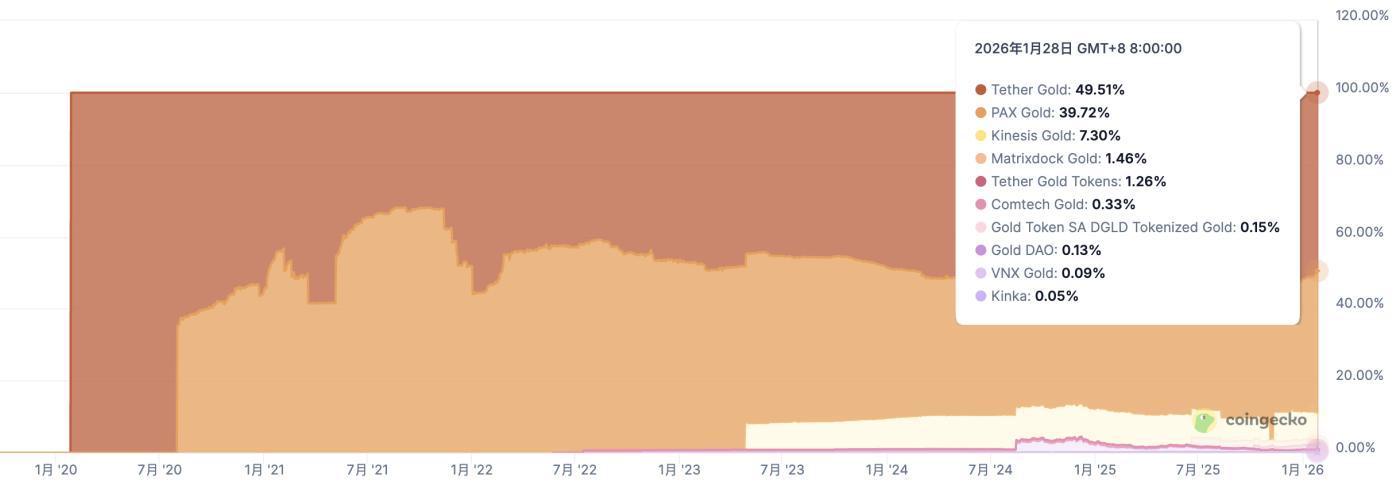
According to CoinGecko data, as of January 28, the circulating market capitalization of XAU₮ reached $2.7 billion, an increase of approximately 91.3% over the past year, holding a 49.5% market share in the tokenized gold sector, firmly ranking first.
From physical gold hoarding to supply chain layout and financial product innovation, this gold enthusiast's large-scale investment has even left people in the traditional commodities circle saying they "don't understand it," with some describing Tether as "the strangest company they've ever encountered."
But now, with gold prices continuing to hit record highs, Tether's bet is yielding amazing returns.
Earning $15 billion annually, building a capital arsenal.
Tether's confidence in its massive gold hoarding stems from a high-speed "money printing machine."
According to Fortune, Tether generated approximately $15 billion in net profit in 2025, a significant increase from $13 billion the previous year. Supporting this massive profit were only about 200 employees worldwide. Roughly calculated, this translates to a profit per employee of $75 million, a level of efficiency that traditional financial giants can only dream of.
The core of this profitability comes from the pool of funds accumulated by its stablecoin business.
Today, Tether's USDT stablecoin is the most widely used stablecoin globally, with over 500 million users. CoinGecko data shows that as of January 28, 2026, the circulating supply of Tether's USDT stablecoin is close to $187 billion, firmly holding the top spot in the stablecoin market. Its trading activity is also leading; Artemis Analytics data shows that in 2025, total stablecoin trading volume grew by 72% to $33 trillion, with USDT contributing $13.3 trillion, accounting for over 33%.
Building on this, Tether is further expanding the scale of its funds through compliance efforts.
On January 27, Tether officially launched its federally regulated stablecoin, USAT, issued by Anchorage Digital Bank, the first federally regulated stablecoin issuer in the United States. Cantor Fitzgerald serves as the designated reserve custodian and preferred primary dealer, and former White House advisor Bo Hines has been appointed CEO. This is seen as a key step for Tether's full-scale entry into the US domestic market.
Meanwhile, Tether, through investments in content platforms like Rumble, is attempting to integrate USAT into its traffic ecosystem to quickly reach 100 million US users, setting a goal of a $1 trillion market capitalization within five years. If all goes well, USAT could become USDC's first true competitor in the US market.
After acquiring liabilities at virtually zero cost, Tether easily extracts interest rate spreads by allocating highly liquid, low-risk assets.
Interest on US Treasury bonds is Tether's core source of revenue. During periods of high interest rates, US Treasury bond interest directly amplifies Tether's profitability. Currently, Tether holds approximately $135 billion in US Treasury bonds, surpassing sovereign nations like South Korea to become the world's 17th largest holder of US Treasury bonds.
Meanwhile, Tether is also a major player in Bitcoin. Since 2023, Tether has allocated up to 15% of its monthly net profit to Bitcoin through dollar-cost averaging. Currently, it holds over 96,000 Bitcoins, making it one of the world's largest institutional Bitcoin holders, with an average cost of approximately $51,000, far below the current market price. Around the Bitcoin ecosystem, Tether has also built its own mining farms, invested in mining companies, and established DAT (crypto treasury), continuously expanding its industry influence. This has even led to conspiracy theories circulating overseas about Tether being an "invisible manipulator of Bitcoin."
In addition, in order to unlock more potential returns, Tether has embarked on a massive spending spree in the past few years, extending its investment reach to areas such as satellite communications, AI data centers, agriculture, telecommunications and media.
Thus, an arbitrage machine spanning the traditional financial and crypto worlds has gradually taken shape, continuously supplying Tether with capital ammunition and becoming the chips for its large-scale bets.